Dandruff is incredibly common.
Yet despite affecting millions of people, it remains one of the most misunderstood scalp conditions.
Many people blame dry skin. Others think they are not washing their hair often enough. Some believe dandruff is contagious.
None of these explanations tells the full story.
In most cases, dandruff develops because the scalp reacts to a naturally occurring yeast that almost everyone has.
The important word is reacts.
The yeast itself is usually not the problem. The way your skin responds to it is.
Meet Malassezia
Your scalp is home to billions of microorganisms.
Together, they form the scalp microbiome, a normal community of bacteria, fungi and other microscopic organisms.
One of the most common fungi is Malassezia.
It lives on healthy scalps and feeds on sebum, the oily substance produced by sebaceous glands.
For most people, this causes no problems at all.
In others, the breakdown products produced by Malassezia irritate the skin and trigger inflammation.
Why inflammation causes flakes
Healthy scalp skin renews itself continuously.
Old skin cells are gradually shed in amounts too small to notice.
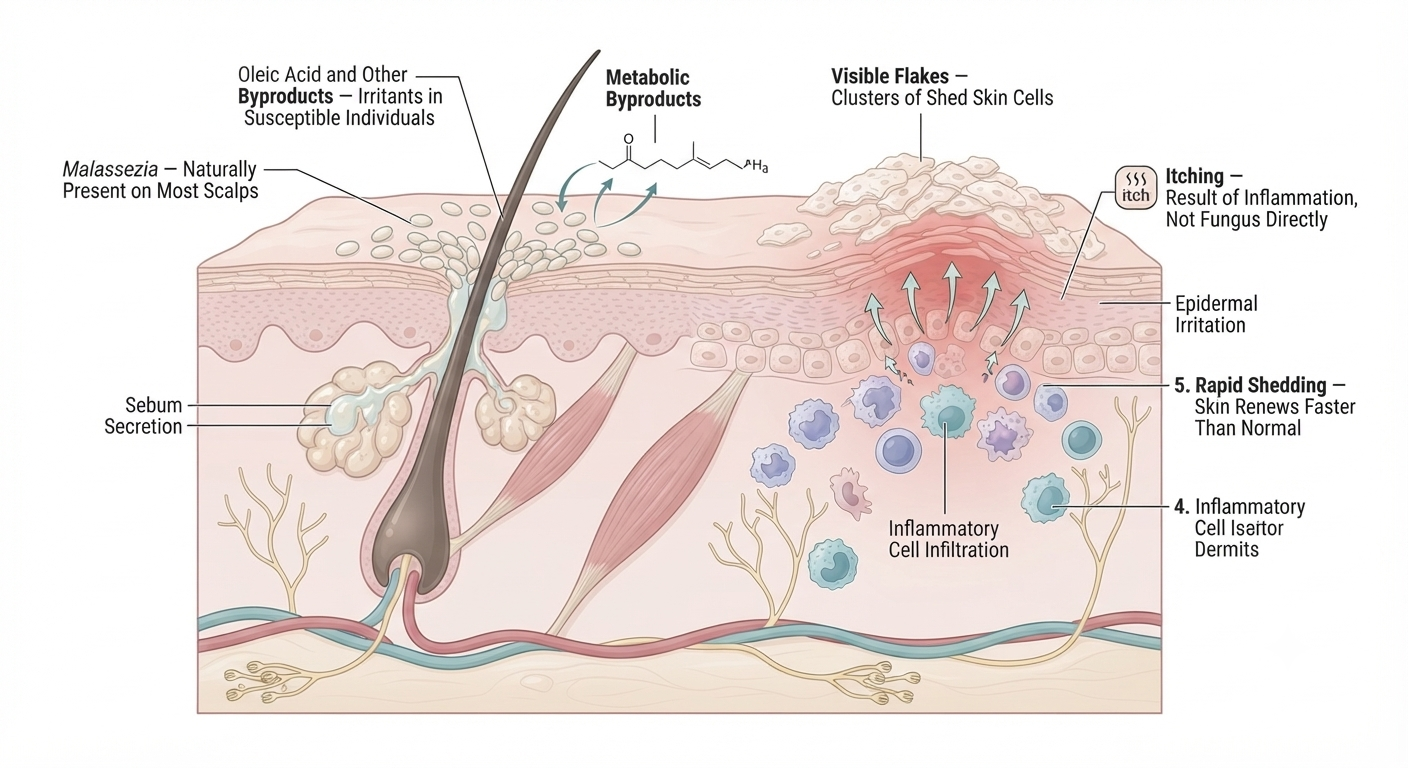
When inflammation develops, this process speeds up dramatically.
Instead of shedding individual microscopic cells, clusters of skin cells are released together.
These larger groups become the white or yellowish flakes associated with dandruff.
The itching that often accompanies dandruff is also a result of inflammation rather than the fungus itself.
Why do only some people get dandruff?
Since Malassezia is present on most adults, another question naturally follows.
Why doesn’t everyone develop dandruff?
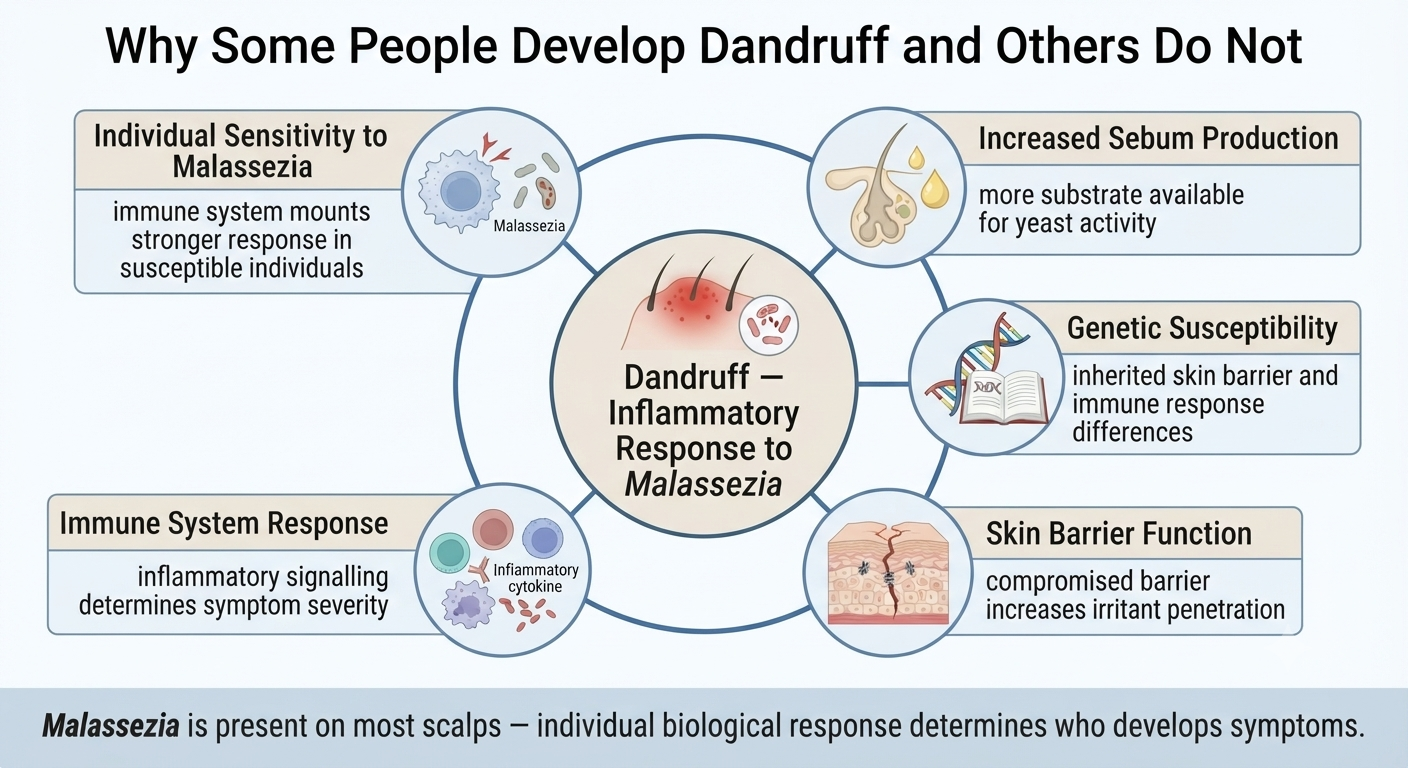
Researchers believe several factors contribute:
- Individual sensitivity to Malassezia
- Increased sebum production
- Genetic susceptibility
- Differences in skin barrier function
- Immune system responses
This combination explains why one person may never experience dandruff while another struggles with recurring flare-ups.
Is dandruff caused by poor hygiene?
No.
Not washing the hair regularly may allow oil and flakes to accumulate, making dandruff more noticeable.
However, poor hygiene does not create Malassezia or cause the underlying inflammatory response.
Similarly, someone with excellent hair care habits can still develop dandruff.
Is dandruff the same as a dry scalp?
No.
Although both conditions can produce flakes, they have different causes.
A dry scalp develops because the skin lacks sufficient moisture.
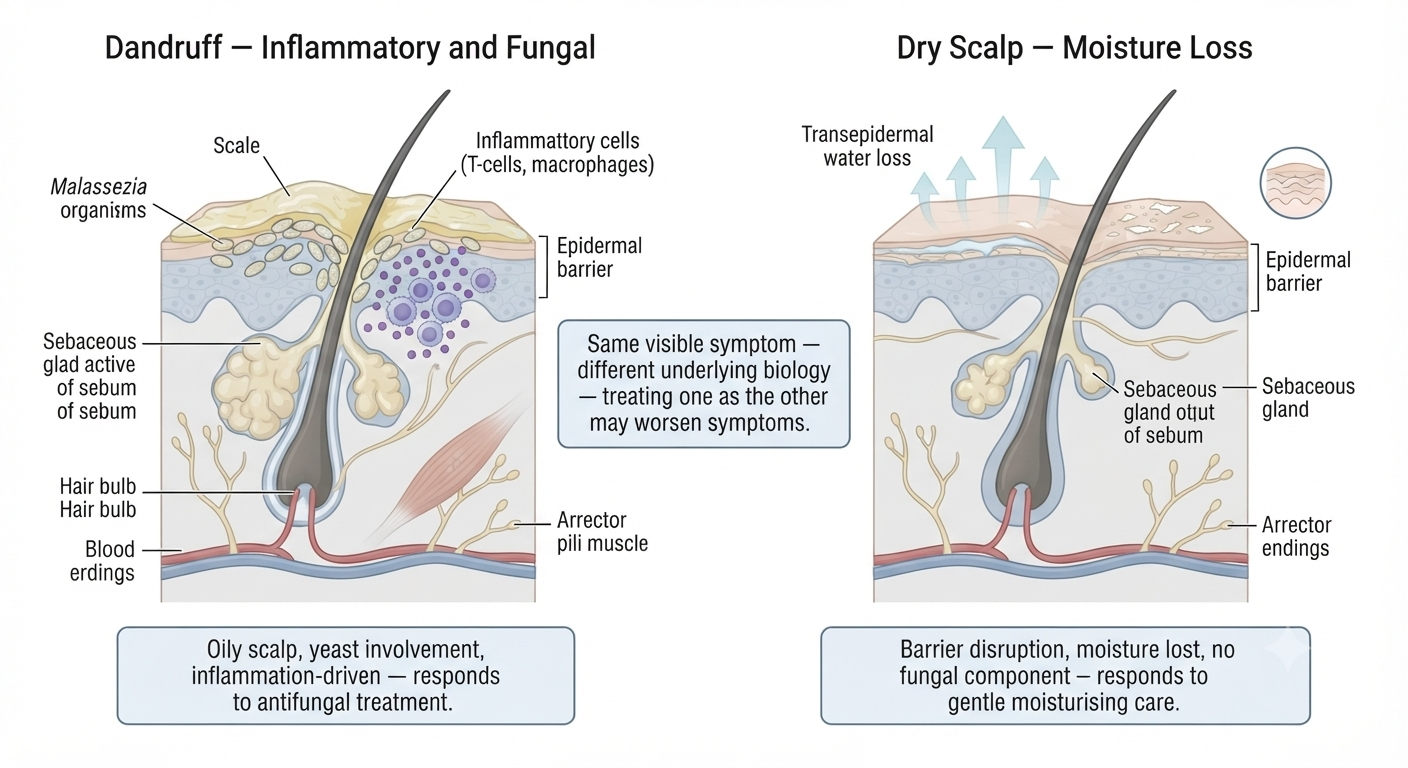
Dandruff usually occurs on a scalp with normal or increased oil production and is linked to inflammation associated with Malassezia.
Treating a dry scalp with strong anti-dandruff products may increase irritation if dandruff is not actually present.
How is dandruff diagnosed?
Diagnosis is usually based on clinical examination.
Typical features include:
- White or yellowish flakes
- Itching
- Mild scalp redness
- Oily areas beneath the flakes
Most cases do not require laboratory testing.
However, if symptoms are severe or unusual, a healthcare professional may consider other scalp conditions such as psoriasis, eczema or fungal infections that require different treatment.
What treatments work?
Evidence supports several antifungal ingredients that reduce Malassezia populations and help control inflammation.
Common examples include:
- Ketoconazole
- Selenium sulphide
- Zinc pyrithione
- Piroctone olamine
- Ciclopirox
These shampoos usually need to be used consistently for several weeks before their full benefit becomes apparent.
Once symptoms improve, many people continue using them periodically to reduce the risk of recurrence.
Can dandruff cause hair loss?
Dandruff itself does not permanently damage hair follicles.
However, persistent inflammation and repeated scratching may contribute to temporary hair shedding in some individuals.
If hair loss is significant, patchy or continues despite successful dandruff treatment, another underlying condition should be considered.
When should you seek medical advice?
Medical assessment is advisable if:
- Symptoms do not improve after appropriate treatment.
- Thick crusts develop.
- The scalp becomes painful or swollen.
- There is bleeding or significant redness.
- Hair loss becomes noticeable.
- The diagnosis is uncertain.
These features may suggest a condition other than uncomplicated dandruff.
Looking beyond the flakes
Dandruff is not simply a cosmetic nuisance.
It reflects a complex interaction between the scalp, natural skin oils, the microbiome and the immune system.
Understanding that it is largely driven by an inflammatory response to a naturally occurring fungus helps explain why appropriate antifungal treatment is often effective, why dandruff tends to recur and why long-term scalp care is usually more successful than searching for a permanent cure.
Author: Dr. Priya Goswami
Medical review: Dr. Denis Broun
Next step
If you notice coverage changes without increased shedding, confirm what process is occurring.
Take the Hair Assessment to have a physician review your pattern, identify whether miniaturization is present, and determine appropriate staging and next steps.
Add Comment