Starting finasteride can be psychologically difficult for many people with hair loss. Expectations are often high, anxiety about side effects is common, and attention to every shed hair suddenly increases.
One particular concern appears repeatedly in hair loss discussions: shedding shortly after beginning treatment.
Some people interpret this as evidence the medication is working. Others fear it means the drug is accelerating baldness permanently.
The truth is more nuanced.
Initial shedding can occur during treatment with finasteride, but it is not universal, and it should not automatically be interpreted as either a guaranteed positive sign or a treatment failure. Understanding what may biologically explain shedding helps place the experience into better clinical context.
Finasteride changes hormone activity around follicles
Finasteride works by inhibiting the enzyme 5 alpha reductase type II, which converts testosterone into dihydrotestosterone, commonly called DHT.
DHT plays a major role in androgenetic alopecia by gradually miniaturising genetically sensitive follicles.
Reducing DHT exposure may slow this miniaturisation process and help preserve hair density over time.
Hair follicles cycle continuously
Hair does not grow continuously in a uniform way.
Each follicle cycles independently through phases including:
Anagen, or active growth
Catagen, or transition
Telogen, or resting
Exogen, or shedding
At any given moment, some hairs are naturally being shed as part of normal cycling.
Treatment can alter follicular timing
One proposed explanation for early shedding is that treatment may influence synchronisation of follicle cycling.
Some miniaturised hairs may shed before newer, potentially healthier hairs emerge.
This idea is commonly discussed in hair loss medicine, although the exact biological mechanisms are not fully understood.
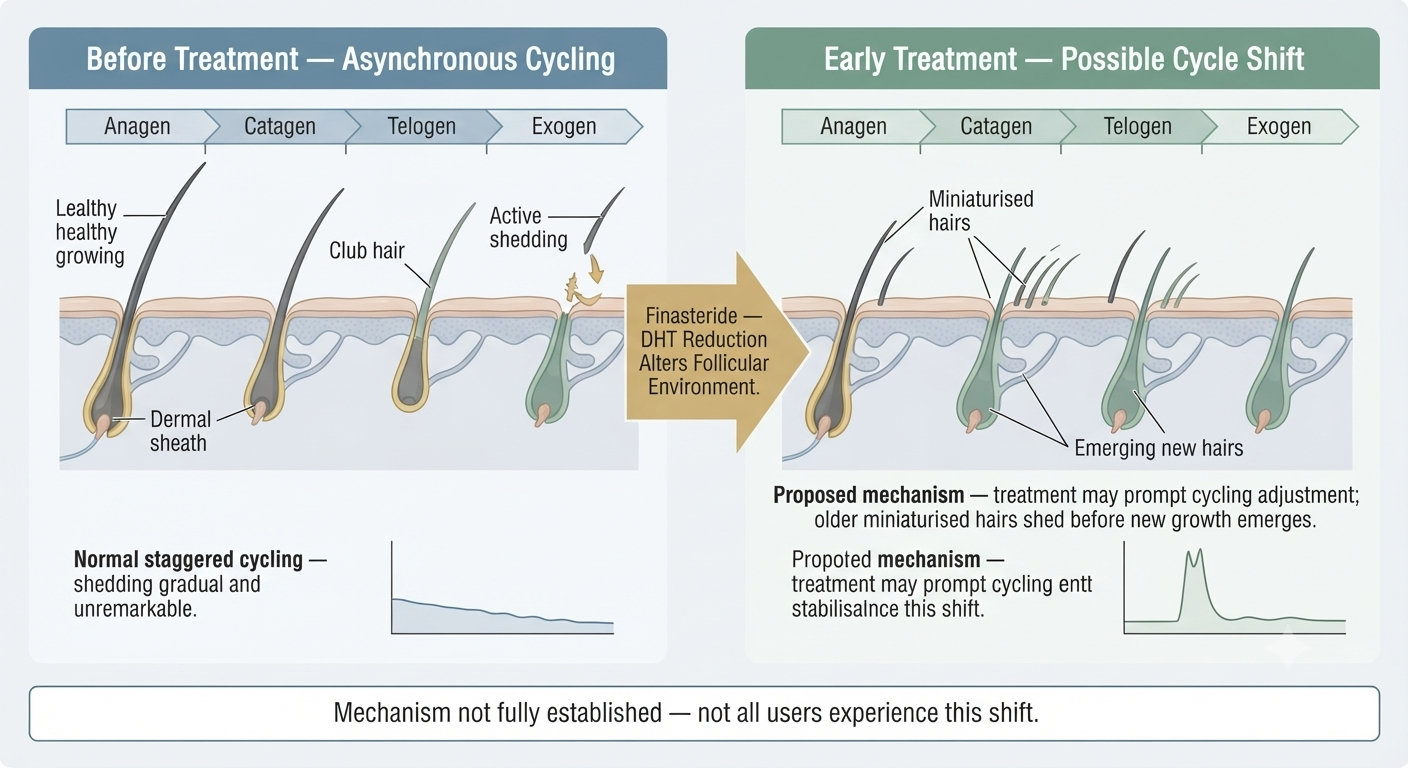
Shedding does not happen to everyone
Importantly, many people taking finasteride experience no noticeable increase in shedding at all.
Others report temporary increased shedding during the first few months.
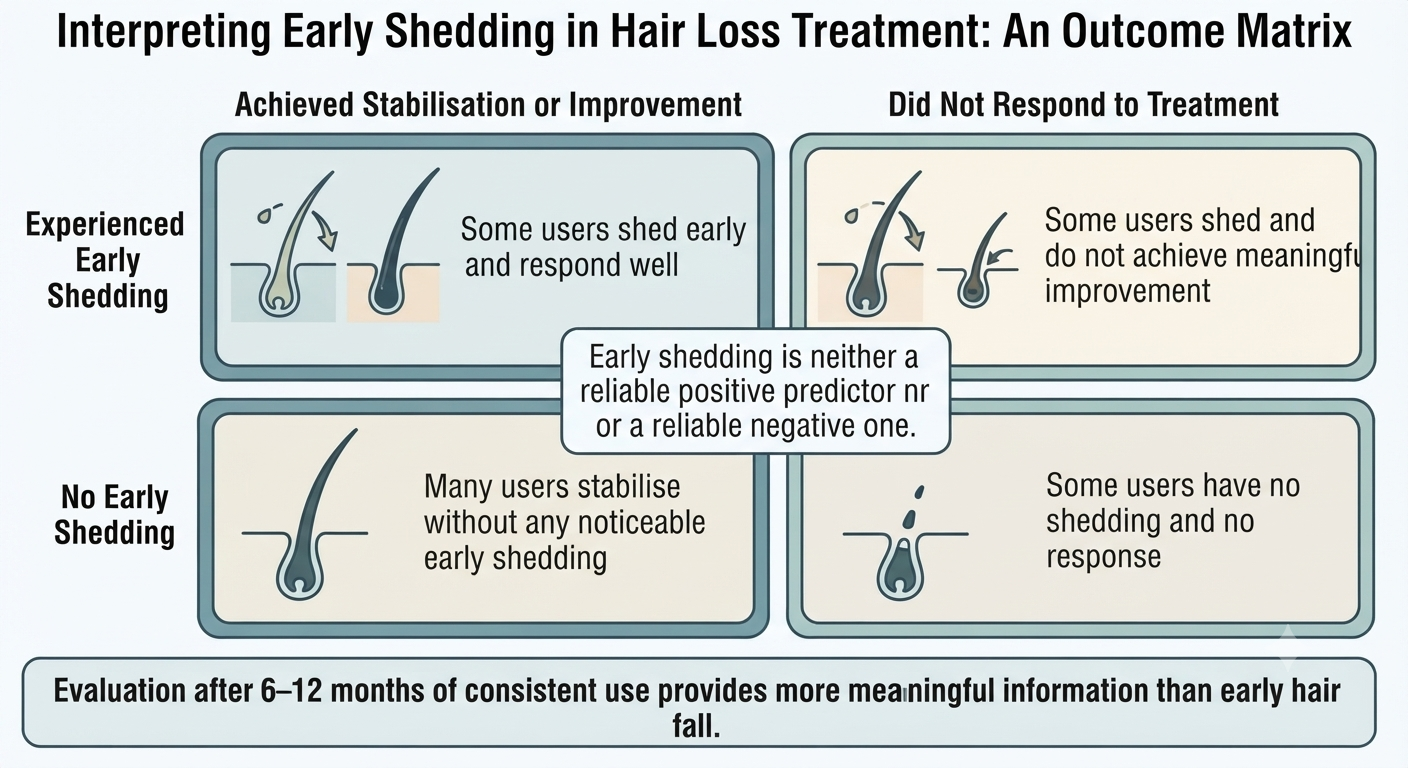
The absence of shedding does not mean the medication is failing, just as the presence of shedding does not guarantee success.
Increased awareness can amplify perception
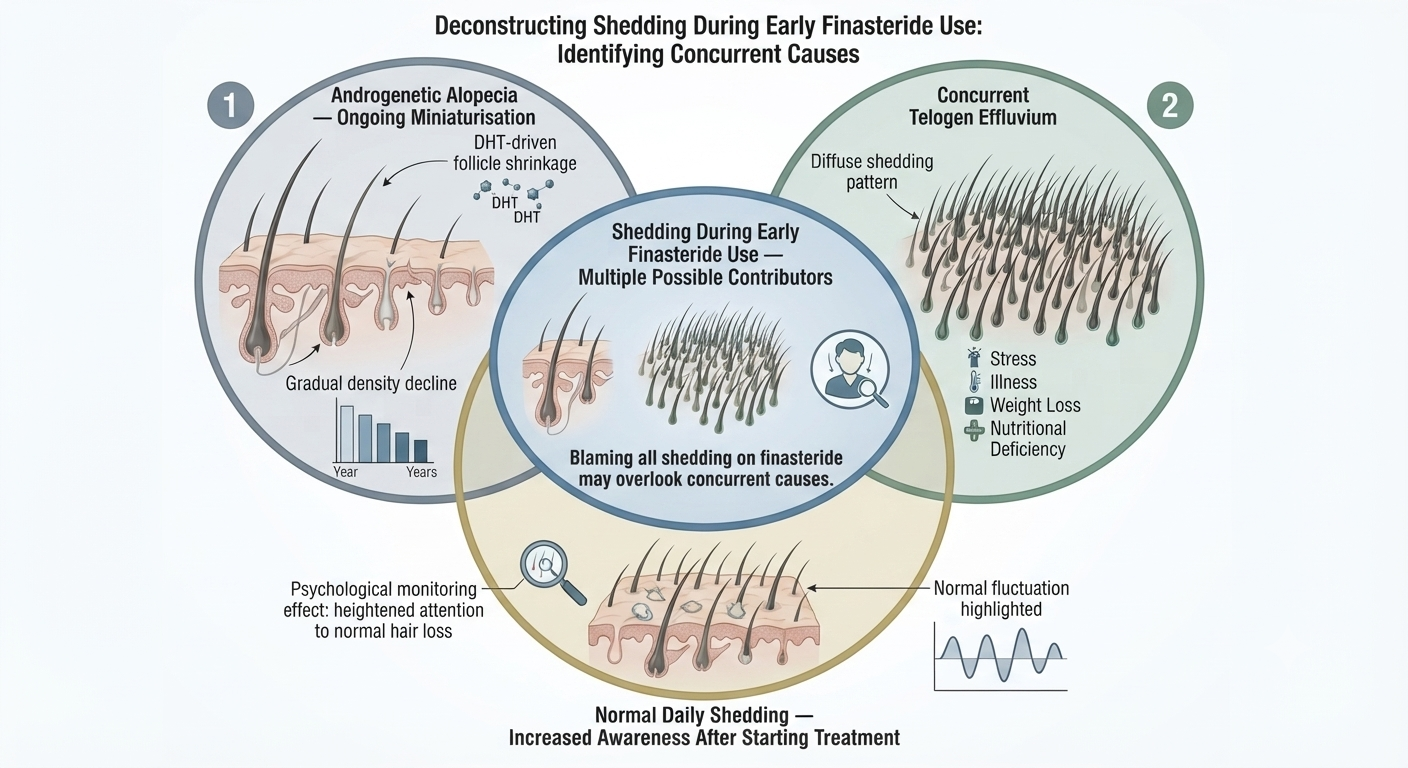
Once treatment begins, people often monitor their hair much more intensely.
Normal daily shedding that previously went unnoticed may suddenly feel alarming.
This psychological effect is very common and can complicate interpretation of what is truly changing biologically.
Early shedding is usually temporary
When shedding related to treatment occurs, it is generally described as temporary.
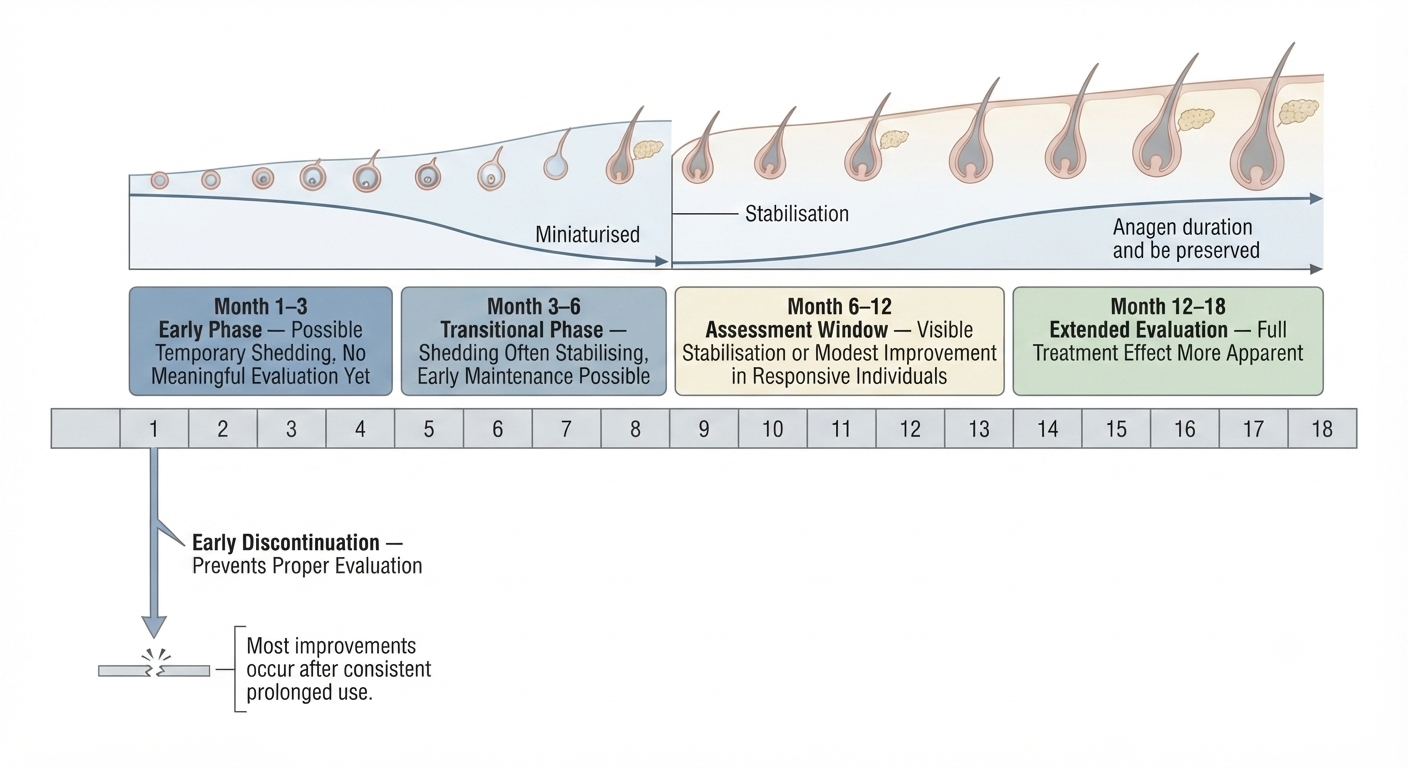
Many clinicians advise evaluating finasteride over a period closer to:
Six months
Nine months
Twelve months
rather than drawing conclusions within the first few weeks.
Hair biology changes slowly.
Finasteride is primarily a stabilisation treatment
Another important point is that finasteride often works better at slowing progression than dramatically regrowing lost density.
The main therapeutic goal is usually preservation and stabilisation.
Some regrowth may occur, particularly in earlier stages of androgenetic alopecia, but expectations should remain realistic.
Shedding alone does not predict long-term outcome
People often search for reassurance that shedding means “new stronger hairs are coming.”
Unfortunately, the evidence does not support a simple predictive rule.
Some individuals who shed improve significantly. Others improve without shedding at all.
The relationship is inconsistent.
Timing matters clinically
Mild increased shedding during the early treatment phase is usually viewed differently from severe worsening that continues progressively over many months.
Persistent rapid deterioration deserves reassessment because:
The diagnosis may be incomplete
Another hair disorder may coexist
The shedding may not be related to finasteride at all
Telogen effluvium can overlap with androgenetic alopecia
Many people starting finasteride already have concurrent telogen effluvium triggered by:
Stress
Illness
Weight loss
Nutritional deficiency
Hormonal change
This overlapping shedding may mistakenly be blamed entirely on the medication.
Hair counts fluctuate naturally
Even without treatment, shedding varies seasonally and biologically.
Daily fluctuations in visible hair fall are normal.
This makes it difficult to determine with certainty whether short-term shedding changes are truly medication-related.
Photographs are more reliable than shower counts
People often judge treatment success based on hairs seen during washing or brushing.
This can become misleading very quickly.
Consistent photographs taken under similar:
Lighting
Angles
Hair length conditions
are usually more useful for tracking genuine long-term changes.
Miniaturised hairs are fragile already
In androgenetic alopecia, affected hairs often become progressively finer and shorter before disappearing entirely.
These weakened hairs may shed more easily regardless of treatment.
Finasteride does not instantly reverse this process.
Improvement takes time
Even when finasteride works well, visible changes develop gradually.
Hair grows slowly, and follicles require time to complete cycles and produce thicker shafts.
Many patients see the most meaningful changes after prolonged consistent use rather than in the first few months.
Abrupt discontinuation may create confusion
Some individuals stop treatment quickly after noticing shedding.
This can complicate interpretation because androgenetic alopecia itself continues progressing over time without treatment.
Stopping early may therefore prevent proper evaluation of whether the medication would ultimately have helped.
Side effects and shedding are separate issues
It is important not to confuse shedding discussions with concerns about systemic side effects.
A person may experience:
No shedding but side effects
Shedding without side effects
Neither
Both
These are biologically separate considerations.
Online forums often amplify anxiety
Hair loss communities can be useful sources of shared experience, but they also tend to concentrate dramatic stories.
People with smooth uncomplicated improvement are often less likely to post extensively than individuals experiencing distress or uncertainty.
This can distort perception of how common severe shedding actually is.
Not all hair loss responds to finasteride
Finasteride primarily targets androgenetic alopecia.
It is not designed to treat:
Alopecia areata
Scarring alopecias
Nutritional shedding
Inflammatory scalp disease
If the underlying diagnosis is incorrect, continued hair loss may occur despite treatment.
Medical review may help when uncertainty persists
Ongoing severe shedding, scalp inflammation, pain, or rapidly progressive thinning deserves proper assessment rather than relying solely on internet reassurance.
Diagnosis matters because multiple hair disorders can coexist.
The bottom line
Initial shedding on finasteride can occur, but it is not universal and should not automatically be viewed as either a good sign or a bad one. In some individuals, treatment-related shifts in follicle cycling may temporarily increase visible shedding before longer-term stabilisation occurs.
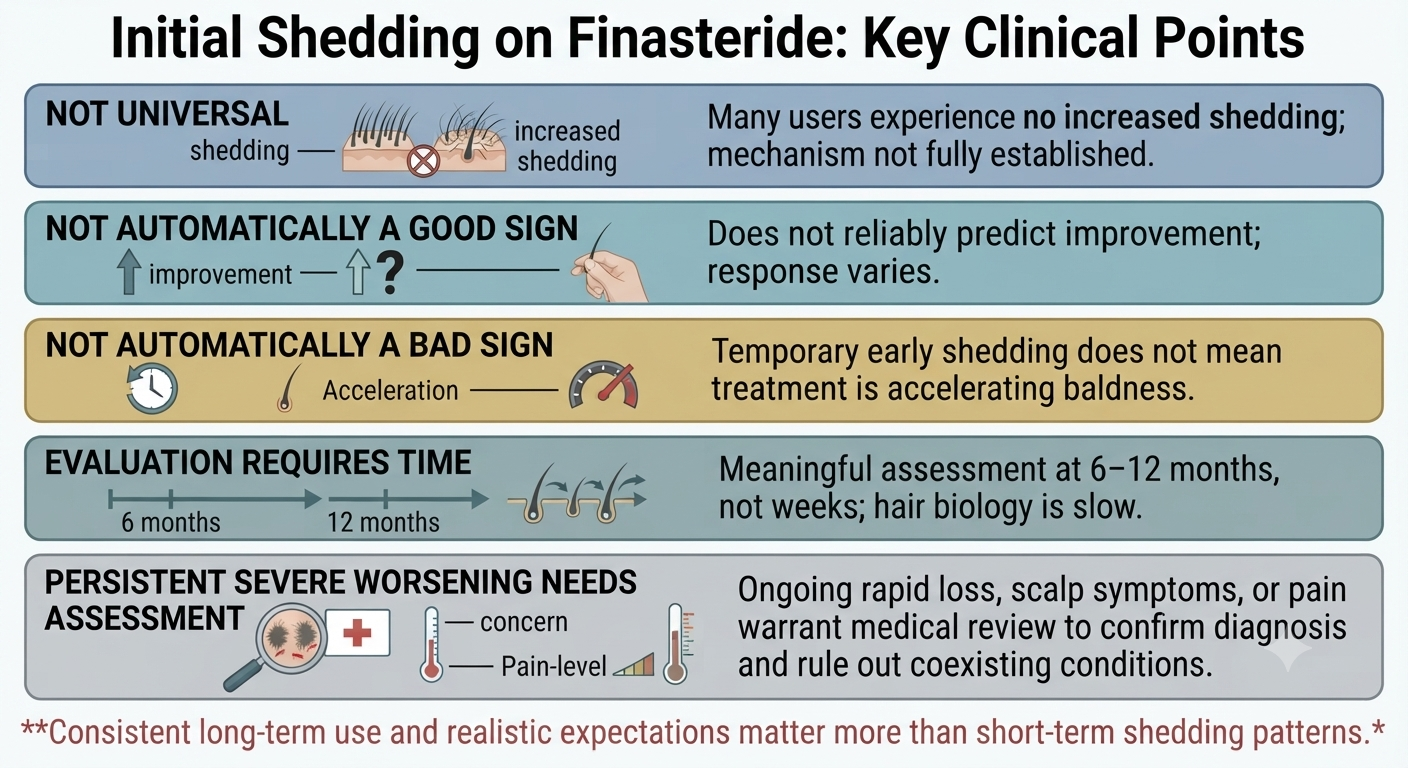
However, shedding alone does not reliably predict treatment success, and many people improve without experiencing any noticeable early hair fall at all. Because hair growth cycles operate slowly, finasteride usually requires several months of consistent use before meaningful evaluation is possible.
Persistent or severe worsening deserves medical reassessment to ensure the diagnosis is correct and no additional scalp conditions are contributing to ongoing loss.
Author: Dr. Priya Goswami
Medical review: Dr. Denis Broun
Next step
If you notice coverage changes without increased shedding, confirm what process is occurring.
Take the Hair Assessment to have a physician review your pattern, identify whether miniaturization is present, and determine appropriate staging and next steps.
Add Comment