Two brothers can grow up in the same house, eat similar diets and lead similar lifestyles.
One develops noticeable hair loss before the age of 30.
The other still has thick hair at 60.
This difference often raises the same question.
Why do some men go bald while others don’t?
The answer is more complex than many people realise. Hair loss is rarely caused by one factor alone. Instead, it reflects the interaction between genetics, hormones and the biology of individual hair follicles.
It starts with your hair follicles
Every hair grows from a follicle beneath the skin.
Not all follicles behave in the same way.
Some are naturally resistant to hormonal changes throughout life. Others are genetically programmed to become increasingly sensitive to DHT.
This difference largely determines whether hair remains stable or gradually becomes thinner over time.
DHT is part of the story
DHT is a hormone produced when testosterone is converted by an enzyme called 5-alpha reductase.
It plays important roles in normal male development.
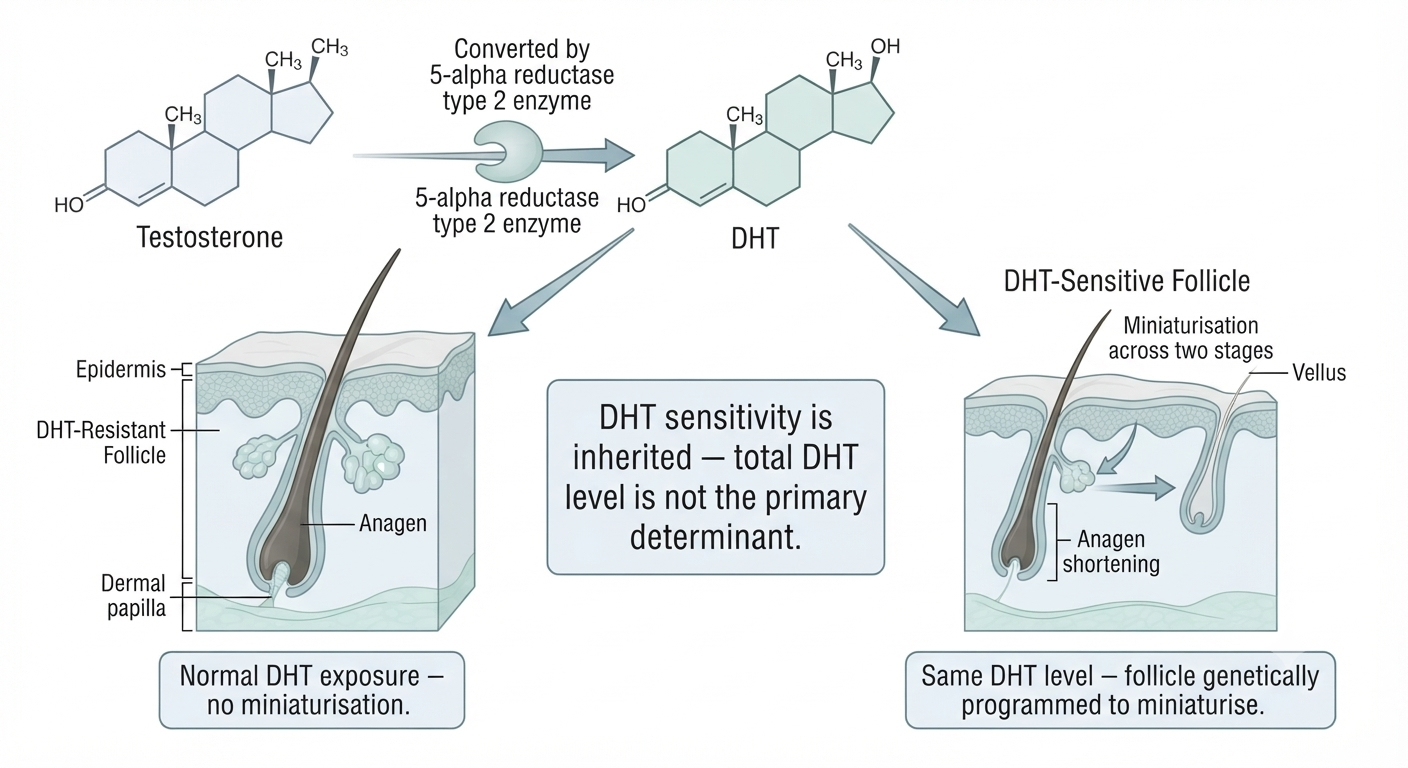
However, in genetically susceptible individuals, DHT also affects certain scalp follicles.
Over many years, repeated exposure leads to:
- Shorter growth phases
- Progressive follicle miniaturisation
- Finer hair shafts
- Reduced hair density
The process is gradual rather than sudden.
More testosterone does not mean more hair loss
One of the most persistent myths is that bald men have unusually high testosterone levels.
Current evidence does not support this.
Many men with significant androgenetic alopecia have hormone levels that fall within the normal range.
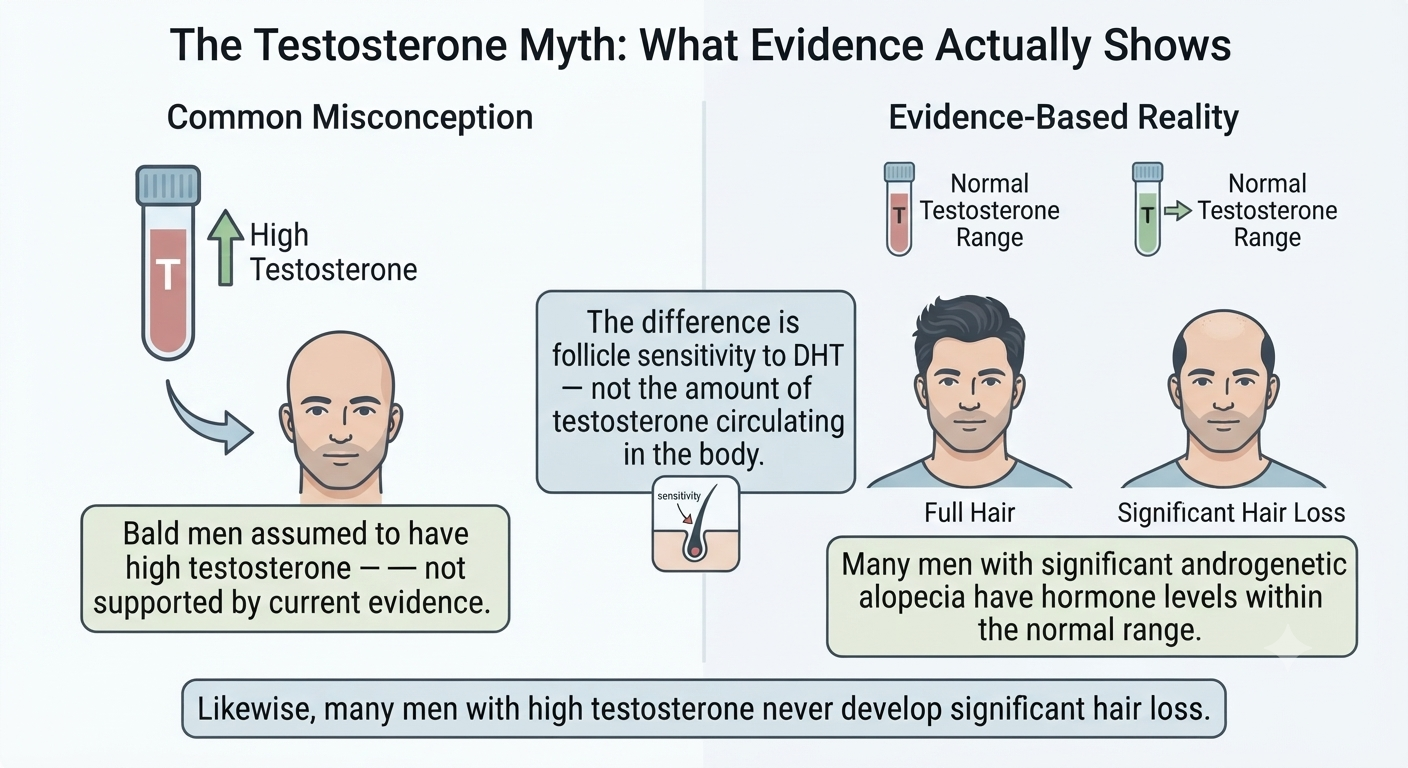
Likewise, many men with high testosterone never develop substantial hair loss.
The key difference is usually the follicle’s sensitivity to DHT, not the amount of testosterone circulating in the body.
Genetics influence risk, not certainty
Family history is important, but it is not perfectly predictable.
Hair loss does not come exclusively from one side of the family.
Instead, many genes inherited from both parents contribute to overall risk.
This explains why:
- Brothers may experience different degrees of hair loss.
- Fathers and sons may develop different patterns.
- Some men with little family history still develop androgenetic alopecia.
Genetics increase the likelihood, but they do not determine the exact outcome for every individual.
Why does baldness follow a pattern?
Pattern hair loss affects specific areas because follicles in different parts of the scalp respond differently to DHT.
Follicles at the:
- Temples
- Frontal hairline
- Crown
are generally more susceptible.
Follicles at the back and sides of the scalp are usually much more resistant.
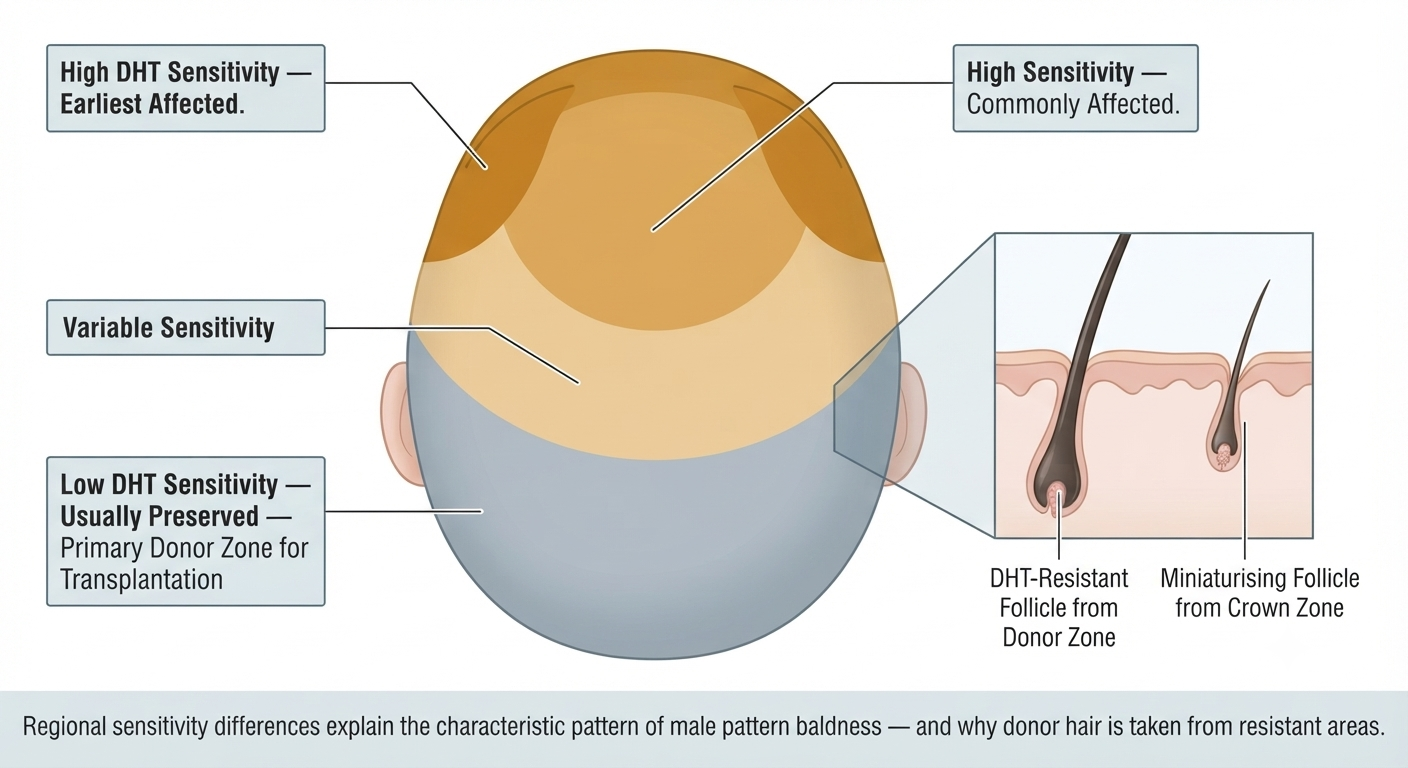
This difference explains the characteristic pattern seen in male pattern baldness and why donor hair for transplantation is typically taken from these resistant areas.
Do lifestyle factors matter?
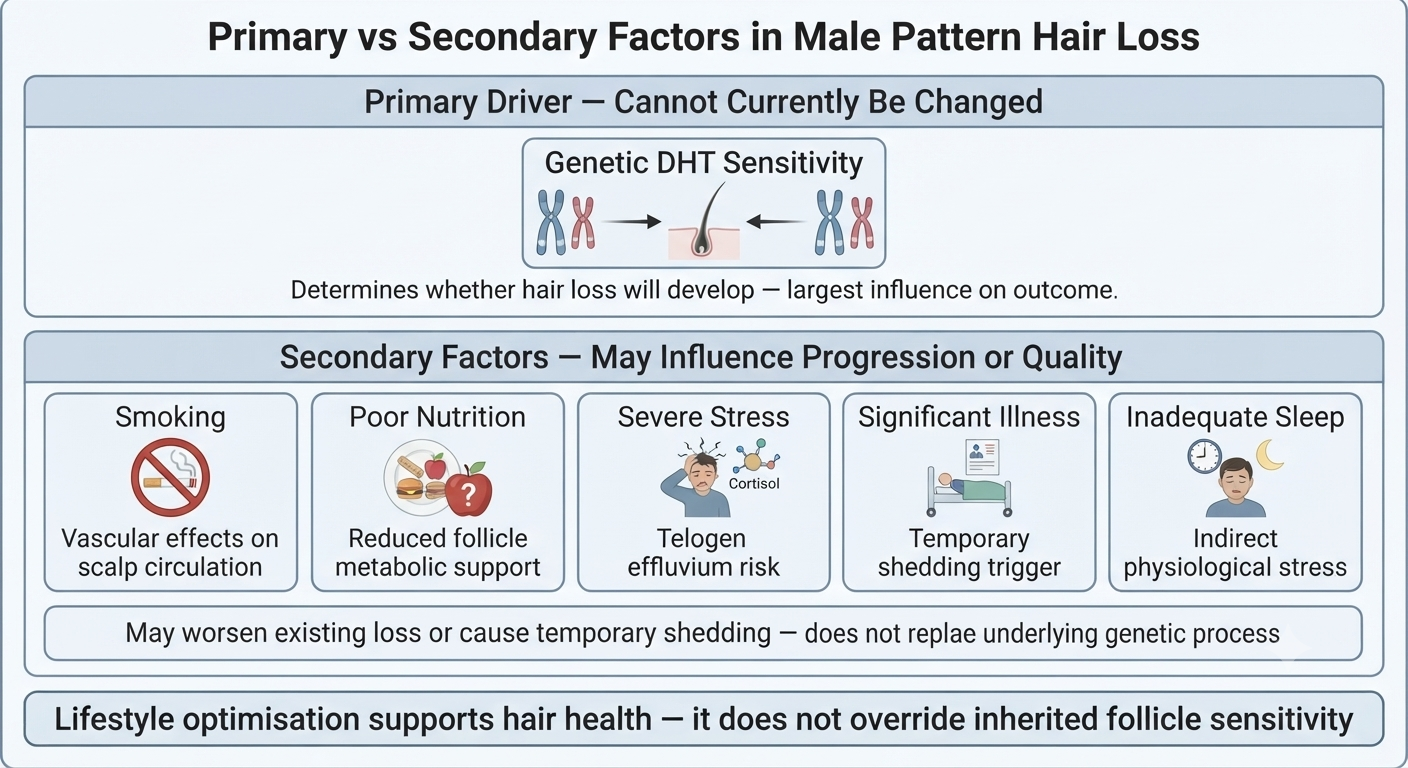
Lifestyle influences overall hair health but is not usually the primary cause of androgenetic alopecia.
Factors that may affect hair quality or temporary shedding include:
- Smoking
- Poor nutrition
- Significant psychological stress
- Severe illness
- Inadequate sleep
These factors may make existing hair loss more noticeable or contribute to temporary shedding, but they do not replace the underlying genetic process.
Can you predict how quickly hair loss will progress?
Not with complete accuracy.
Doctors consider several clues, including:
- Age at onset
- Family history
- Current pattern of thinning
- Rate of progression over recent years
Some men lose hair slowly over decades.
Others notice more rapid progression over a relatively short period.
Because progression varies, regular assessment can help guide treatment decisions.
Why understanding the cause matters
Knowing why hair loss is happening changes how it should be managed.
If the cause is androgenetic alopecia, treatment focuses on slowing follicular miniaturisation and preserving existing hair.
If another condition is responsible, such as a nutritional deficiency or thyroid disorder, a completely different approach may be required.
Accurate diagnosis always comes before effective treatment.
Looking beyond genetics
Although genetics cannot currently be changed, they do not tell the whole story.
The health of the follicle, the timing of diagnosis and appropriate medical management all influence long-term outcomes.
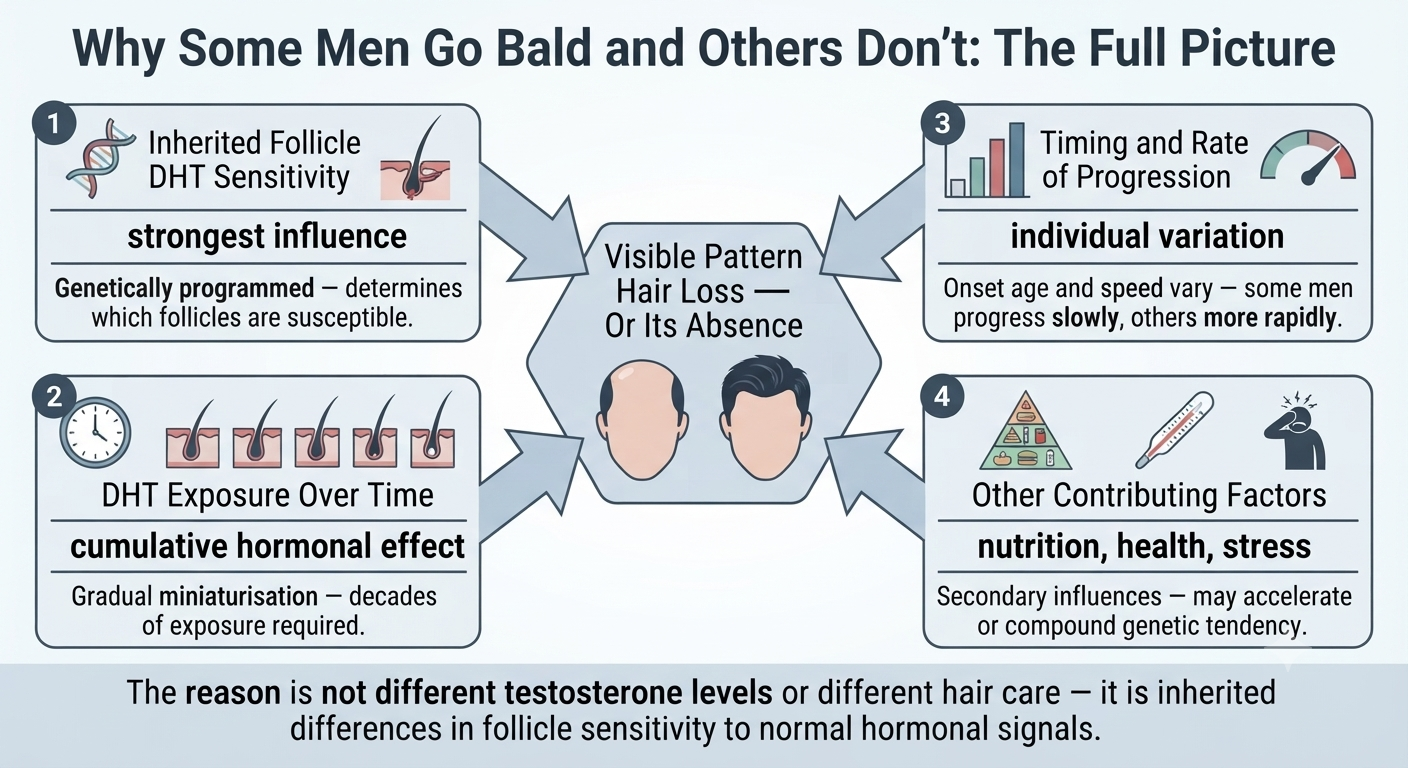
The reason some men go bald while others do not is not because they cared for their hair differently or had more testosterone. It is because their follicles inherited different levels of sensitivity to hormonal signals. Understanding that biology provides a much clearer foundation for making informed decisions about hair loss and its treatment.
Author: Dr. Priya Goswami
Medical review: Dr. Denis Broun
Next step
If you notice coverage changes without increased shedding, confirm what process is occurring.
Take the Hair Assessment to have a physician review your pattern, identify whether miniaturization is present, and determine appropriate staging and next steps.

Add Comment