Hair loss doesn’t usually begin with hairs suddenly falling out forever.
The process is much quieter than that.
For months or even years, each new hair becomes a little finer than the one before it. The changes are so gradual that many people don’t notice them until photographs from several years apart reveal a receding hairline or a thinning crown.
To understand why this happens, it helps to look beneath the surface of the scalp.
The real story takes place inside the hair follicle.
A healthy hair follicle is remarkably active
Every visible hair grows from a tiny structure beneath the skin called a hair follicle.
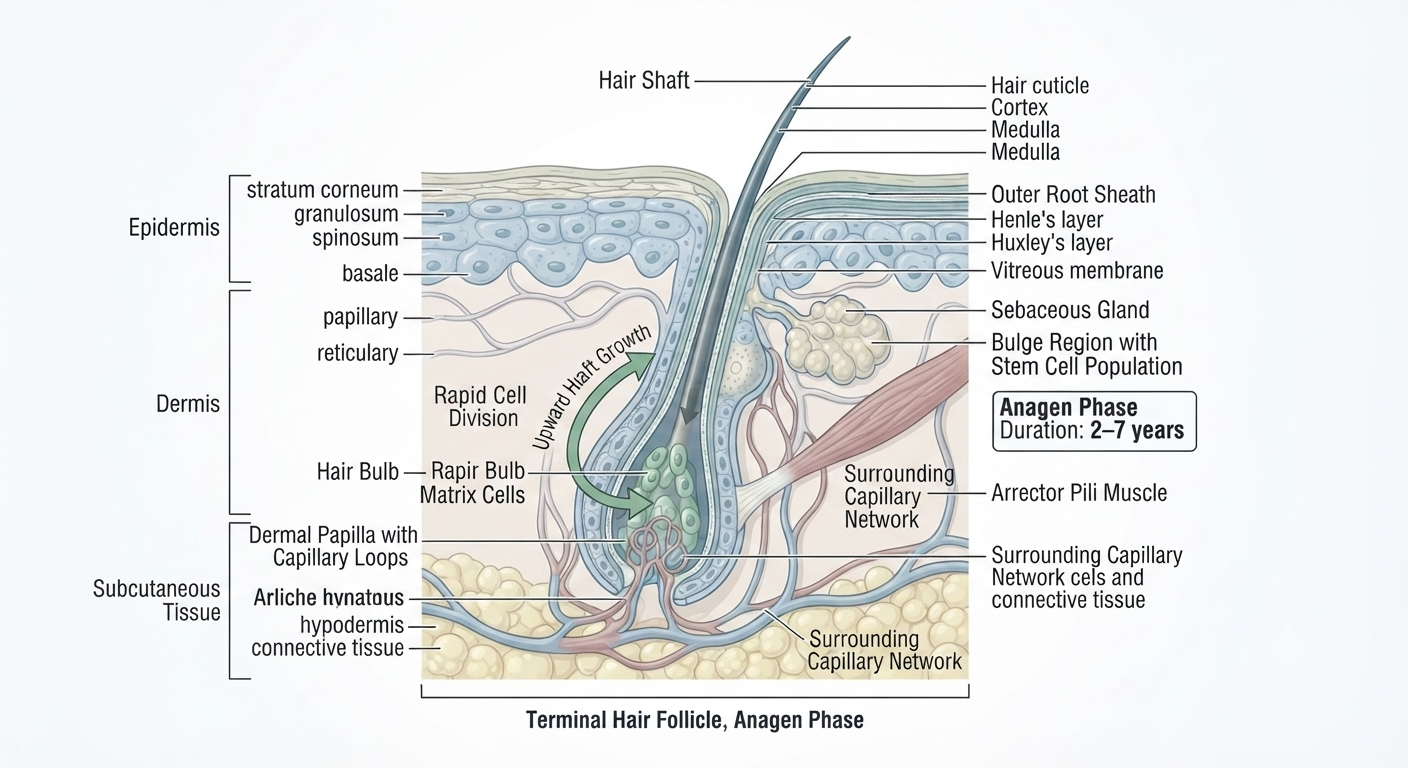
A healthy follicle repeatedly cycles through three main stages:
- An active growth phase (anagen)
- A short transition phase (catagen)
- A resting and shedding phase (telogen)
After one hair is shed, the follicle normally begins producing another.
This cycle continues throughout much of adult life.
Genetics determine which follicles are sensitive
Not every hair follicle behaves the same way.
In androgenetic alopecia, certain follicles inherit increased sensitivity to DHT.
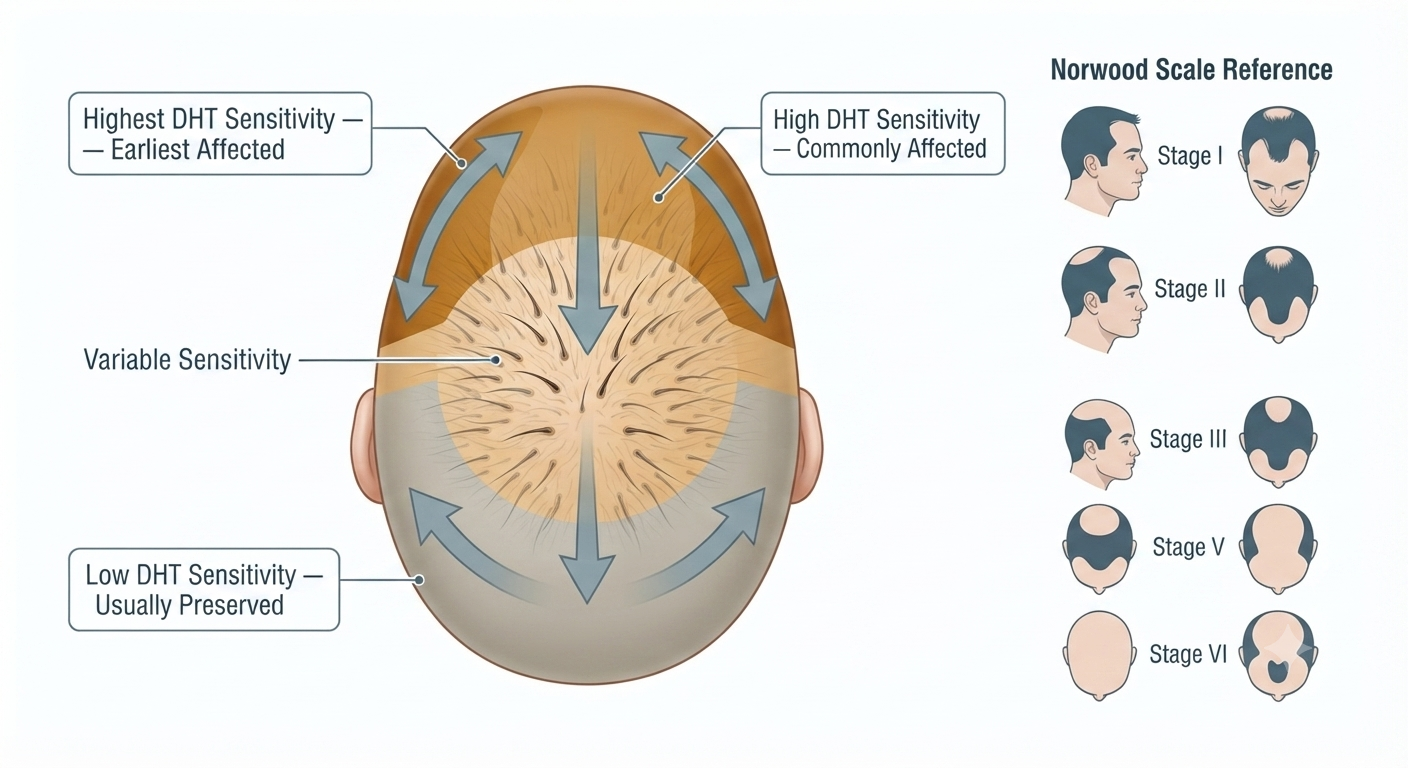
Interestingly, follicles at the back and sides of the scalp are usually much less affected. This difference explains why these areas often retain hair even when the top of the scalp becomes significantly thinner.
What does DHT actually do?
DHT does not simply make hair fall out.
Instead, repeated exposure gradually changes how susceptible follicles behave.
Over time:
- The growth phase becomes shorter.
- The resting phase becomes relatively longer.
- New hairs emerge thinner than before.
- Hair diameter decreases.
- Pigment may become lighter.
- Overall density gradually falls.
The follicle itself remains alive for a considerable period.
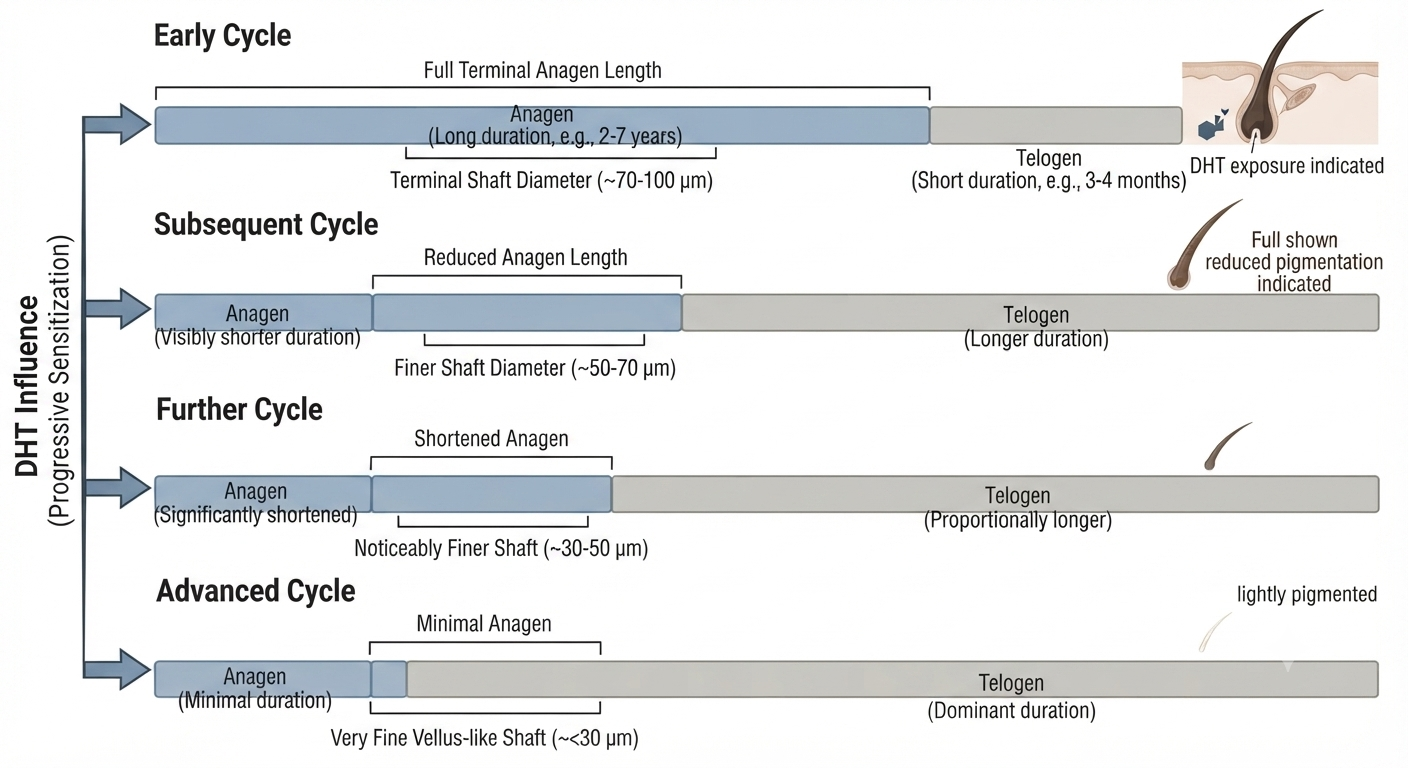
It is simply producing progressively smaller hairs.
Miniaturisation is the key process
The hallmark of male pattern baldness is follicular miniaturisation.
Imagine a mature tree producing smaller leaves every year.
The tree is still alive, but its output steadily declines.
Hair follicles behave in a similar way.
At first, thick terminal hairs become slightly finer.
Later, they resemble softer, shorter hairs.
Eventually, some follicles produce hairs so small that they become almost invisible.
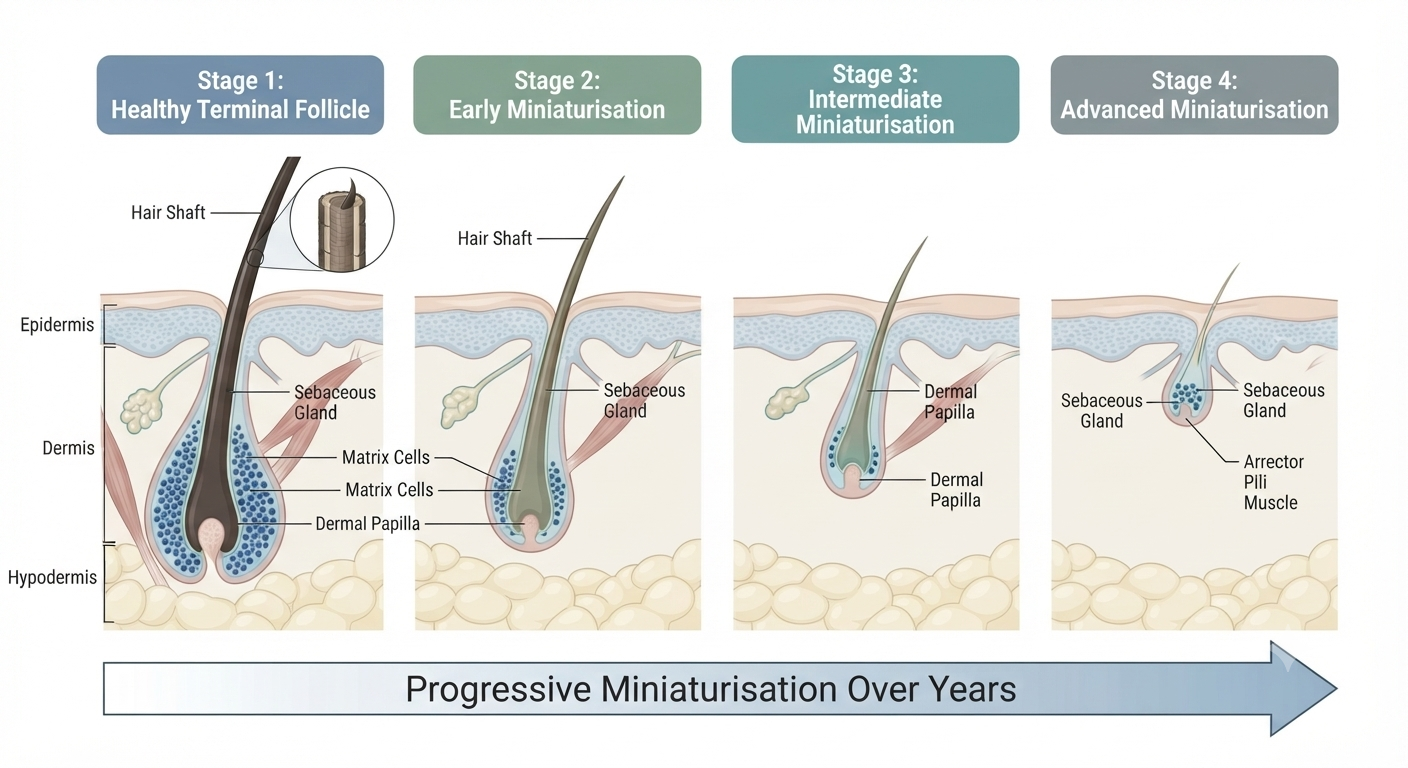
This gradual progression explains why hair loss often appears as thinning before baldness develops.
Why does the hairline recede first?
Male pattern baldness follows recognisable patterns because different parts of the scalp have different genetic sensitivity to DHT.
The temples and crown are commonly affected first.
As neighbouring follicles continue to miniaturise, these areas slowly enlarge and may eventually join together in more advanced stages.
The back and sides usually remain relatively preserved because their follicles respond differently to hormonal signals.
Is inflammation involved?
Researchers now believe that mild, long-term inflammation may contribute to follicular damage in some people.
Microscopic studies have identified inflammatory cells around affected follicles, although the exact role of inflammation is still being investigated.
This appears to be one factor among many rather than the sole cause of male pattern baldness.
Can miniaturised follicles recover?
The answer depends on how advanced the process has become.
Follicles that are still active, even if they produce thin hairs, may respond to appropriate treatment.
However, follicles that have remained inactive for many years are generally much less likely to regain normal function.
This is one reason why delaying treatment can reduce the range of available options.
Why early assessment makes a difference
Many men wait until hair loss becomes obvious before seeking advice.
By that stage, a significant proportion of susceptible follicles may already have undergone years of progressive miniaturisation.
Early assessment allows a healthcare professional to:
- Confirm the diagnosis.
- Exclude other causes of hair loss.
- Assess the rate of progression.
- Discuss appropriate treatment options.
- Monitor changes over time.
Not every thinning scalp is caused by androgenetic alopecia, so confirming the diagnosis is an important first step.
The follicle tells the real story
Male pattern baldness is not simply about losing hair.
It is about gradual changes occurring inside thousands of individual follicles over many years.
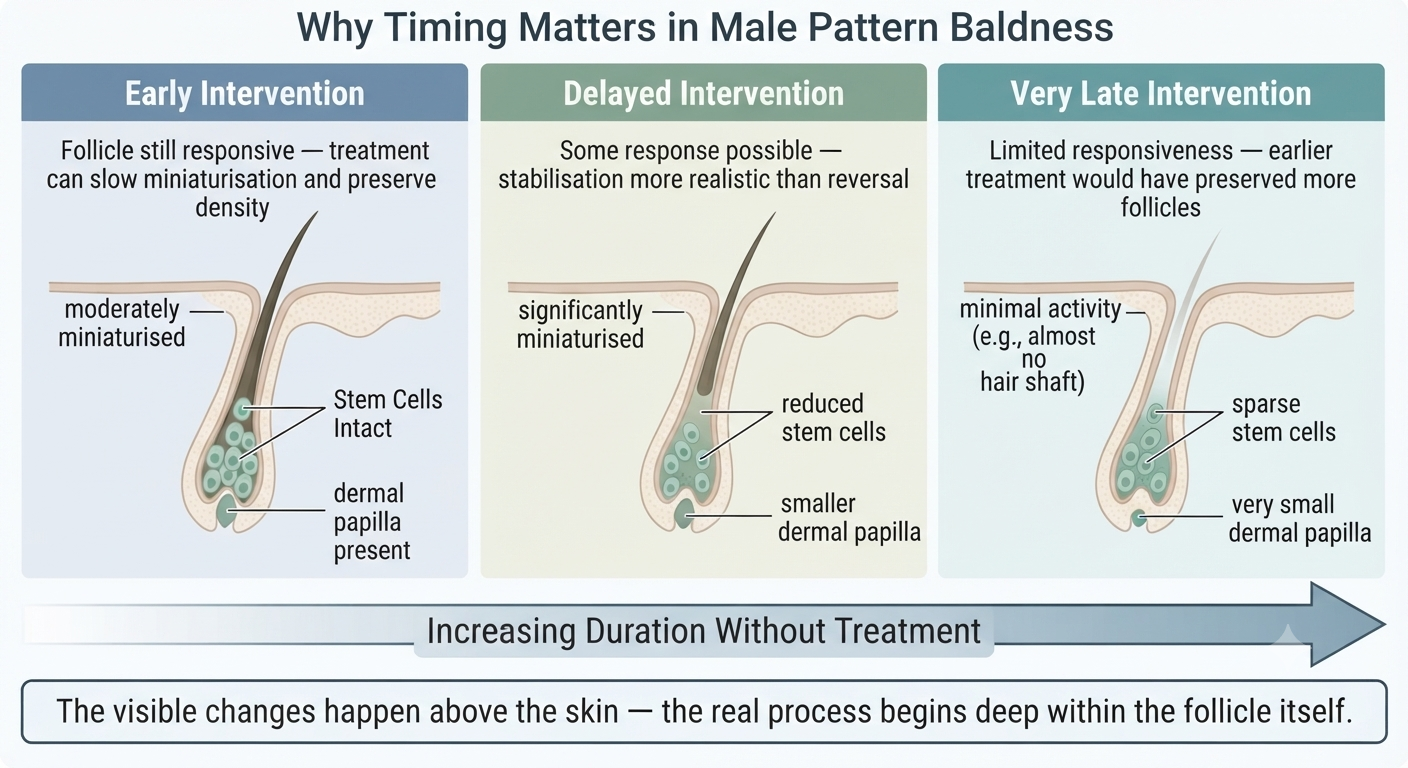
Understanding this biology helps explain why treatments take time to work, why consistency matters and why early intervention often offers the greatest opportunity to preserve existing hair.
The visible changes happen above the skin, but the real process begins deep within the follicle itself.
Author: Dr. Priya Goswami
Medical review: Dr. Denis Broun
Next step
If you notice coverage changes without increased shedding, confirm what process is occurring.
Take the Hair Assessment to have a physician review your pattern, identify whether miniaturization is present, and determine appropriate staging and next steps.

Add Comment