Many people say their hair is “getting thinner” when what they actually mean is that it feels finer.
Others have always had delicate hair but worry they are developing hair loss.
Although the words sound similar, fine hair and thinning hair describe two different things.
Understanding the difference is one of the first steps towards choosing the right treatment, because not every concern about hair volume is caused by hair loss.
What is fine hair?
Fine hair refers to the thickness of each individual hair strand.
People with fine hair are born with hair fibres that have a smaller diameter than average. This is usually determined by genetics.
Fine hair can still be:
- Healthy
- Dense
- Strong
- Fast-growing
Someone with fine hair may have thousands of healthy follicles producing normal numbers of hairs. The overall appearance may simply be softer or less voluminous than someone with thicker hair fibres.
Fine hair is a normal variation rather than a disease.
What is thinning hair?
Thinning hair refers to a reduction in hair density.
This means fewer hairs are growing in a particular area of the scalp than before.
Thinning may develop because:
- Hair follicles become smaller
- More hairs enter the shedding phase
- Follicles stop producing visible hairs
- Certain medical conditions affect hair growth
Unlike fine hair, thinning usually represents a change from a person’s previous baseline.
Why they are often confused
Both conditions can make hair look flatter and reduce overall volume.
However, the underlying biology is different.
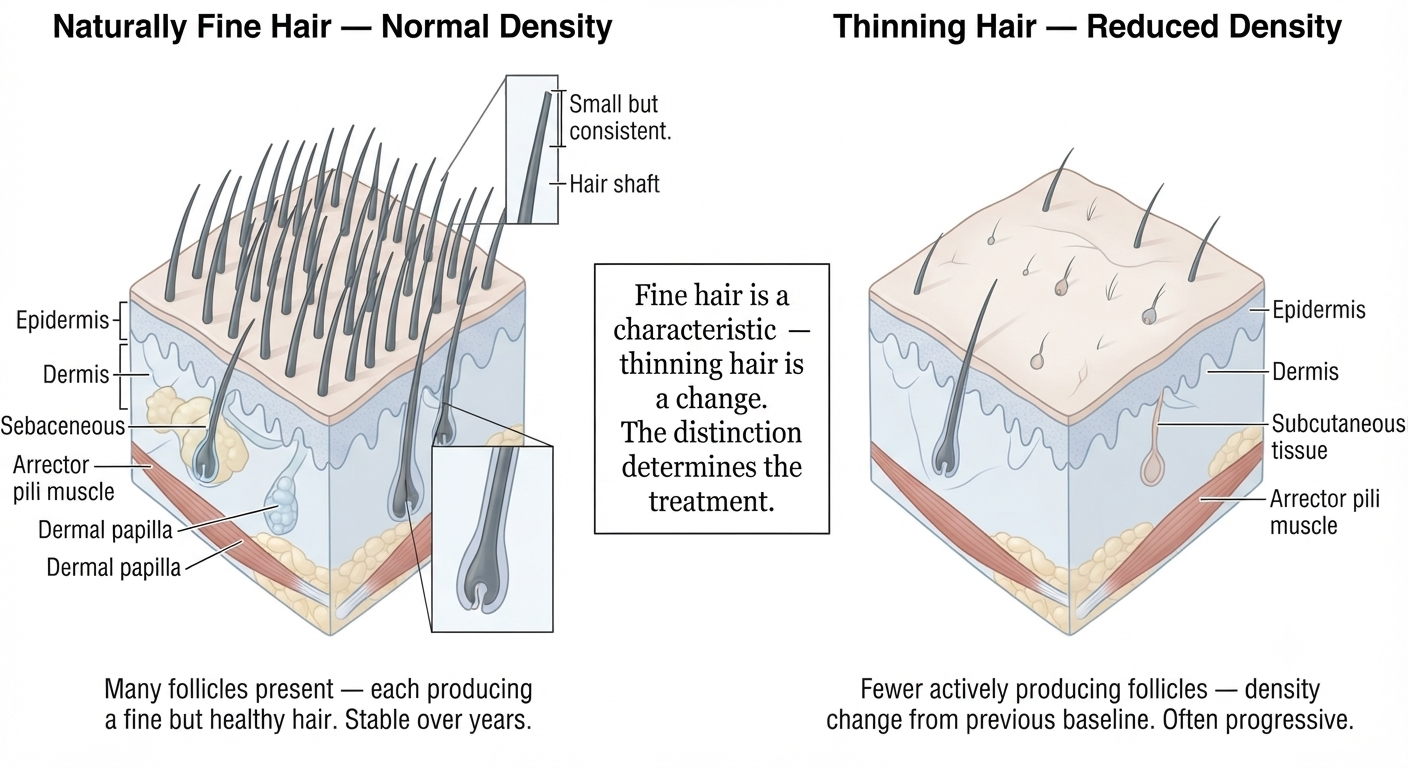
With naturally fine hair:
- Hair diameter is small.
- Hair density is usually normal.
- The appearance often remains stable over many years.
With thinning hair:
- Hair density decreases.
- The scalp may become more visible.
- Hairstyles may no longer cover the scalp as effectively.
- The change often progresses over time.
Looking only in the mirror does not always reveal which process is occurring.
Can you have both?
Yes.
Someone may naturally have fine hair and later develop androgenetic alopecia or another form of hair loss.
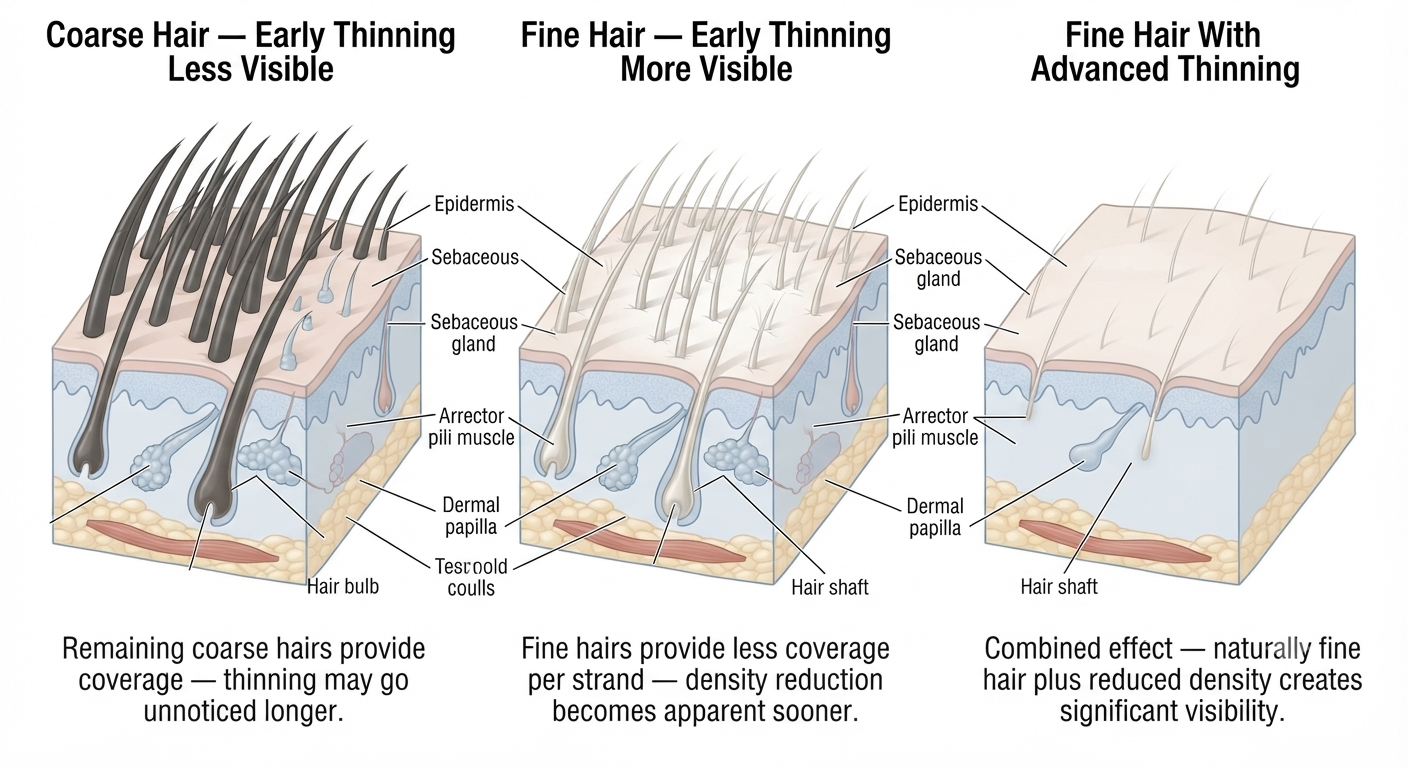
When this happens, the reduction in density may become noticeable earlier because each remaining hair is already relatively thin.
Conversely, someone with naturally coarse hair may lose a substantial number of follicles before thinning becomes obvious.
What commonly causes thinning hair?
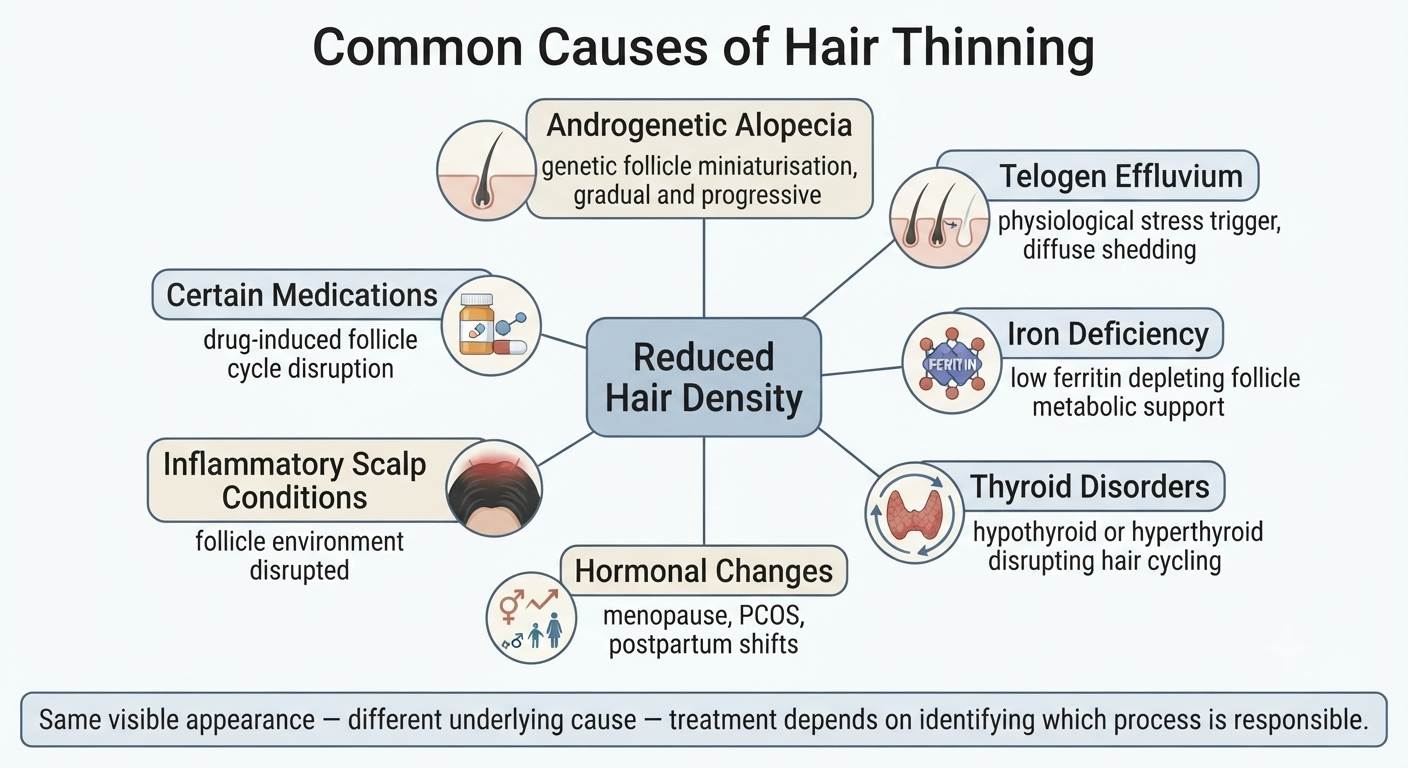
Hair thinning has many possible causes.
Common examples include:
- Androgenetic alopecia
- Telogen effluvium
- Iron deficiency
- Thyroid disorders
- Certain medications
- Hormonal changes
- Inflammatory scalp conditions
Each condition affects hair growth differently.
That is why identifying the cause is more important than simply describing the appearance.
How do doctors tell the difference?
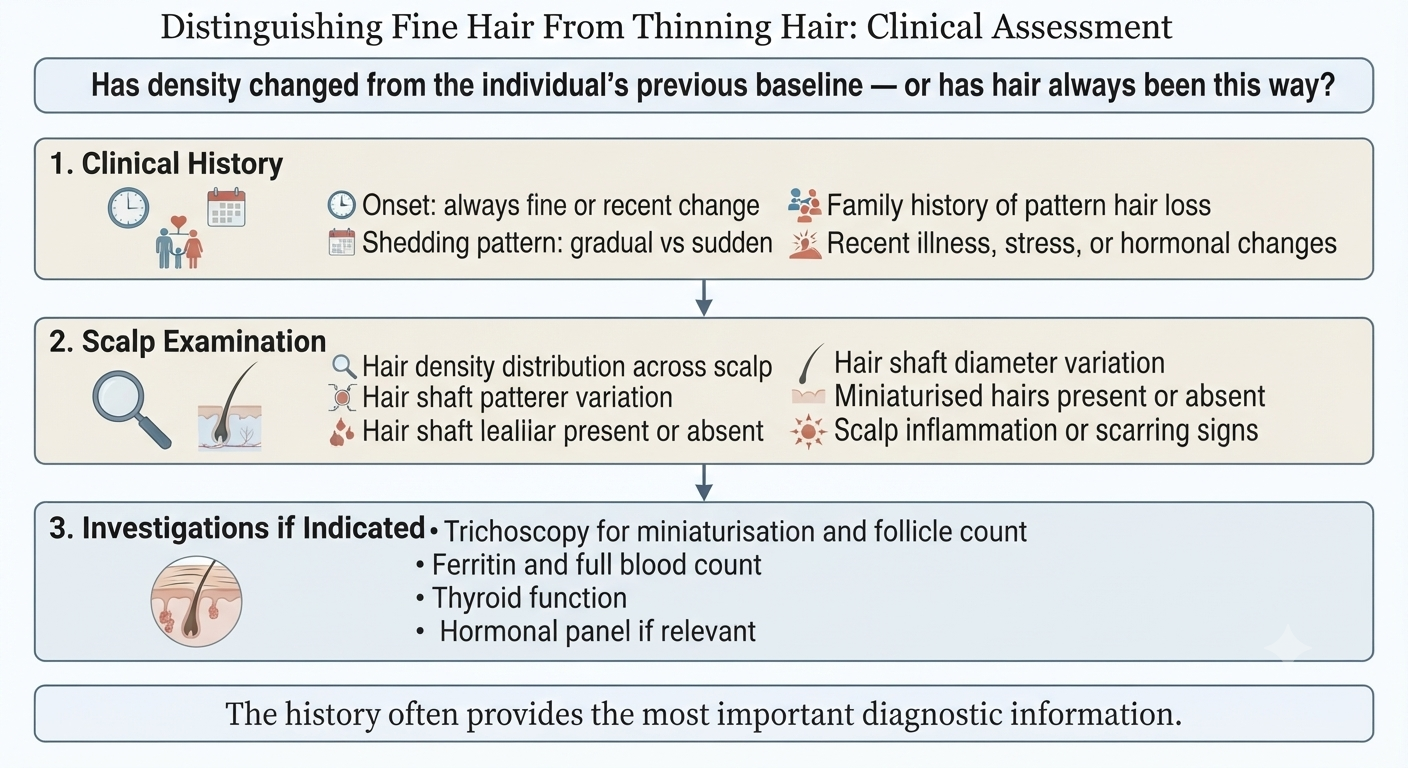
Assessment begins with a detailed history.
Your healthcare professional may ask:
- When did you first notice the change?
- Has the volume reduced gradually or suddenly?
- Is there increased shedding?
- Does anyone in your family have pattern hair loss?
- Have you recently been ill or under significant stress?
The scalp is then examined.
Doctors assess:
- Hair density
- Hair shaft diameter
- Distribution of thinning
- Signs of inflammation
- Miniaturised hairs
- Overall scalp health
In some cases, dermoscopy or blood tests may provide additional information.
Can fine hair become thicker?
The natural diameter of genetically fine hair is difficult to change permanently.
Some cosmetic products temporarily increase the apparent thickness of individual hairs by coating the hair shaft.
These products can improve volume but do not alter the follicle itself.
If hair appears finer because follicles are becoming miniaturised, treating the underlying condition may help preserve or improve hair calibre in some individuals.
Why the diagnosis matters
Treatments for thinning hair are designed to address the cause of reduced hair density.
They are unlikely to transform naturally fine hair into coarse hair.
Similarly, using volumising products alone will not stop progressive hair loss if follicles are gradually becoming smaller.
The most appropriate approach depends on understanding which process is taking place.
Looking at the whole picture
Hair appearance depends on more than one factor.
The number of hairs, the thickness of each strand, hair texture, colour and styling all contribute to how full the hair looks.
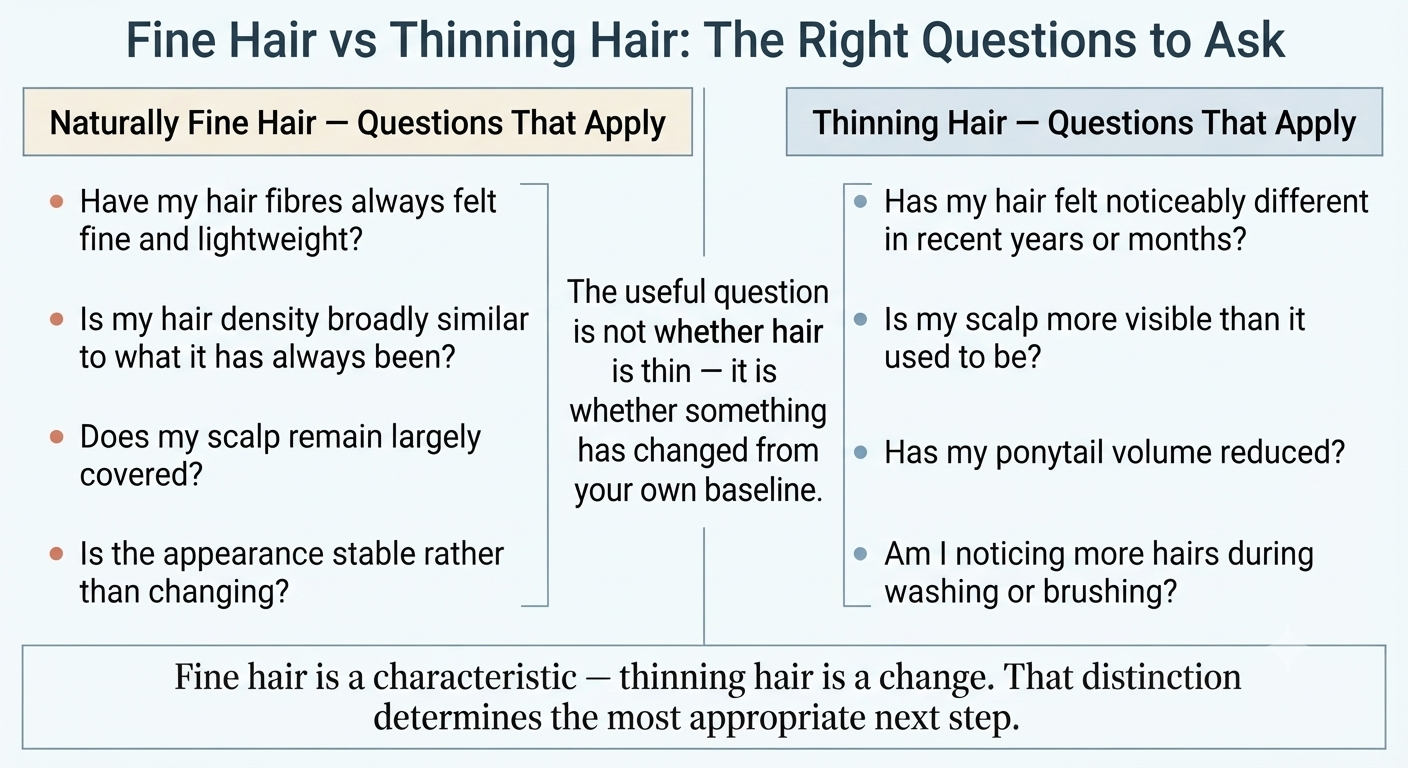
Recognising the difference between fine hair and thinning hair allows expectations to become more realistic and treatment decisions to become more targeted.
Rather than asking whether your hair is “thin”, the more useful question is whether the hair fibres have always been fine or whether the number of growing hairs has changed. That distinction often determines everything that follows.
Author: Dr. Priya Goswami
Medical review: Dr. Denis Broun
Next step
If you notice coverage changes without increased shedding, confirm what process is occurring.
Take the Hair Assessment to have a physician review your pattern, identify whether miniaturization is present, and determine appropriate staging and next steps.


Add Comment