When people talk about hair loss, they usually focus on the hair they can see.
The truth is that hair itself is no longer alive once it emerges from the skin.
The real activity happens underneath.
Every strand begins inside a tiny structure called a hair follicle. It is here that new hair is created, nourished and shaped. Whether your hair is thick or fine, curly or straight, growing or shedding, the answer usually lies within the follicle.
Understanding how the follicle works makes it much easier to understand why hair loss happens and why treatments succeed or fail.
A hair follicle is more than a simple hole in the skin
A common misconception is that hair grows from an opening in the scalp.
In reality, the follicle is a highly organised structure that extends deep into the skin.
It contains specialised cells that work together to:
- Produce the hair shaft
- Control the hair growth cycle
- Supply nutrients
- Create hair pigment
- Respond to hormonal and biological signals
Each follicle functions almost like its own miniature organ.
The main parts of the follicle
Although the follicle is small, it contains several important structures.
The dermal papilla
Located at the base of the follicle, the dermal papilla contains blood vessels and signalling cells.
It provides nutrients and sends chemical signals that regulate hair growth.
Many researchers consider it one of the most important control centres of the follicle.
The hair matrix
Just above the dermal papilla lies the hair matrix.
This is where rapidly dividing cells produce the hair shaft.
These cells multiply continuously during the active growth phase, gradually pushing the hair upwards through the skin.
Stem cells
Hair follicle stem cells allow the follicle to regenerate repeatedly throughout life.
Rather than producing hair continuously, they become active at specific stages of the growth cycle, helping initiate each new period of growth.
Protecting these stem cells is essential for long-term hair production.
Melanocytes
Melanocytes produce melanin, the pigment responsible for hair colour.
As these cells gradually become less active with age, hair turns grey or white.
How does a follicle grow hair?
Hair growth follows a repeating cycle.
During the growth phase, matrix cells divide rapidly, creating the hair shaft.
Eventually, the follicle enters a short transition phase before moving into a resting period.
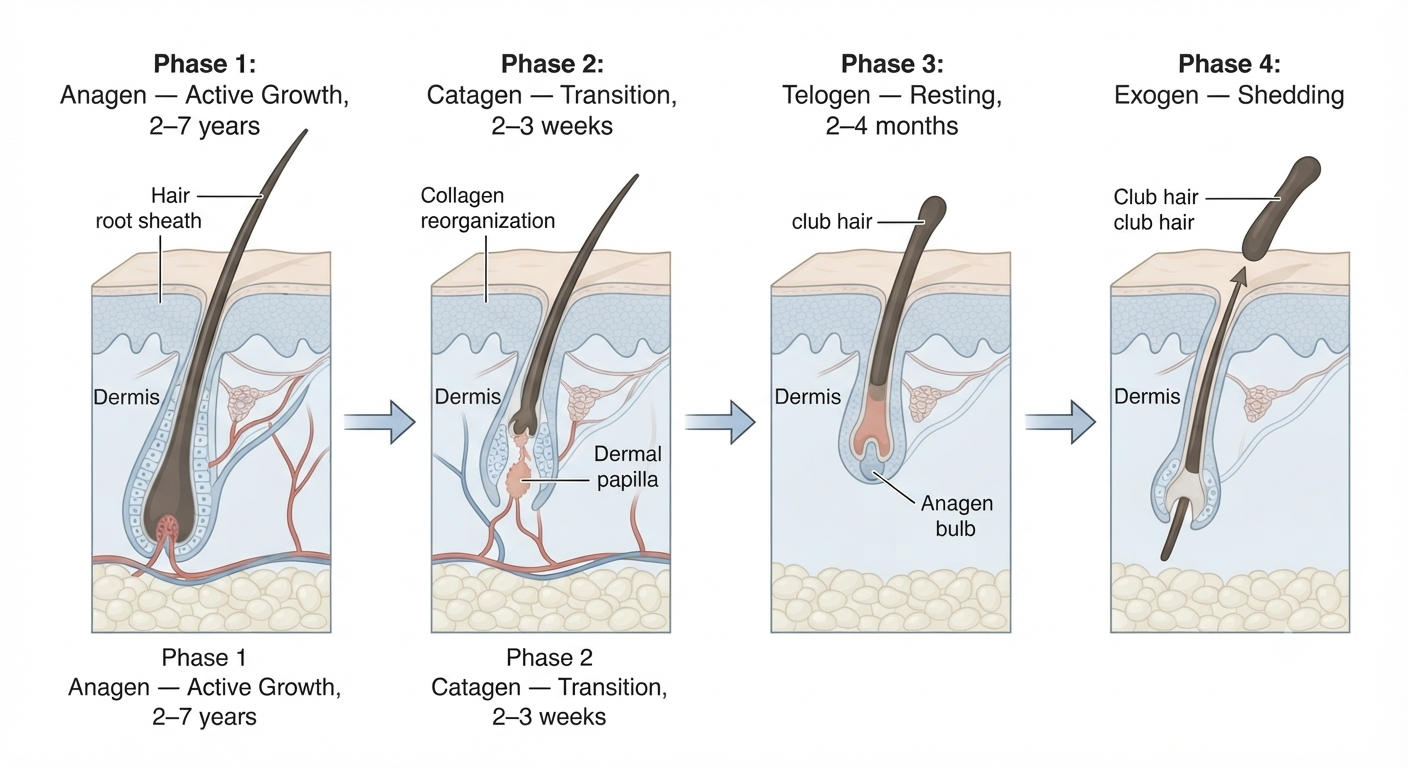
After the old hair is shed, the follicle begins producing a new one.
This cycle continues independently in thousands of follicles across the scalp.
Because each follicle follows its own timetable, people normally lose some hairs every day without noticing any reduction in overall hair density.
What happens during pattern hair loss?
In androgenetic alopecia, the follicle itself changes.
Repeated exposure to hormonal signals in genetically susceptible individuals causes the follicle to become progressively smaller.
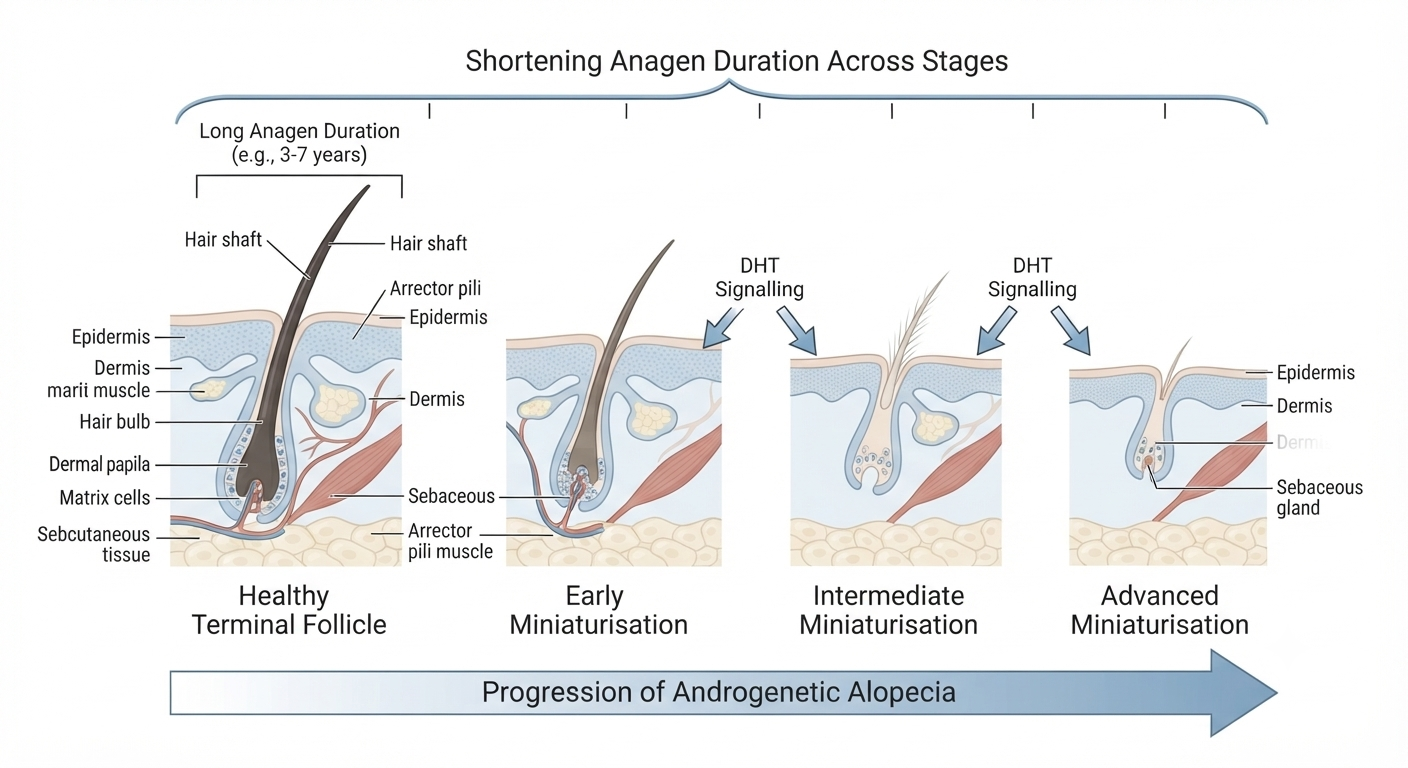
This process is called miniaturisation.
As miniaturisation progresses:
- The growth phase becomes shorter.
- Hair shafts become thinner.
- Hair grows for less time.
- Overall density gradually decreases.
The follicle often remains alive for years, but it produces increasingly finer hairs.
Can damaged follicles recover?
That depends on the type of damage.
If follicles are temporarily affected by illness, nutritional deficiencies or certain medications, they may recover once the underlying cause is corrected.
Miniaturised follicles in early androgenetic alopecia may also respond to treatment while they remain biologically active.
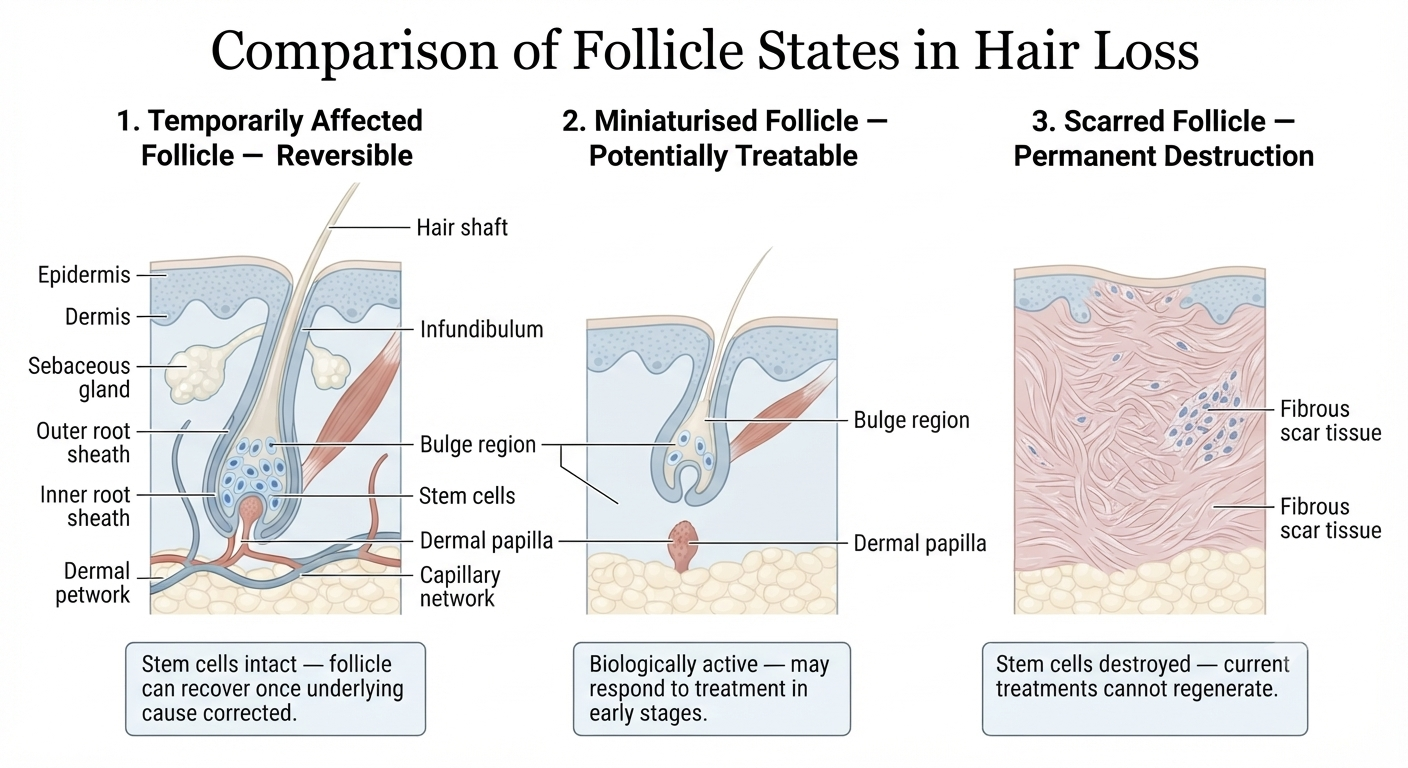
However, follicles that have been permanently destroyed, such as in some scarring alopecias, cannot currently regenerate with existing medical treatments.
This distinction explains why early diagnosis is so important.
The scalp supports the follicle
Hair follicles do not function in isolation.
They rely on healthy surrounding skin, adequate blood supply and a balanced local environment.
Persistent inflammation, infection or chronic skin disorders may interfere with normal follicular function.
Looking after scalp health therefore supports the environment in which follicles operate, even though it cannot reverse every cause of hair loss.
What are researchers studying?
The hair follicle remains one of the most active areas of hair loss research.
Current investigations include:
- Hair follicle stem cell biology
- Molecular signalling pathways
- Regenerative medicine
- Tissue engineering
- Growth factor therapies
- Cell-based treatments
While several approaches show promise, many remain experimental and require further clinical study before becoming routine treatments.
Why every treatment ultimately targets the follicle
Whether the treatment involves medication, surgery or supportive scalp care, the goal is almost always the same: to protect, stimulate or replace functioning hair follicles.
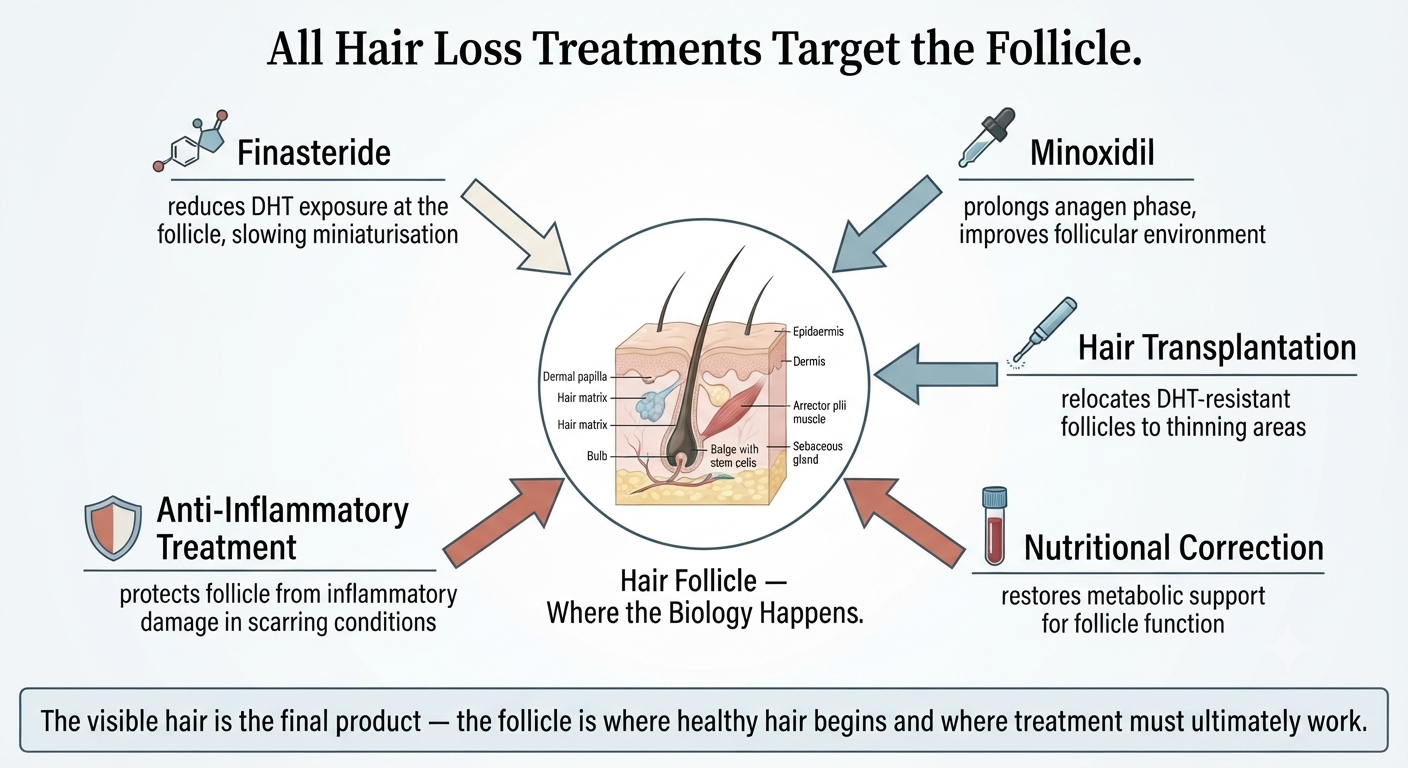
The visible hair is simply the final product.
The follicle is where the biology happens.
Understanding that simple fact changes how we think about hair loss. Instead of chasing products that promise instant cosmetic improvements, it shifts the focus towards preserving the tiny structures that make healthy hair possible in the first place.
Author: Dr. Priya Goswami
Medical review: Dr. Denis Broun
Next step
If you notice coverage changes without increased shedding, confirm what process is occurring.
Take the Hair Assessment to have a physician review your pattern, identify whether miniaturization is present, and determine appropriate staging and next steps.
Add Comment