Hair follicles do not all behave in the same way throughout life. Some continue producing thick, pigmented hair for decades, while others gradually begin producing finer and shorter hair. This change usually occurs slowly and may not become noticeable until the visible density of the scalp begins to decrease.
The gradual reduction in hair thickness is often linked to changes within the follicle itself. These changes influence how the follicle grows hair, how long the hair remains in the growth phase, and how much coverage the hair provides on the scalp.
Understanding why some follicles stop producing thick hair helps explain how common forms of hair thinning develop over time.
The structure of the hair follicle
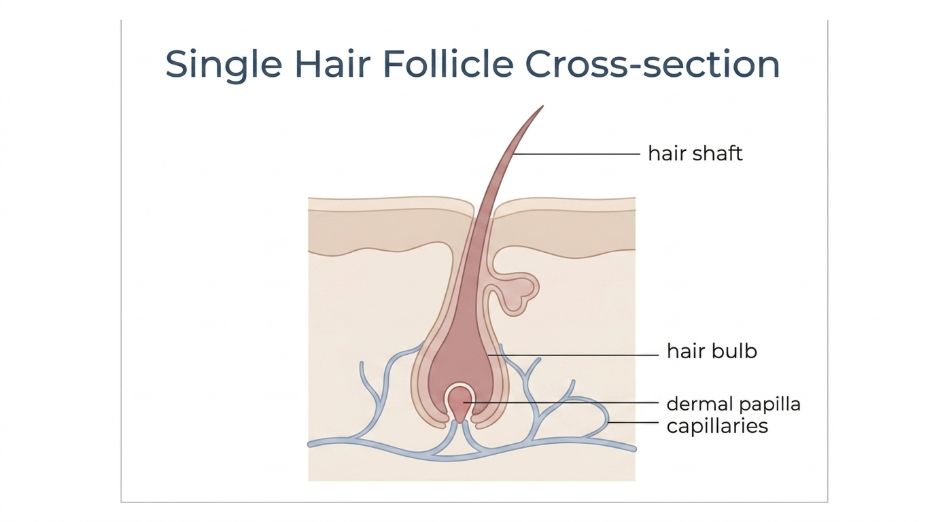
A hair follicle is a specialised structure located within the skin that produces the hair shaft.
At the base of the follicle is the hair bulb, where cells divide rapidly and form the growing hair. Beneath the bulb lies the dermal papilla, which contains blood vessels and signalling molecules that regulate hair growth.
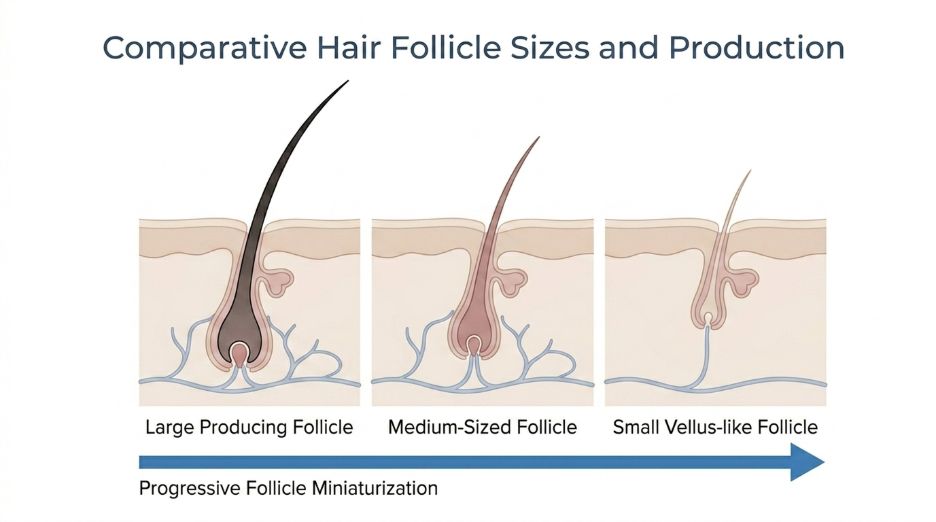
The size and activity of the follicle influence the characteristics of the hair shaft. Larger follicles generally produce thicker terminal hairs, while smaller follicles produce finer hairs.
Because follicles operate within repeating growth cycles, changes in follicle behaviour usually occur gradually over multiple cycles.
Thick hair and terminal follicles
The thick hairs that provide most of the visible coverage of the scalp are known as terminal hairs.
Terminal hairs are produced by healthy follicles with a well-developed growth structure. These hairs contain a strong cortex filled with keratin fibres, giving them thickness and durability.
When a large proportion of scalp follicles produce terminal hairs, the hair appears dense and full.
The ability of follicles to continue producing thick terminal hairs depends on several biological factors, including genetics, hormonal influences, and the duration of the hair growth cycle.
The process of follicle miniaturisation
One of the main reasons follicles stop producing thick hair is a process called follicle miniaturisation.
Miniaturisation occurs when the follicle gradually becomes smaller during successive growth cycles. As the follicle shrinks, the hair shaft it produces also becomes thinner.
At first, the change may be subtle. A hair that was previously thick may become slightly finer during the next cycle. Over many cycles, however, the follicle may produce increasingly thin hairs that provide less visible coverage of the scalp.
Eventually, some follicles produce hairs that resemble fine vellus hairs rather than thick terminal hairs.
Hormonal influences on follicles
Hair follicles respond to a variety of biological signals, including hormones.
In individuals who are genetically predisposed to androgenetic alopecia, certain follicles are more sensitive to hormonal influences. Over time, these signals gradually alter the behaviour of the follicle.
The growth phase becomes shorter, and the follicle begins producing thinner hair during each cycle.
Not all follicles respond equally. Follicles at the temples and crown are often more sensitive than follicles on the sides and back of the scalp. This difference explains why hair thinning commonly follows recognisable patterns.
Changes in the hair growth cycle
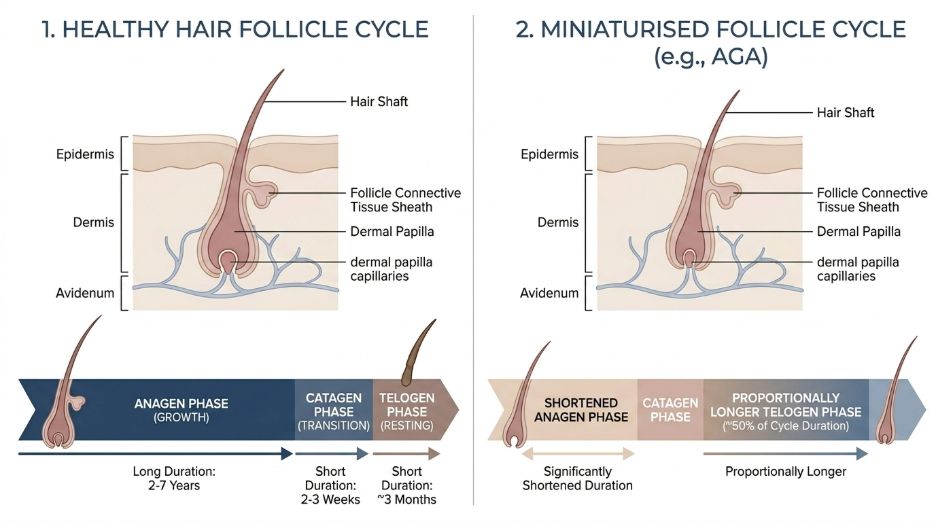
Healthy follicles remain in the growth phase of the hair cycle for several years. This allows the hair shaft to grow long and thick.
In follicles undergoing miniaturisation, the growth phase gradually shortens. Because the hair spends less time growing, it emerges thinner and shorter than before.
At the same time, the resting phase of the cycle may become relatively longer.
These combined changes reduce the visible density of the hair over time.
Ageing and follicle activity
Ageing can also influence how follicles behave.
As the body ages, some follicles may gradually become less active. Hair shafts may become slightly finer, and the overall density of hair may decrease slowly over time.
These age-related changes vary widely between individuals. Some people retain thick hair throughout life, while others experience more noticeable thinning.
Ageing alone does not explain all hair thinning, but it can contribute to gradual changes in hair characteristics.
Why thinning develops gradually
Hair thinning usually develops slowly because follicles operate in long growth cycles.
A single hair cycle on the scalp may last several years. This means that changes in follicle behaviour become visible only gradually as successive cycles produce progressively finer hair.
In the early stages, only a small proportion of follicles may be affected. Over time, however, more follicles may begin producing thinner hairs, leading to visible changes in hair density.
Because the process unfolds over many years, the transition often appears gradual rather than sudden.
When follicles stop producing visible hair
In advanced stages of miniaturisation, some follicles may produce hairs that are extremely fine and difficult to see.
Although the follicles remain present beneath the skin, the hairs they produce provide very little visible coverage of the scalp.
This is why the scalp may appear bald even though many follicles are still present.
The visible appearance of baldness therefore often reflects changes in hair thickness rather than the complete disappearance of follicles.

Understanding follicle behaviour
The ability of a follicle to produce thick hair depends on its size, activity, and the duration of the hair growth cycle.
When follicles undergo miniaturisation, they gradually produce thinner and shorter hairs over successive cycles. Hormonal influences, genetic predisposition, and age-related changes can all contribute to this process.
Understanding how follicles change over time helps explain why hair thinning develops gradually and why certain areas of the scalp are more affected than others.
Author: Dr. Priya Goswami
Medical review: Dr. Denis Broun
Next step
If you notice coverage changes without increased shedding, confirm what process is occurring.
Take the Hair Assessment to have a physician review your pattern, identify whether miniaturization is present, and determine appropriate staging and next steps.

Add Comment