Human hair varies enormously in appearance and structure. Some people naturally have straight hair, while others have wavy, curly, or tightly coiled hair. Hair texture may also differ in thickness, smoothness, softness, and volume.
These differences are determined primarily by the biology of the hair follicle and the structure of the hair shaft itself. Genetics plays the dominant role, although hormones, ageing, and environmental factors can also influence how hair behaves over time.
Understanding what determines hair texture and curl pattern requires looking closely at how the follicle produces the hair shaft.
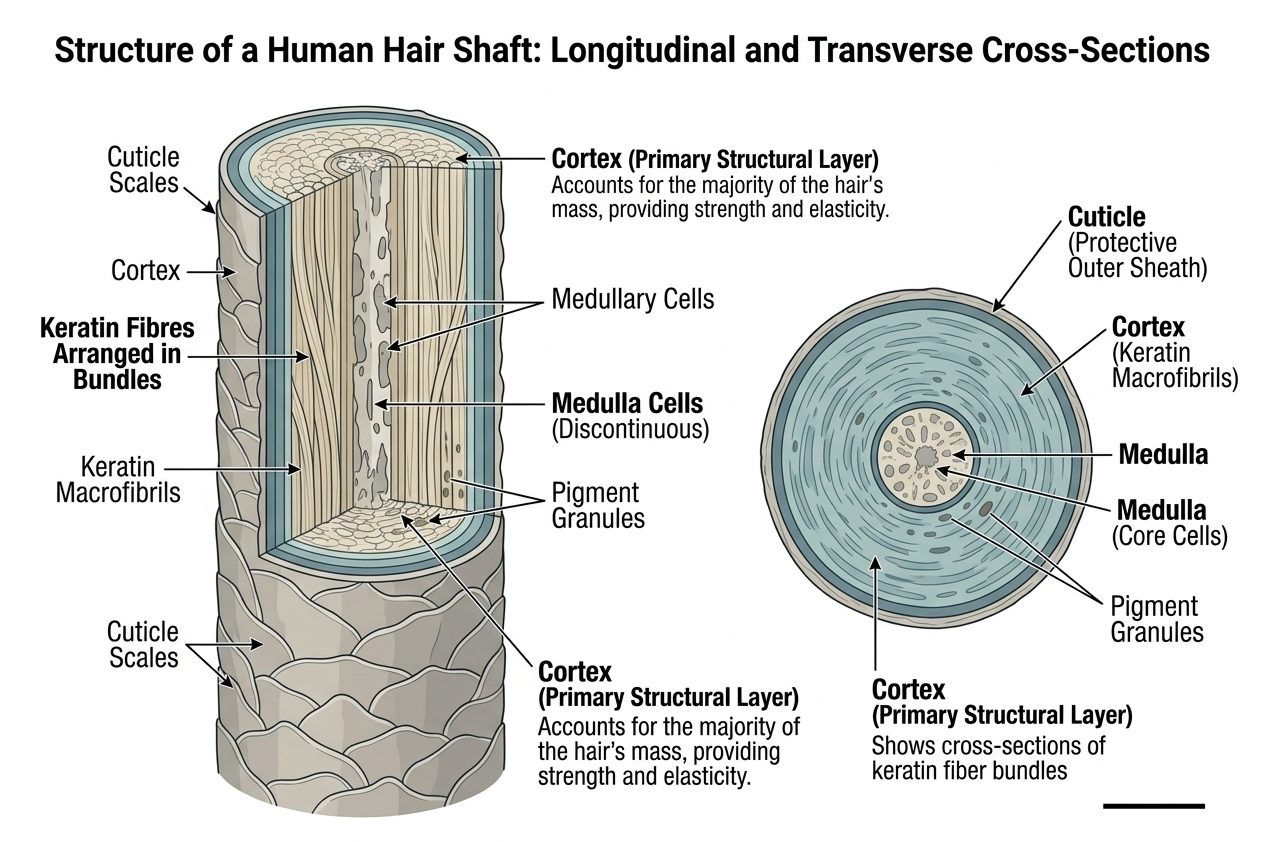
The hair shaft is made of keratin
Hair is composed mainly of a structural protein called keratin.
The hair shaft contains several layers:
- the cuticle
- the cortex
- sometimes the medulla
The cortex forms most of the hair shaft and largely determines:
- strength
- elasticity
- texture
- curl pattern
The arrangement of keratin fibres within the cortex influences how straight or curved the hair becomes as it grows.
The shape of the follicle matters
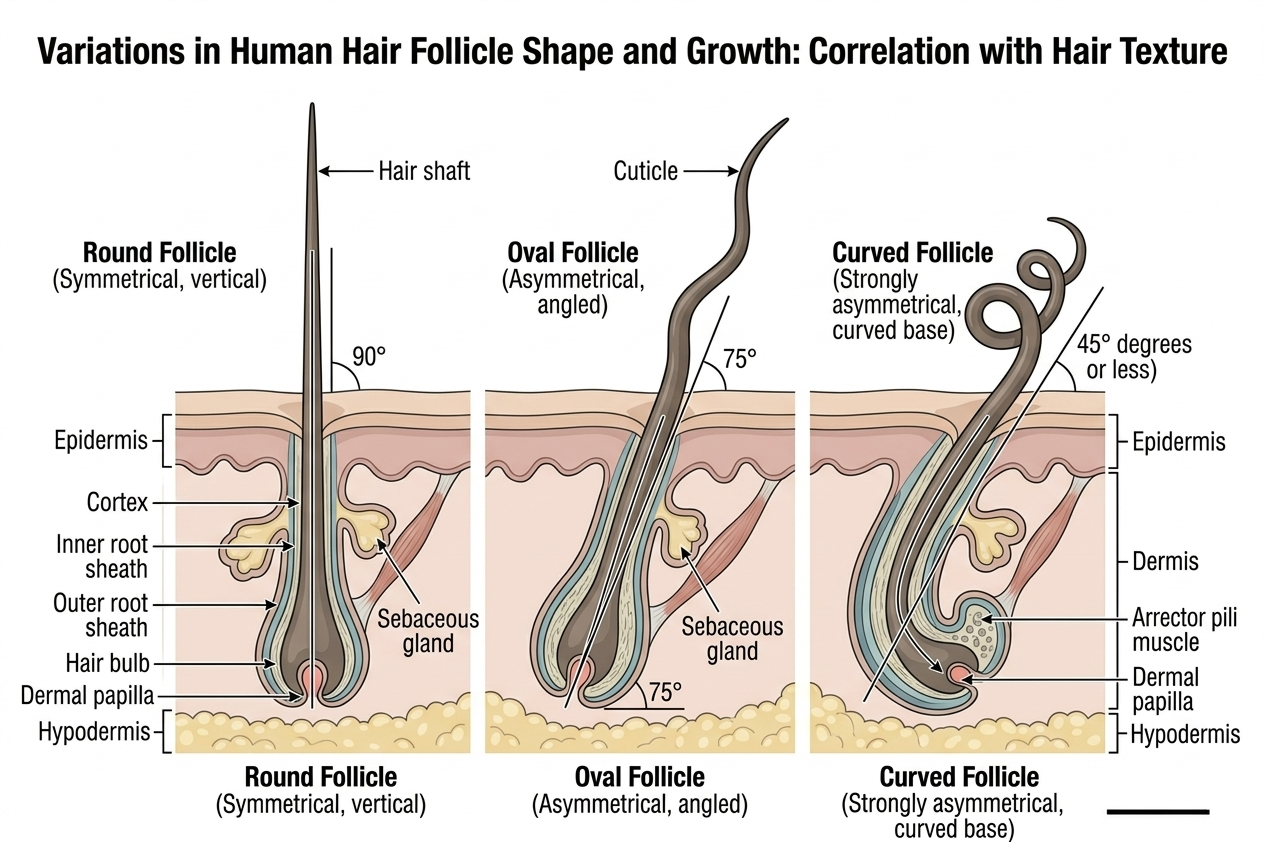
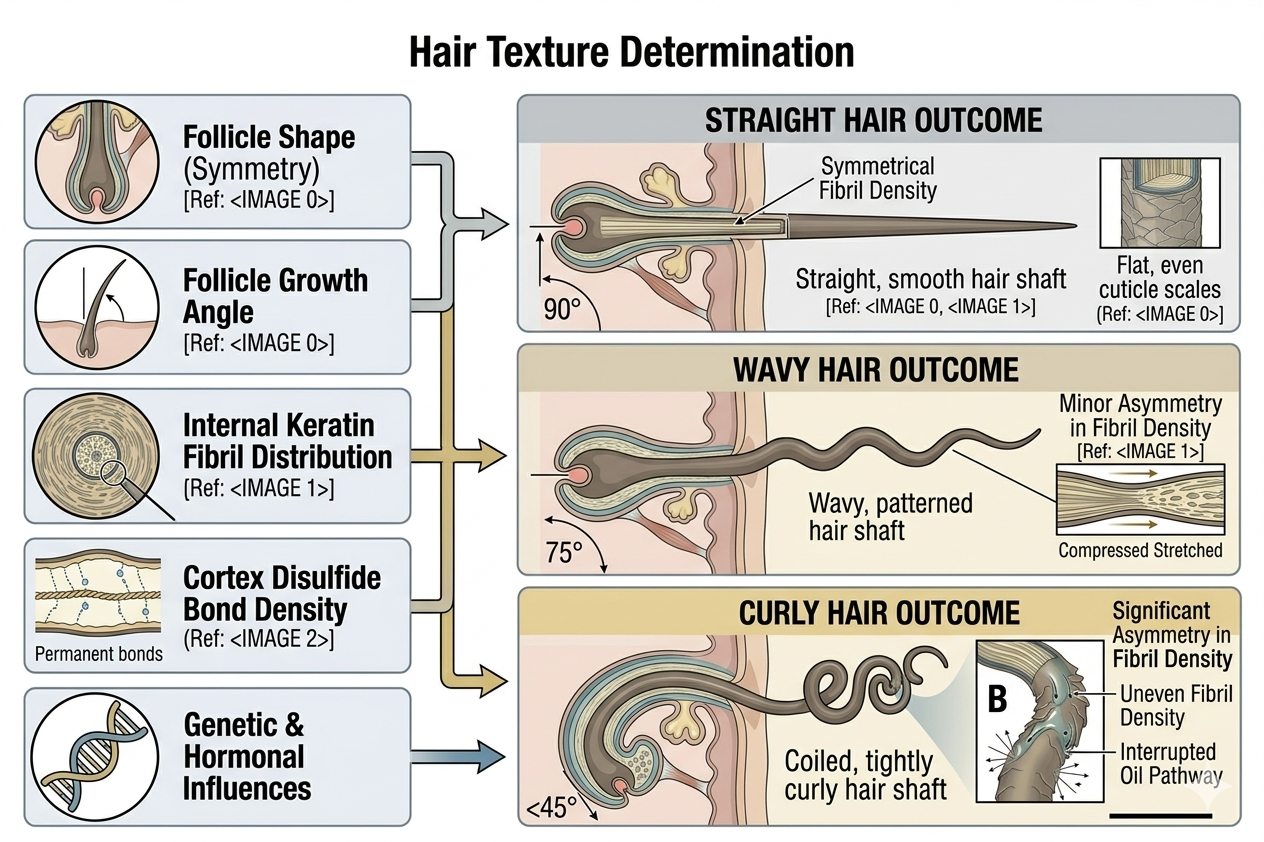
One of the most important determinants of curl pattern is the shape of the hair follicle itself.
Round follicles
Round follicles tend to produce straighter hair shafts.
The hair grows relatively evenly from all sides, creating a more symmetrical structure.
Oval or curved follicles
Oval or asymmetrical follicles tend to produce wavy or curly hair.
Because the follicle bends or curves during hair formation, the emerging hair shaft develops an uneven structure that causes it to curve as it grows.
The more asymmetrical the follicle, the tighter the curl pattern may become.
The angle of hair growth also contributes
The angle at which the follicle sits within the skin also affects hair texture.
Straight follicles often grow more vertically from the scalp, while curly follicles may emerge at more angled orientations.
This influences:
- how the hair bends
- how curls form
- how the hair lies on the scalp
Keratin distribution affects curl formation
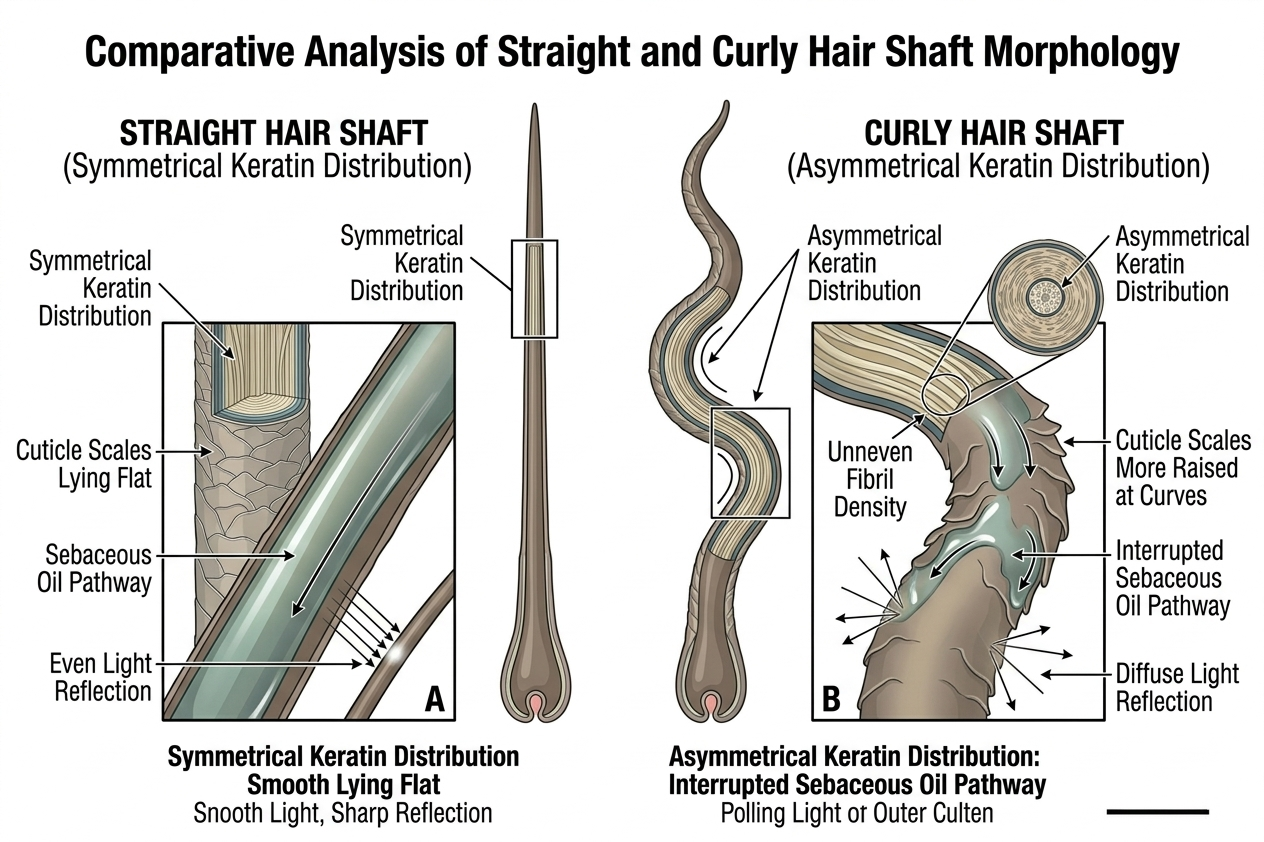
The distribution of keratin proteins inside the hair shaft is not always perfectly symmetrical.
In curly hair:
- keratin may be distributed unevenly
- different sides of the hair shaft may grow at slightly different rates
This imbalance creates tension within the fibre and causes the shaft to curve naturally.
Chemical bonds influence hair shape
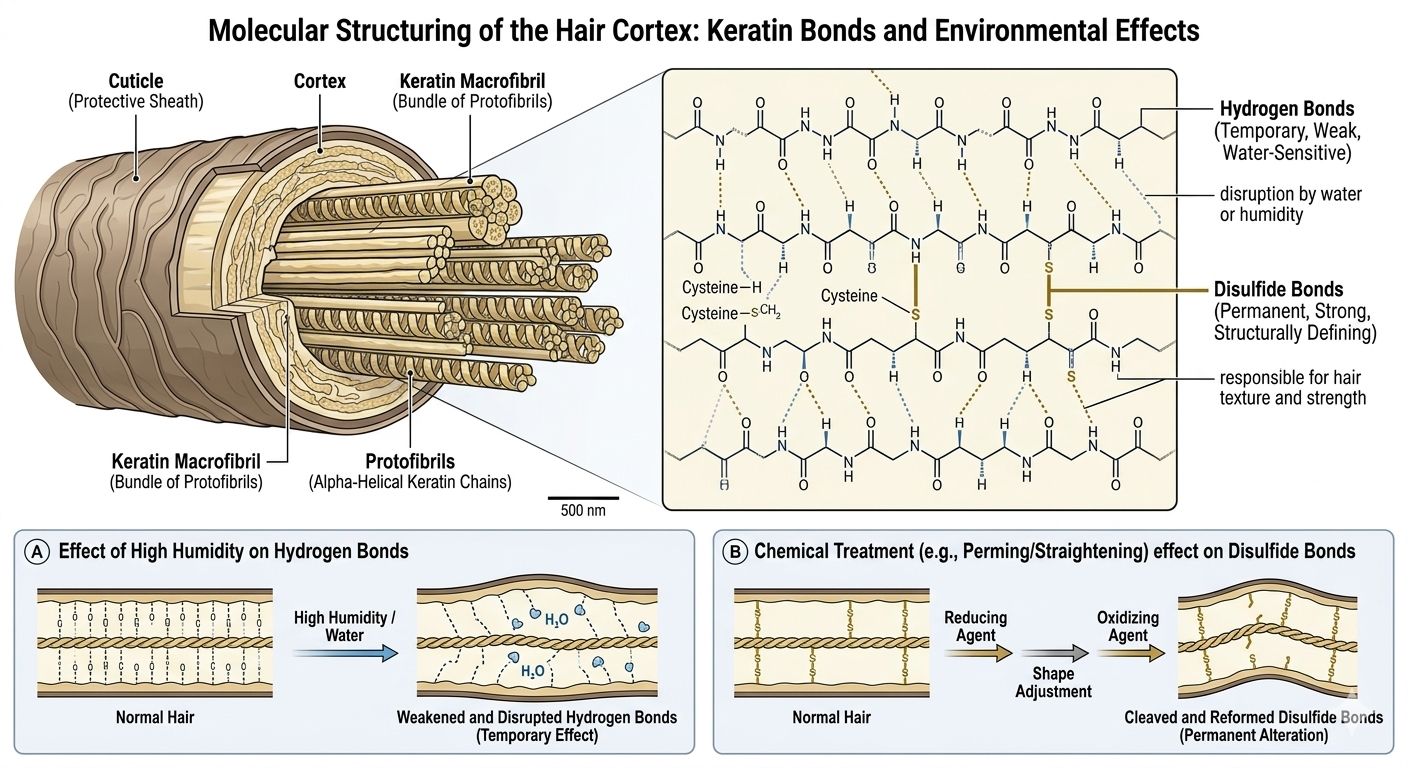
Several types of molecular bonds help maintain hair structure.
The most important are:
- hydrogen bonds
- disulfide bonds
Hydrogen bonds
These are temporary bonds affected by water and humidity.
They explain why:
- hair changes shape when wet
- straightened hair may become curly again in humidity
- temporary styling methods work
Disulfide bonds
These are much stronger and more permanent.
They help determine the natural curl pattern of the hair and are altered during chemical treatments such as:
- perms
- relaxers
- chemical straightening
Genetics is the primary determinant
Hair texture is strongly inherited.
Genes influence:
- follicle shape
- keratin structure
- growth angle
- follicle size
- curl pattern
Different populations around the world show characteristic variations in hair texture because of inherited follicular traits.
However, considerable variation exists within all populations.
Hair texture can change over time
Although genetics establishes the baseline texture, hair characteristics may change during life.
Factors influencing texture changes include:
- hormonal fluctuations
- ageing
- pregnancy
- menopause
- medications
- illness
- chemical treatments
For example:
- hair may become finer with age
- hormonal shifts may alter curl patterns
- repeated chemical processing may damage the cuticle and change texture temporarily
Curly hair behaves differently biologically
Curly hair often behaves differently from straight hair because of its structure.
Curved hair shafts:
- reflect light differently
- are more prone to dryness
- may tangle more easily
- can be more fragile mechanically
Natural scalp oils also travel less efficiently along curved fibres, which partly explains why curly hair often appears drier.
Hair diameter and texture are separate concepts
Hair texture and hair thickness are not identical.
A person may have:
- fine curly hair
- coarse straight hair
- thick wavy hair
Hair diameter depends mainly on follicle size, while texture depends largely on follicle shape and keratin organisation.
Environmental factors influence appearance
Humidity, heat, ultraviolet exposure, and grooming practices all affect how hair behaves.
Environmental moisture alters hydrogen bonds within the shaft, which explains why hair may:
- frizz
- flatten
- curl more strongly in humid conditions
Heat styling temporarily changes bond structure, allowing reshaping of the hair.
A highly individual biological trait
Hair texture and curl pattern result from the interaction of:
- follicle shape
- growth angle
- keratin distribution
- molecular bonding
- genetics
- hormonal influences
These factors determine how the hair shaft forms as it emerges from the follicle.
Understanding the biology behind hair texture helps explain why hair varies so widely between individuals and why texture may gradually evolve throughout life.
Author: Dr. Priya Goswami
Medical review: Dr. Denis Broun
Next step
If you notice coverage changes without increased shedding, confirm what process is occurring.
Take the Hair Assessment to have a physician review your pattern, identify whether miniaturization is present, and determine appropriate staging and next steps.

Add Comment