Hair grows on many parts of the human body, yet not all hair behaves in the same way. Scalp hair may grow for years and reach considerable lengths, while eyebrow hair, arm hair, or leg hair remains relatively short regardless of how long it is left uncut.
This difference is not primarily due to how fast the hair grows. Instead, it reflects differences in the duration of the hair growth cycle within follicles located in different regions of the body.
Understanding why scalp hair grows longer than body hair helps explain how hair follicles are biologically specialised depending on their location.
Hair follicles are region-specific
Although hair follicles share a common structure, follicles in different body areas are biologically distinct.
Scalp follicles differ from body follicles in:
- growth cycle duration
- hormonal sensitivity
- follicle depth
- hair shaft thickness
- pigmentation
- response to ageing and hormones
These regional differences are genetically programmed and begin during development before birth.
The hair growth cycle determines length
Hair length depends mainly on the duration of the anagen phase, which is the active growth phase of the hair cycle.
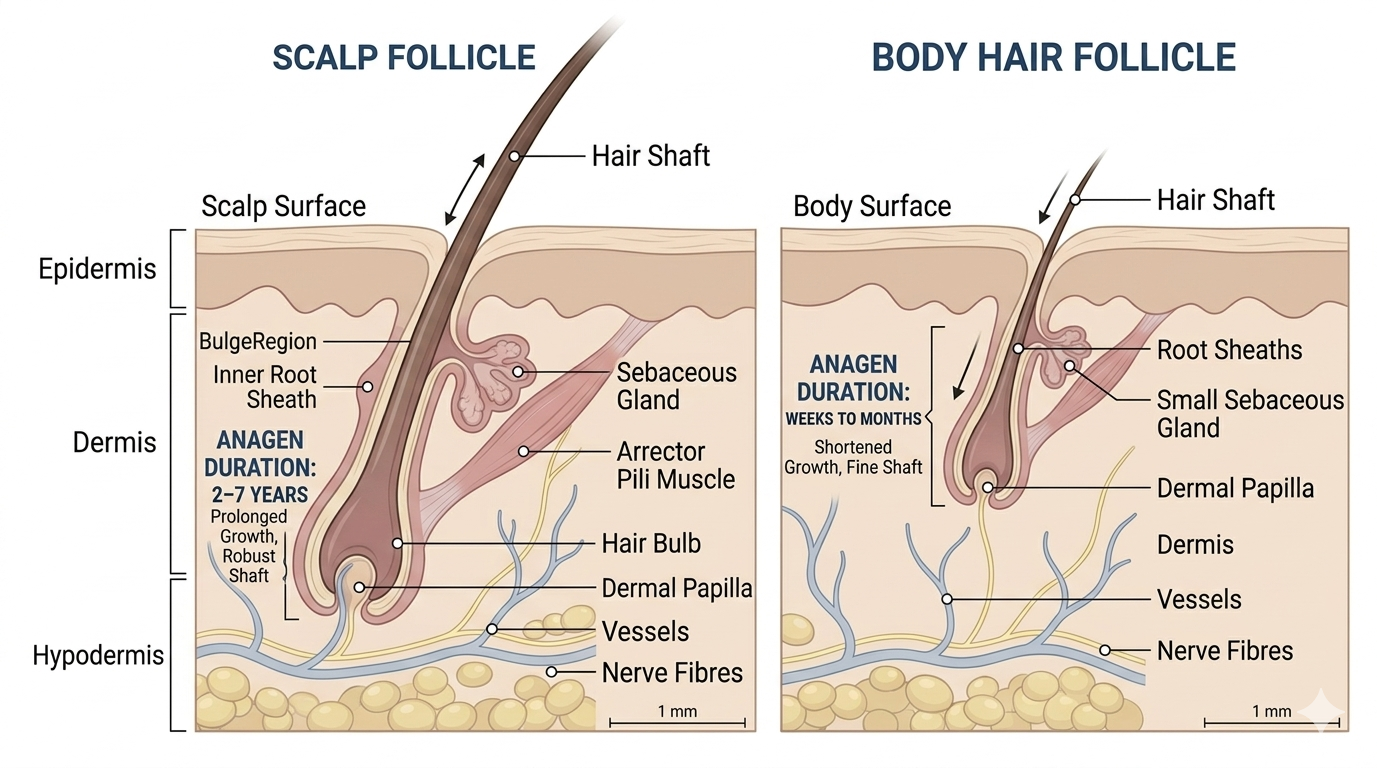
During anagen:
- the follicle continuously produces a growing hair shaft
- cells in the hair bulb divide rapidly
- the hair elongates progressively
The longer a follicle remains in anagen, the longer the hair can become.
Scalp hair has a very long anagen phase
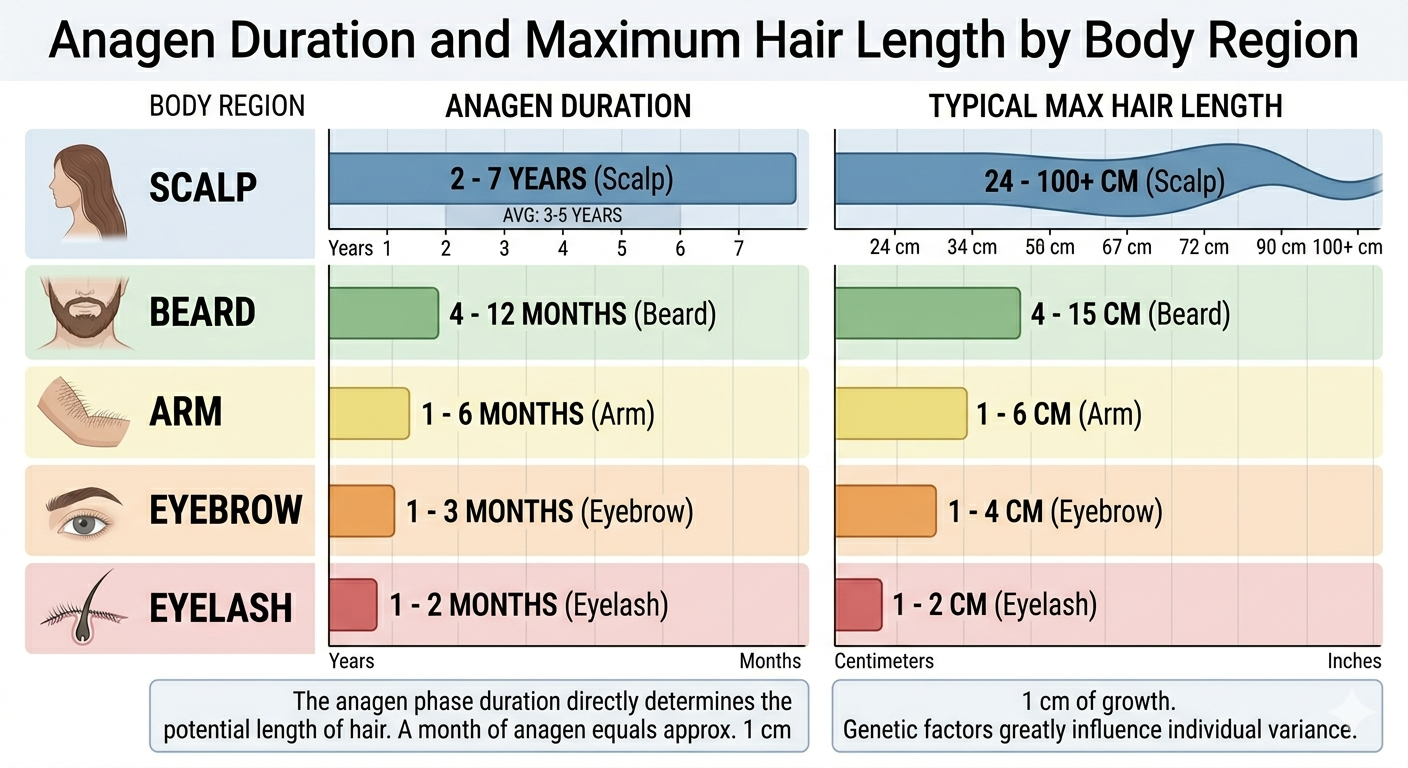
Scalp follicles typically remain in the growth phase for several years.
In many individuals, scalp anagen lasts:
- between two and seven years
- sometimes even longer
Because the follicle continues producing hair throughout this time, scalp hair can grow to substantial lengths if left uncut.
This prolonged growth phase is one of the defining biological features of scalp follicles.
Body hair has a much shorter growth phase
Body hair follicles behave differently.
Hair on areas such as:
- arms
- legs
- eyebrows
- eyelashes
- torso
usually remains in the growth phase for only weeks or months.
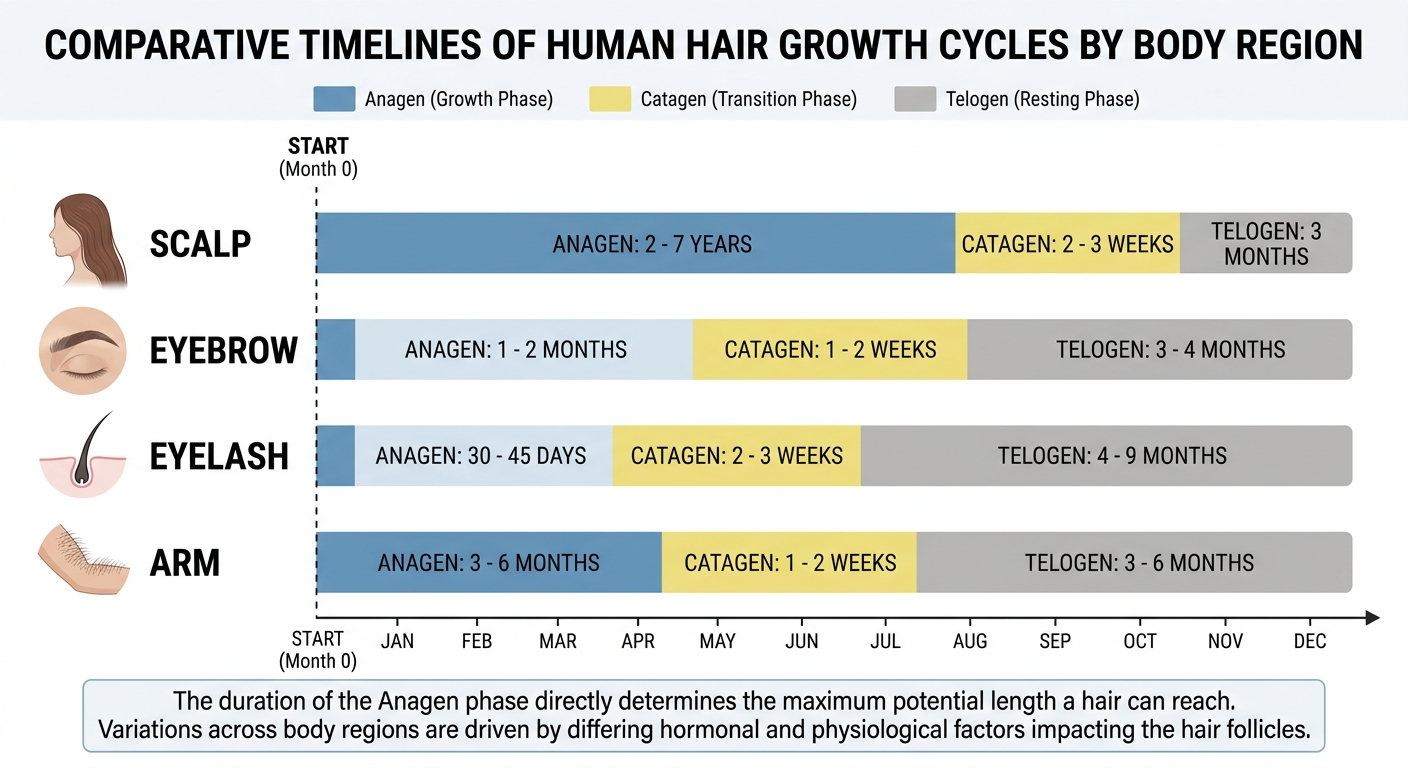
As a result, these hairs stop growing relatively quickly and enter the resting phase before reaching long lengths.
Even though body hair may grow at a similar daily rate initially, the short duration of growth limits its final length.
Eyebrows and eyelashes as examples
Eyebrows and eyelashes illustrate this principle clearly.
Their growth phases are extremely short compared with scalp hair.
This biological design helps:
- protect the eyes
- prevent excessive hair length in sensitive areas
If eyebrow follicles had the same growth cycle as scalp follicles, eyebrow hair would continue growing for years.
Growth speed is not the main difference
Many people assume scalp hair grows faster than body hair.
In reality, the actual daily growth rate is relatively similar across many body regions.
The key difference is:
- how long the follicle continues producing hair before stopping
A follicle that grows hair for five years naturally produces longer hair than one that grows for only two months.
Hormones influence regional hair behaviour
Hormones also affect how follicles behave in different regions.
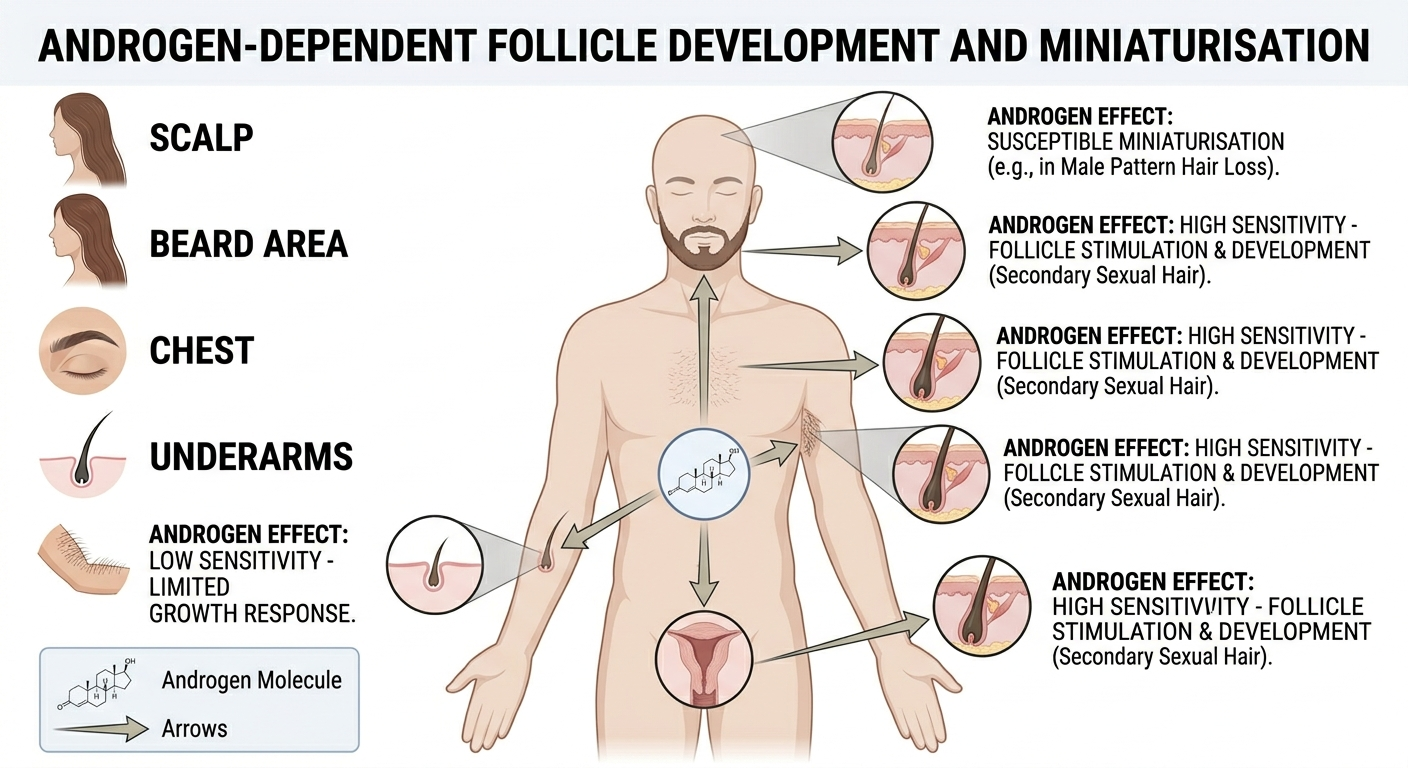
During puberty, androgen hormones stimulate certain body follicles to:
- enlarge
- produce thicker terminal hairs
- become more active
This occurs particularly in:
- beard areas
- chest
- underarms
- pubic regions
Interestingly, the same hormones that stimulate beard growth may contribute to scalp follicle miniaturisation in genetically susceptible individuals.
Follicle shape and hair type differ
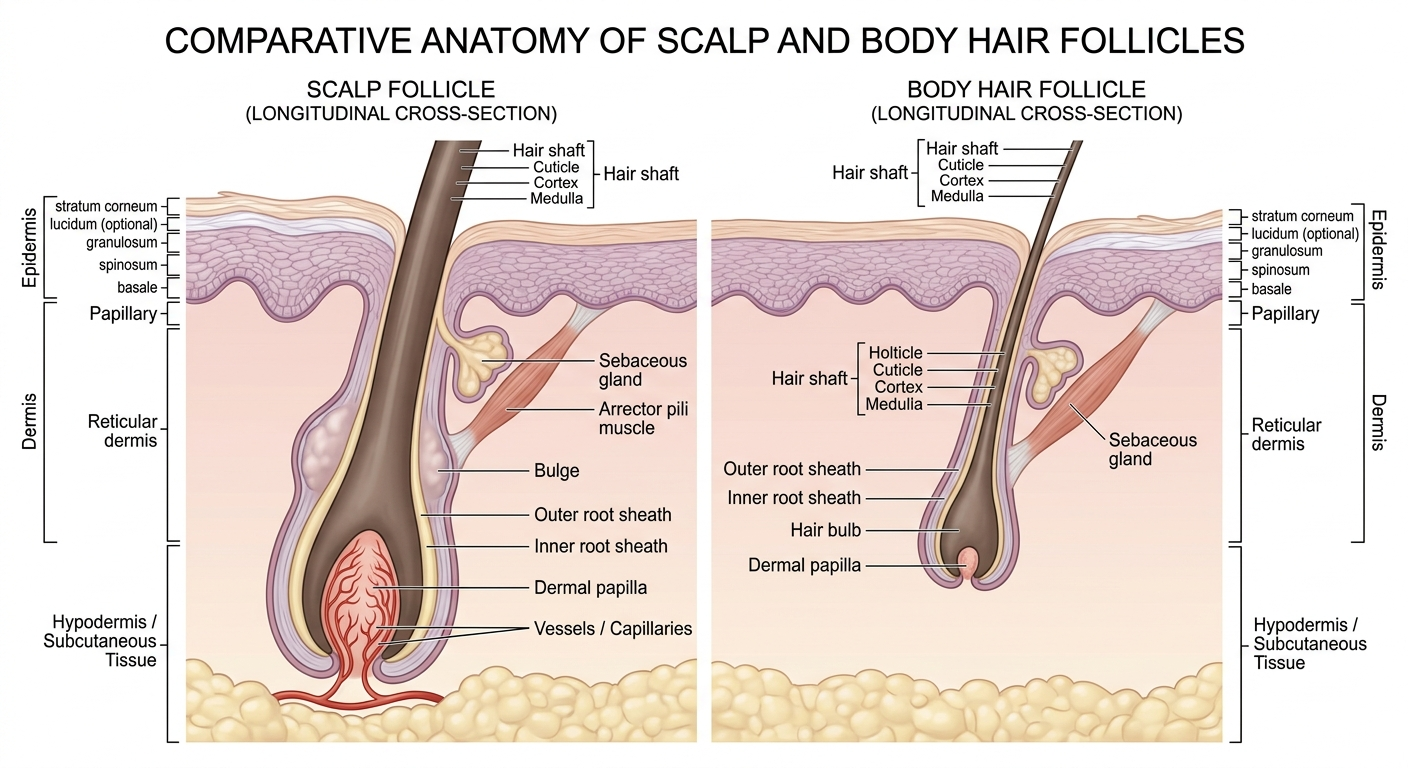
Scalp follicles are usually:
- deeper
- larger
- more robust
than many body follicles.
They produce thick terminal hairs designed for:
- insulation
- ultraviolet protection
- mechanical protection of the scalp
Body follicles often produce finer hair suited to different biological roles.
Evolutionary and protective functions
Hair distribution evolved differently across body regions depending on functional needs.
Scalp hair provides:
- thermal insulation
- protection from sunlight
- cushioning for the scalp
Long scalp hair likely offered evolutionary advantages related to temperature regulation and protection.
By contrast, excessively long body hair would provide little additional advantage in many regions.
Why scalp hair changes with age
Although scalp follicles are designed for prolonged growth, ageing and hormonal influences can gradually shorten the anagen phase.
This is one reason why:
- hair may not grow as long with age
- density may decrease over time
- follicles may produce shorter hairs in androgenetic alopecia
Changes in growth cycle duration therefore influence not only hair length but also visible density.
A specialised biological design
Scalp hair grows longer than body hair because scalp follicles remain in the active growth phase for far longer periods.
The duration of the hair growth cycle is genetically programmed according to the location and function of each follicle. Hormonal influences, follicle structure, and regional biology all contribute to these differences.
Understanding these variations helps explain why hair behaves differently across the body and why changes in the growth cycle can significantly alter hair appearance over time.
Author: Dr. Priya Goswami
Medical review: Dr. Denis Broun
Next step
If you notice coverage changes without increased shedding, confirm what process is occurring.
Take the Hair Assessment to have a physician review your pattern, identify whether miniaturization is present, and determine appropriate staging and next steps.
Add Comment