Hair changes throughout life. In childhood, the scalp often appears full and dense. During adulthood, hair characteristics gradually evolve, and many people notice that their hair becomes less thick or less voluminous over time.
These changes are usually gradual and reflect alterations in how hair follicles function during ageing. Hair density may decrease because individual hairs become finer, because fewer follicles remain active at the same time, or because the hair growth cycle changes.
Understanding why hair density changes with age requires looking closely at the biology of the hair follicle and the dynamics of the hair growth cycle.
Hair density and follicle number
Hair density refers to the number of hair shafts present within a given area of the scalp.
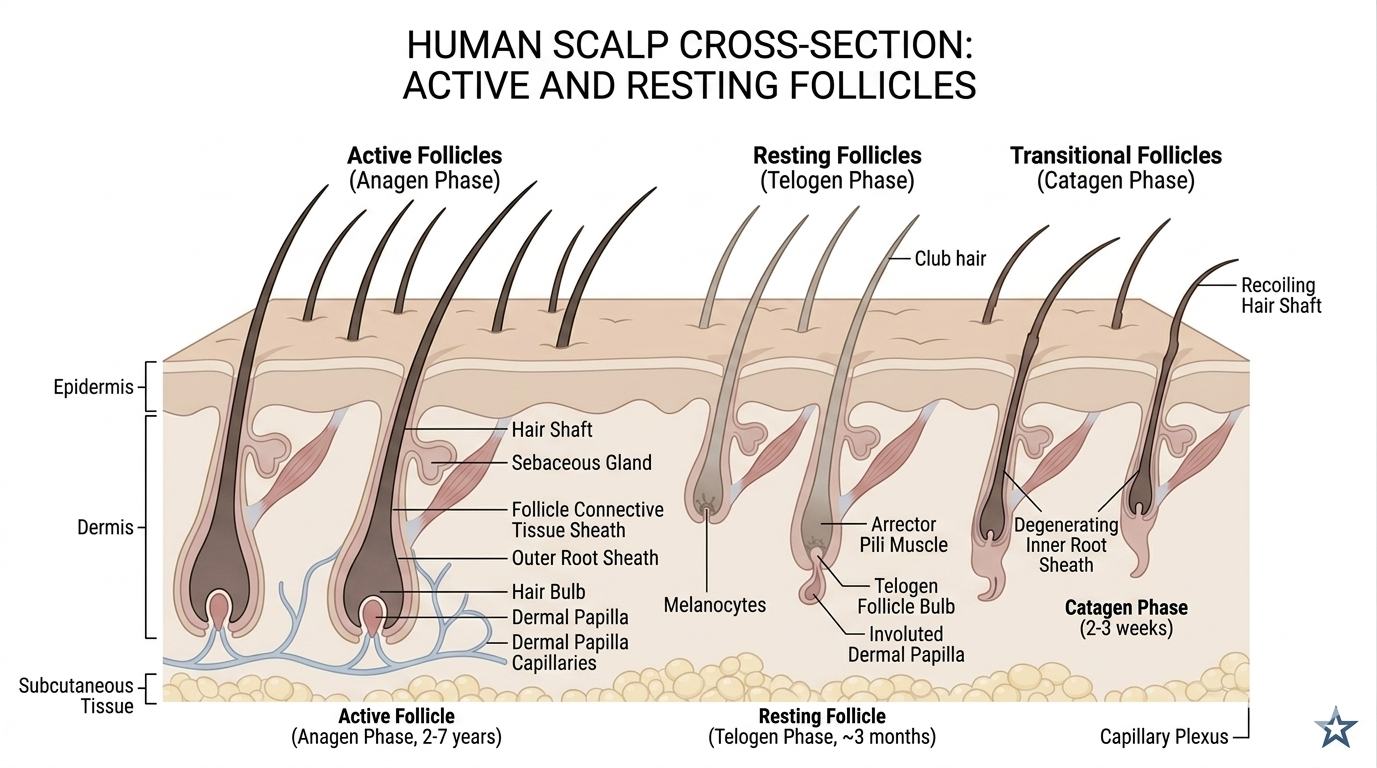
The total number of follicles on the scalp is largely determined before birth. Humans are born with a finite number of hair follicles, and new follicles are generally not created later in life.
Although follicles remain present for many years, their activity can change over time.
Hair density therefore depends not only on how many follicles exist, but also on how actively those follicles produce visible hair.
Hair thickness also influences density
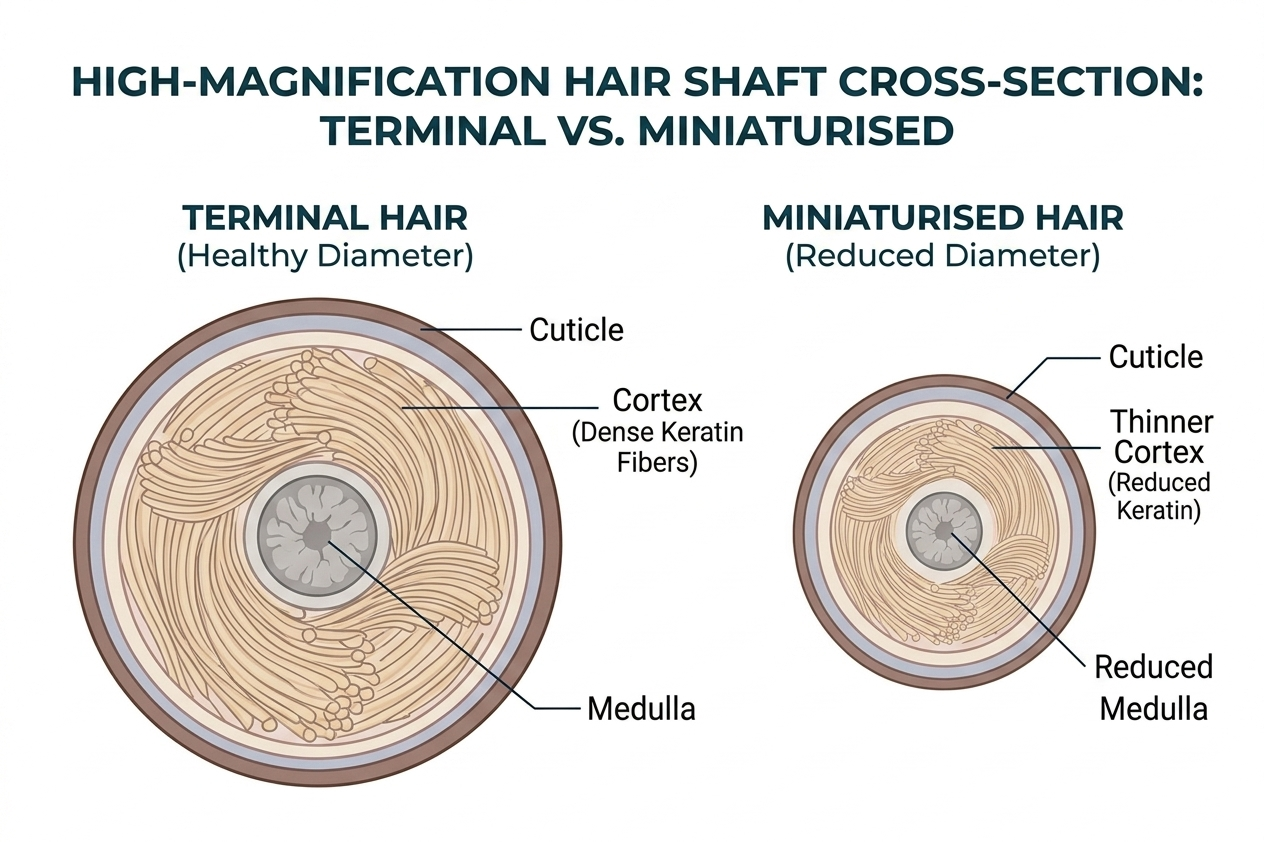
The visible appearance of hair density depends heavily on hair shaft thickness.
Even when the number of follicles remains stable, finer hairs provide less scalp coverage. A scalp with many thin hairs may therefore appear less dense than a scalp with fewer thick hairs.
This is one reason why hair can appear thinner with age even without major follicle loss.
Age-related changes in follicles
As follicles age, several biological changes may occur.
The dermal papilla, which helps regulate follicle activity, may become less efficient over time. Cellular activity within the hair bulb can gradually decrease, and some follicles may spend more time in resting phases of the hair cycle.
These changes can influence:
- hair shaft thickness
- hair growth duration
- pigmentation
- the number of actively growing hairs
The result is often a gradual reduction in overall hair volume.
The growth phase becomes shorter
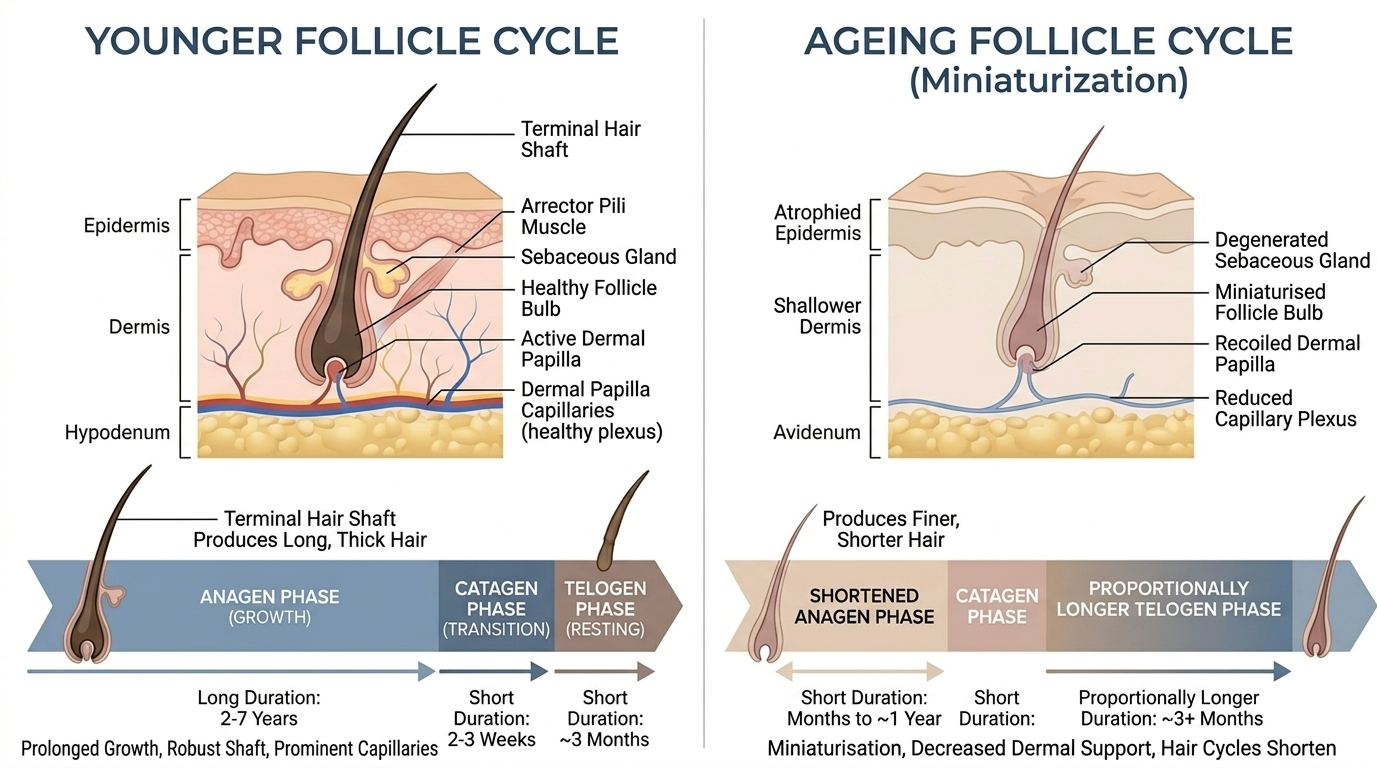
One important change associated with ageing is a shortening of the anagen phase, the active growth stage of the hair cycle.
In younger individuals, scalp hair may remain in the growth phase for several years. This allows hairs to become long and thick.
With age, the growth phase may gradually shorten. As a result:
- hairs may not grow as long
- hair shafts may become thinner
- more follicles may spend time resting rather than growing
These changes contribute to reduced hair density.
More follicles enter resting phases
The telogen phase, or resting phase, may become relatively longer with age.
When a larger proportion of follicles are resting rather than actively growing, scalp coverage decreases slightly. Even without visible shedding, the scalp may gradually appear less dense.
Because the process develops slowly, many people notice these changes only over several years.
Hair shaft miniaturisation
In some individuals, follicles gradually produce finer hairs over time.
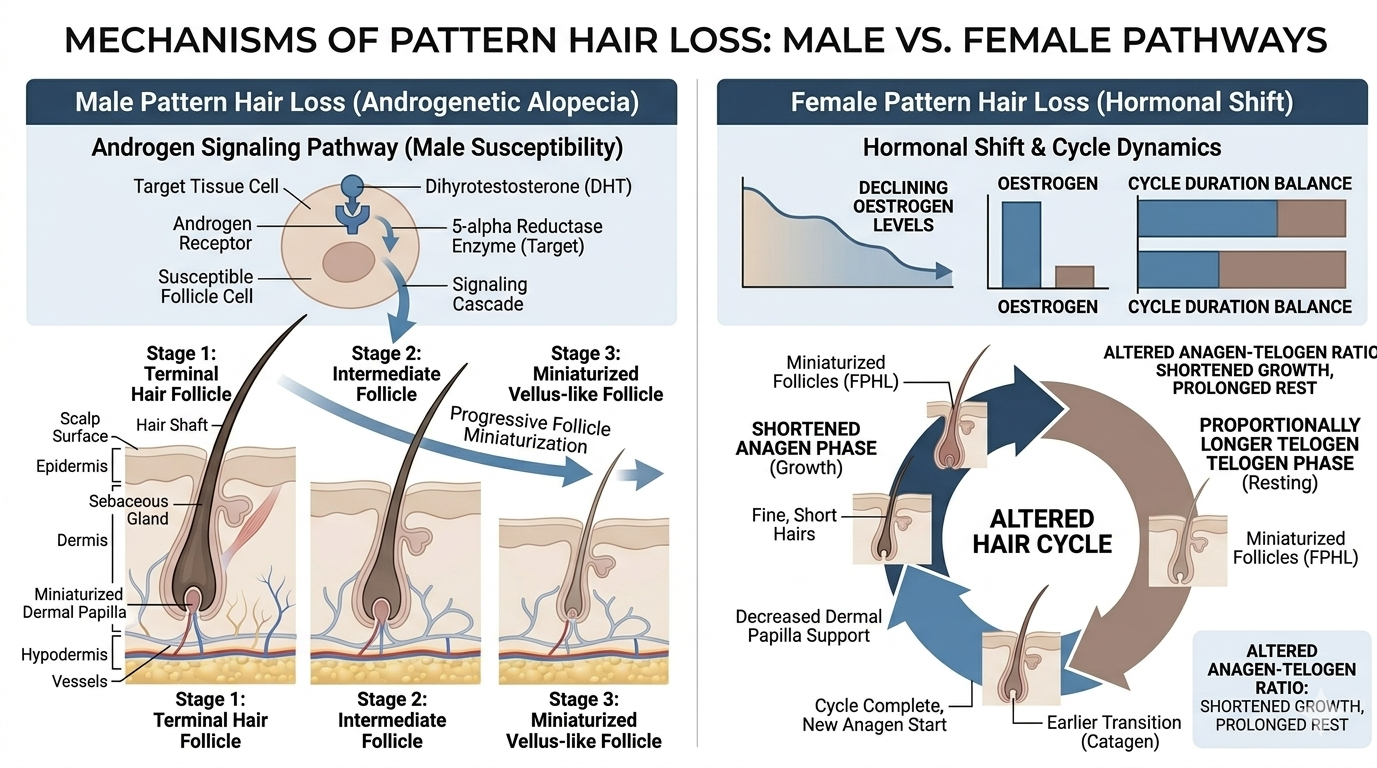
This process resembles mild follicle miniaturisation and may occur naturally with ageing even without classic androgenetic alopecia.
The reduction in hair shaft diameter means that each strand provides less visible coverage. Hair may feel lighter, flatter, or less voluminous.
These changes often become more noticeable under bright lighting or when the hair is wet.
Pigment loss and perceived density
Hair colour also influences how dense hair appears.
As hair loses pigment and becomes grey or white, light passes through the hair differently. Grey hair may reflect more light and provide less visual contrast against the scalp.
This optical effect can make the scalp appear more visible even when follicle numbers remain stable.
Hormonal influences with age
Hormonal changes also affect hair density over time.
In men, prolonged exposure of susceptible follicles to androgen-related signals can contribute to gradual miniaturisation. In women, hormonal changes associated with menopause may alter the balance of the hair growth cycle and affect follicle activity.
These influences vary considerably between individuals.
Some people retain relatively dense hair throughout life, while others experience more noticeable thinning.
Distinguishing ageing from pathological hair loss
Age-related changes in density are usually gradual and diffuse.
This differs from conditions such as:
- androgenetic alopecia
- alopecia areata
- telogen effluvium
- inflammatory scalp disorders
These conditions may produce more specific patterns of thinning, patchy loss, or sudden shedding.
Understanding the difference helps place normal age-related changes into context.
A gradual biological process
Changes in hair density with age reflect the combined effects of:
- altered follicle activity
- shortening of the growth phase
- increased resting time
- finer hair production
- hormonal influences
- pigment changes
Because hair follicles function through long biological cycles, these changes usually develop slowly over decades rather than appearing suddenly.
Recognising the biology behind age-related hair changes helps explain why hair density evolves naturally throughout life.
Author: Dr. Priya Goswami
Medical review: Dr. Denis Broun
Next step
If you notice coverage changes without increased shedding, confirm what process is occurring.
Take the Hair Assessment to have a physician review your pattern, identify whether miniaturization is present, and determine appropriate staging and next steps.
Add Comment