Hair is often thought of as something simple. A strand that grows from the scalp, gets longer, and eventually falls out. In reality, the process behind that strand is much more complex. Each hair grows from a small biological structure in the skin known as a hair follicle. This follicle functions almost like a tiny organ. It produces the hair shaft, regulates when hair grows, and responds to signals from the body.
Understanding how the follicle works helps explain why hair thickness varies between people, why hair grows in cycles, and why certain conditions lead to thinning or hair loss.
The structure of a hair follicle
A hair follicle sits beneath the surface of the skin. It begins in the outer layer of the skin and extends down into the deeper layers of the dermis.
The follicle is not a simple tube. It contains several specialised structures that work together to produce hair.
At the base of the follicle is the hair bulb. This is the active growth centre where new hair cells are formed. Cells within the bulb divide rapidly and gradually build the structure of the hair shaft.
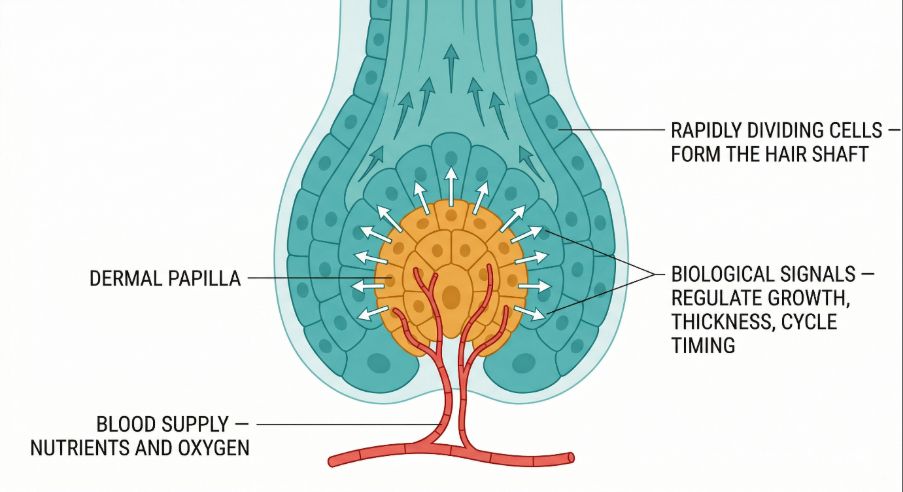
Inside the bulb is another important structure known as the dermal papilla. The dermal papilla contains blood vessels that deliver nutrients and oxygen to the growing hair. It also produces signalling molecules that influence how the follicle behaves.
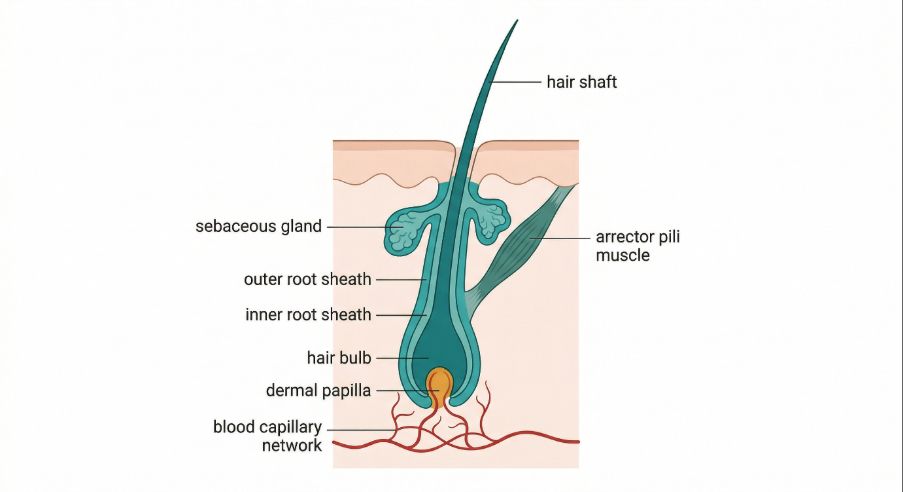
Surrounding the bulb are layers of cells that guide the formation of the hair shaft and determine its shape and strength.
Higher up in the follicle lies the hair shaft, the portion of hair that eventually emerges from the skin and becomes visible.
How the hair shaft is formed
Hair is produced through a process in which specialised cells multiply and gradually transform into the hardened structure of the hair shaft.
At the base of the follicle, cells in the hair bulb divide rapidly. As these cells move upward within the follicle, they begin to change. They fill with a protein called keratin, which gives hair its strength and durability.
During this upward movement, the cells lose their internal structures and harden into the fibrous material that forms the hair shaft.
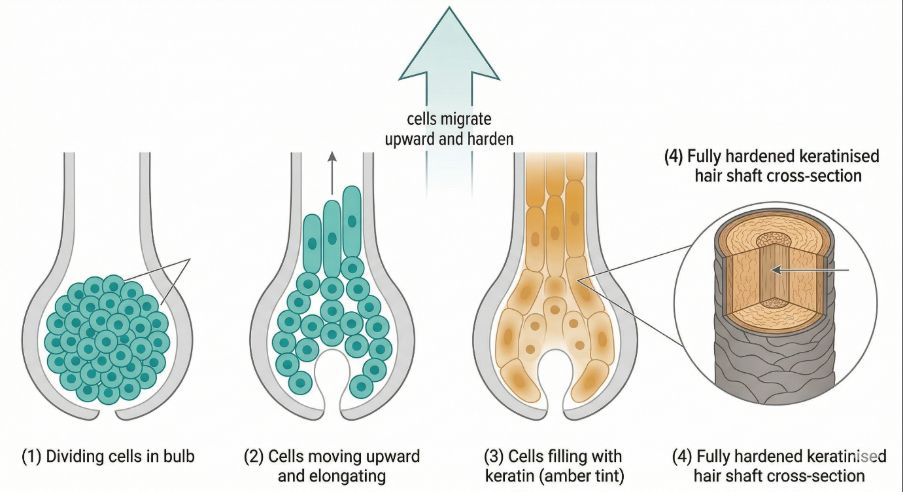
By the time the hair emerges from the skin, the cells are no longer living tissue. The visible strand of hair is made of hardened keratin fibres.
The role of the dermal papilla
The dermal papilla plays a central role in regulating hair growth.
This structure sits at the base of the follicle and is connected to the body’s blood supply. Through this connection it delivers oxygen, nutrients, and signalling molecules that influence the activity of the follicle.
Signals from the dermal papilla help determine:
- how long the hair grows
- how thick the hair shaft becomes
- when the follicle begins or ends a growth cycle
Because of this role, the dermal papilla is often considered the control centre of the follicle.
Why follicles grow hair in cycles
Hair follicles do not produce hair continuously. Instead, they follow a repeating biological rhythm known as the hair growth cycle.
During the growth phase, the follicle actively produces a hair shaft. This is followed by a short transition period and then a resting phase.
Once the resting phase ends, the follicle begins producing a new hair and the cycle repeats.
Each follicle operates independently. Some follicles are actively growing hair while others are resting or preparing to shed a hair.
This staggered pattern allows the scalp to maintain continuous hair coverage rather than losing large amounts of hair at once.
Why hair thickness varies
Not all hair follicles produce the same type of hair.
Some follicles produce terminal hair, which is thick and pigmented. This type of hair is typically found on the scalp, beard, and other areas where hair growth is more pronounced.
Other follicles produce vellus hair, which is much finer and lighter in colour.
The size of the follicle and the activity of its growth centre influence the thickness of the hair shaft. Larger follicles tend to produce thicker hair strands, while smaller follicles produce finer hairs.
Genetic factors play an important role in determining follicle size and hair characteristics.
How follicles respond to hormones
Hair follicles are sensitive to signals from hormones circulating in the body.
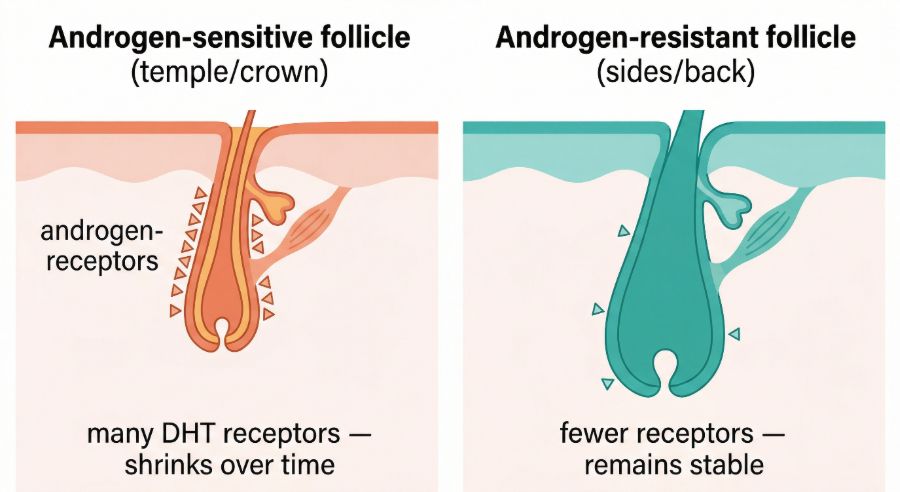
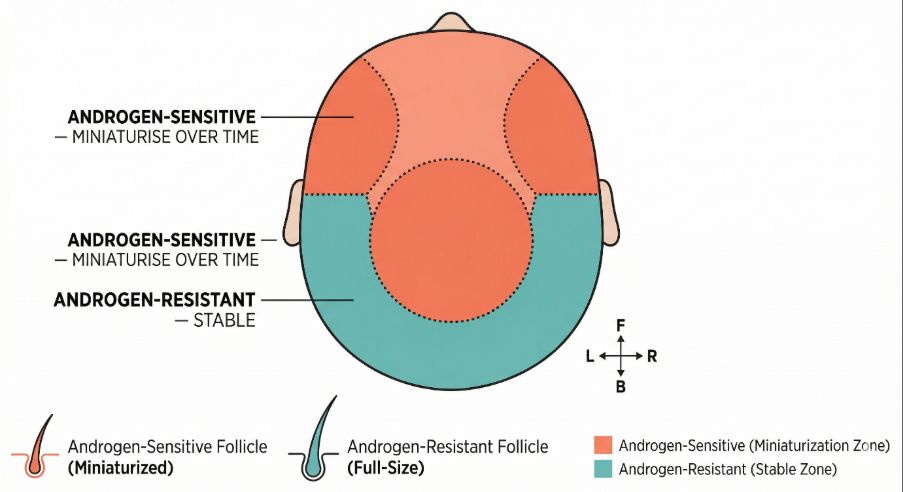
Certain hormones, particularly androgens, influence how follicles behave in different regions of the scalp. In individuals who are genetically susceptible, some follicles respond strongly to these hormonal signals.
Over time, this response can gradually alter the behaviour of the follicle. The follicle may become smaller and produce thinner hair during each growth cycle.
This process is known as follicle miniaturisation, and it plays a central role in androgenetic alopecia, the most common form of hair loss.
Why hair loss patterns develop
Hair follicles across the scalp are not identical. Some areas are more sensitive to hormonal signals than others.
In androgenetic alopecia, follicles at the temples and crown often become progressively smaller, while follicles at the sides and back of the scalp tend to remain stable.
This difference in follicle sensitivity creates the characteristic patterns of hair loss described by systems such as the Norwood scale.
The patterns seen in these classifications reflect the behaviour of follicles in different regions of the scalp.
How follicles regenerate after shedding
Even when a hair sheds, the follicle usually remains alive beneath the skin.
After a resting period, the follicle can begin a new growth cycle and produce another hair shaft. This regenerative ability allows hair to renew itself repeatedly throughout life.
However, when follicles gradually shrink over many cycles, the hair they produce may become thinner. Eventually, some follicles may produce very fine hairs that are barely visible.
Medications and chemical exposure
Certain medications can disrupt the hair growth cycle and contribute to hair loss or thinning. Drug categories known to affect the follicle include anticoagulants such as heparin and warfarin, antihypertensive agents including beta-blockers, retinoids, hormonal treatments, and oncology drugs. Cytotoxic chemotherapy agents are particularly notable — they can directly impair the anagen phase, causing rapid and pronounced hair loss within weeks of treatment beginning.
Chemical exposures are a further recognised cause. Heavy metals including thallium, arsenic, and mercury can damage follicle function, with exposure occurring through occupational contact, contaminated environments, or ingestion. Industrial solvents and aggressive chemical hair treatments may similarly impair follicle health. Identifying and removing the causative substance is the primary step toward allowing the hair cycle to normalise.
What researchers are studying
Although the basic structure of the follicle is well understood, scientists continue to study how follicles regulate hair growth.
Current research is exploring several areas.
One area involves the molecular signals that control the hair growth cycle. Researchers are studying how these signals determine when follicles begin or end a growth phase.
Another area of interest is the interaction between hormones, genetic factors, and the follicle environment.
Scientists are also investigating how stem cells within the follicle contribute to hair regeneration and how these cells might be influenced in different hair disorders.
These areas of research may help improve understanding of hair loss conditions and how follicles respond to different biological signals.
A practical perspective
The hair follicle is a complex structure responsible for producing and regulating hair growth. It contains specialised cells and signalling systems that control when hair grows, how thick it becomes, and when it eventually sheds.
Although the visible strand of hair is composed of hardened protein, the activity that produces it occurs deep within the skin.
Understanding how follicles function provides important insight into why hair grows in cycles, why hair characteristics vary between individuals, and how certain biological processes can lead to hair thinning over time.
Author: Dr. Priya Goswami
Medical review: Dr. Denis Broun
Next step
If you notice coverage changes without increased shedding, confirm what process is occurring.
Take the Hair Assessment to have a physician review your pattern, identify whether miniaturization is present, and determine appropriate staging and next steps.

Add Comment