Hair thinning in women often develops differently from the patterns typically seen in men. Instead of a receding hairline or bald patches, many women experience a gradual reduction in hair density across the top of the scalp. The hairline at the forehead is usually preserved, while the central part of the scalp becomes wider over time.
To describe this pattern in a consistent way, clinicians often use the Ludwig scale. This classification system helps describe the extent and distribution of hair thinning in women with female pattern hair loss, a form of androgenetic alopecia.
The Ludwig scale does not diagnose the cause of hair loss. Instead, it provides a framework for describing how hair thinning appears on the scalp.
The origin of the Ludwig scale
The Ludwig scale was introduced by the German dermatologist Erich Ludwig in the 1970s. Ludwig observed that many women with androgenetic alopecia did not develop the same patterns of hair loss seen in men.
Instead of temple recession and crown baldness, these women experienced progressive thinning across the central scalp. The frontal hairline often remained intact even as the density of hair decreased behind it.
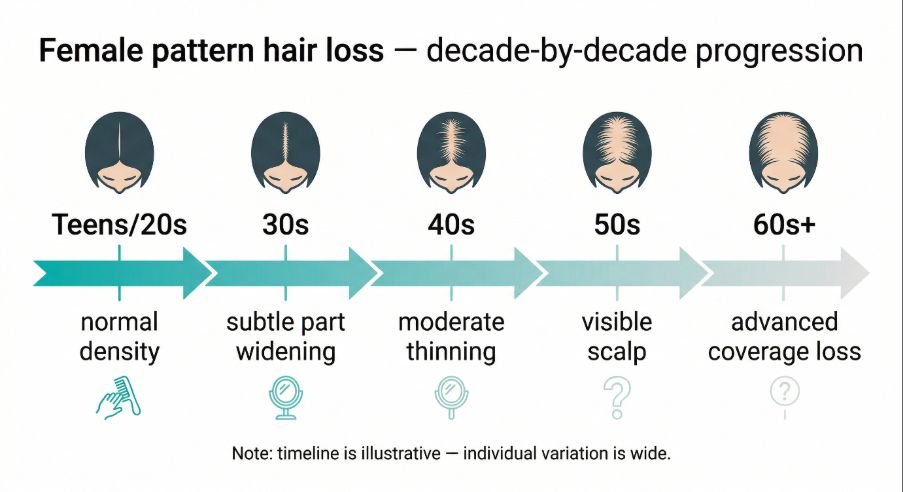
Ludwig described a classification system that divided this pattern of thinning into several stages. The system helped clinicians communicate the severity of hair loss and compare observations over time.
The hair growth cycle
Female pattern hair loss involves gradual changes in the hair growth cycle. Understanding these phases helps explain how diffuse thinning develops.
Each hair follicle on the scalp operates within a repeating three-phase biological cycle that governs how long and thick the hair can grow, and when it is shed.
- The anagen phase is the active growth period, lasting two to six years on the scalp. The duration of this phase directly determines the length and thickness of the hair shaft. Approximately 85 to 90 percent of scalp hairs are in anagen at any given moment.
- The catagen phase is a brief transitional period of approximately two to three weeks, during which the follicle shrinks and detaches from its blood supply.
- The telogen phase is the resting period, lasting approximately three months, after which the hair is shed and the follicle re-enters anagen to begin a new cycle. Because follicles cycle independently of one another, shedding is distributed gradually throughout the day rather than occurring all at once.
What the Ludwig scale measures
The Ludwig scale focuses primarily on changes in hair density across the central scalp.
Rather than measuring individual hairs or follicles, the scale evaluates how much the scalp becomes visible through the hair. As follicles produce thinner hair during successive growth cycles, the overall coverage of the scalp gradually decreases.
This process leads to a widening of the central part line and a reduction in hair volume across the top of the head.
The Ludwig scale describes these changes in three main stages.
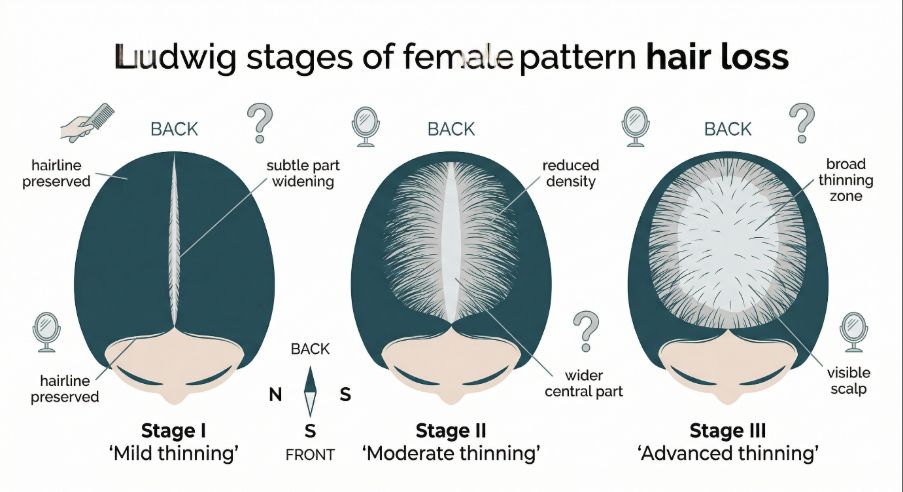
Stage I: early thinning
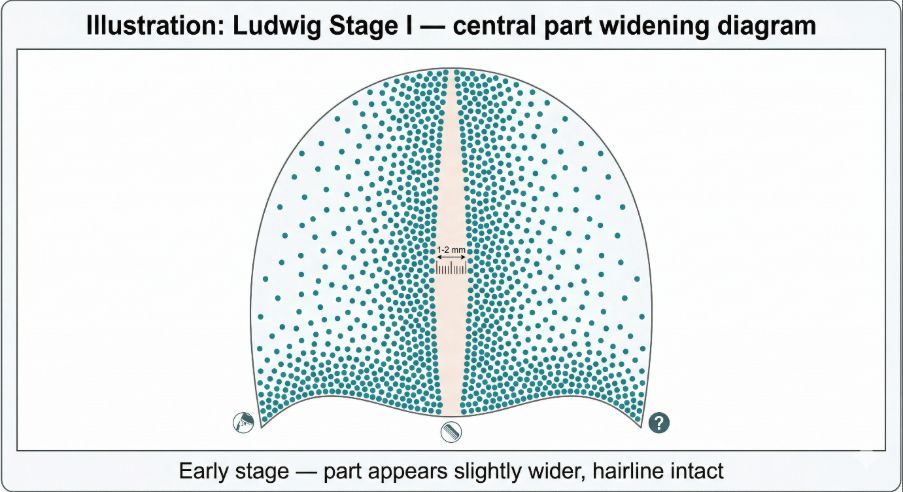
In the first stage of the Ludwig scale, thinning is usually mild and may be difficult to notice initially.
The hairline at the forehead remains stable, but the central part line may begin to appear slightly wider. Hair density across the top of the scalp may decrease subtly, particularly under bright lighting.
At this stage the overall appearance of the hair often remains relatively full, and the thinning may only be noticed when the hair is parted or styled in a certain way.
Many women at this stage continue to have substantial hair coverage.
Stage II: moderate thinning
In the second stage, the reduction in hair density becomes more visible.
The central part line widens further, and the scalp may become easier to see through the hair. The thinning typically extends across the upper portion of the scalp but still spares the frontal hairline.
Hair volume may appear noticeably reduced, especially when the hair is wet or styled flat against the scalp.
Despite the visible thinning, the scalp is usually still covered by hair, and complete baldness is uncommon.
Stage III: advanced thinning
The third stage of the Ludwig scale describes more pronounced thinning across the top of the scalp.
At this stage the reduction in hair density may make the scalp clearly visible through the remaining hair. The thinning is often most apparent along the central scalp and may extend toward the crown.
Even in this stage, however, the frontal hairline is often preserved.
Unlike some forms of male pattern hair loss, complete baldness in women with androgenetic alopecia is relatively rare.
Differences between male and female pattern hair loss
The Ludwig scale highlights an important difference between male and female pattern hair loss.
In men, hair thinning often begins at the temples and crown, leading to distinct patterns that can progress to more extensive baldness. These patterns are described using systems such as the Norwood scale.
In women, thinning usually occurs more diffusely across the top of the scalp, while the frontal hairline remains largely intact.
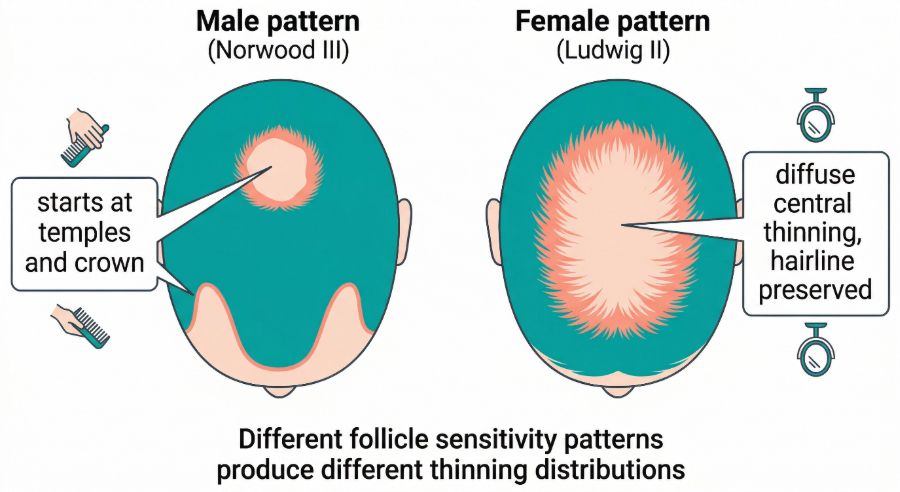
These differences reflect variations in how hair follicles respond to hormonal signals and genetic influences.
Why thinning occurs in female pattern hair loss
Female pattern hair loss involves gradual changes in the behaviour of hair follicles.
Over time, some follicles begin to produce thinner hair shafts during each growth cycle. The growth phase may also become shorter.
This process, known as follicle miniaturisation, leads to a gradual reduction in hair thickness and density.
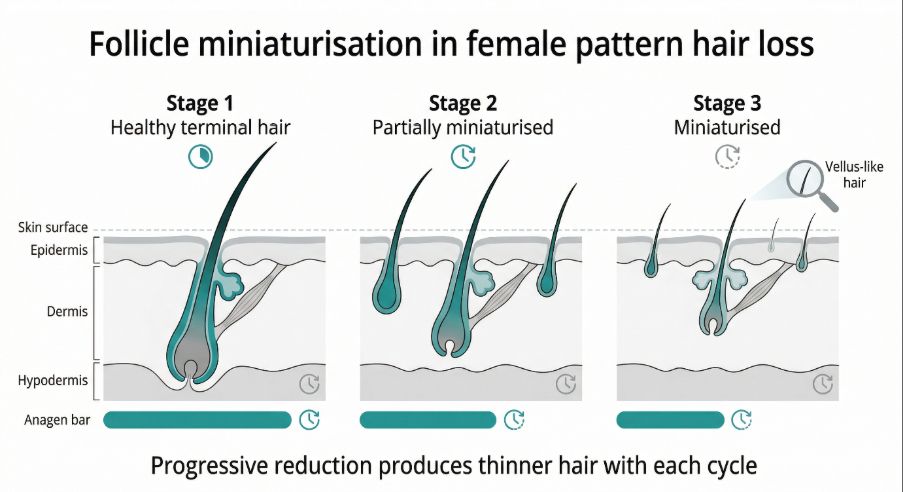
Because the change occurs slowly and affects many follicles at once, the thinning typically appears diffuse rather than forming distinct bald areas.
Medications and chemical exposure
Certain medications can disrupt the hair growth cycle and contribute to hair loss or thinning. Drug categories known to affect the follicle include anticoagulants such as heparin and warfarin, antihypertensive agents including beta-blockers, retinoids, hormonal treatments, and oncology drugs. Cytotoxic chemotherapy agents are particularly notable — they can directly impair the anagen phase, causing rapid and pronounced hair loss within weeks of treatment beginning.
Chemical exposures are a further recognised cause. Heavy metals including thallium, arsenic, and mercury can damage follicle function, with exposure occurring through occupational contact, contaminated environments, or ingestion. Industrial solvents and aggressive chemical hair treatments may similarly impair follicle health. Identifying and removing the causative substance is the primary step toward allowing the hair cycle to normalise.
Limitations of the Ludwig scale
Although the Ludwig scale is widely used, it has certain limitations.
The classification focuses primarily on the central pattern of thinning and may not fully describe all variations of female hair loss. Some women experience different patterns, including thinning that affects other areas of the scalp.
In addition, the scale does not measure the biological activity of follicles or the underlying cause of hair loss. It simply provides a visual framework for describing the extent of thinning.
For these reasons, clinicians often use the Ludwig scale together with clinical examination and medical history when evaluating hair loss.
A practical perspective
The Ludwig scale is a simple classification system used to describe the typical pattern of hair thinning seen in many women with androgenetic alopecia.
By outlining stages of increasing hair thinning across the central scalp, the scale helps clinicians communicate the extent of hair loss and monitor changes over time.
While it does not explain the underlying causes of hair loss, it provides a useful reference for describing how female pattern hair thinning develops.
Author: Dr. Priya Goswami
Medical review: Dr. Denis Broun
Next step
If you notice coverage changes without increased shedding, confirm what process is occurring.
Take the Hair Assessment to have a physician review your pattern, identify whether miniaturization is present, and determine appropriate staging and next steps.

Add Comment