Hair thinning in many men and women develops gradually over time rather than occurring as sudden hair loss. One of the key biological processes behind this change is known as follicle miniaturisation . This process plays a central role in the most common form of hair thinning, called androgenetic alopecia.
Follicle miniaturisation refers to the gradual shrinking of the hair follicle. As the follicle becomes smaller, the hair it produces becomes thinner, shorter, and less visible on the scalp. Over many growth cycles, this process can significantly change the appearance of hair density.
Understanding follicle miniaturisation helps explain why hair thinning often develops slowly and why it tends to affect specific areas of the scalp.
The structure of a hair follicle
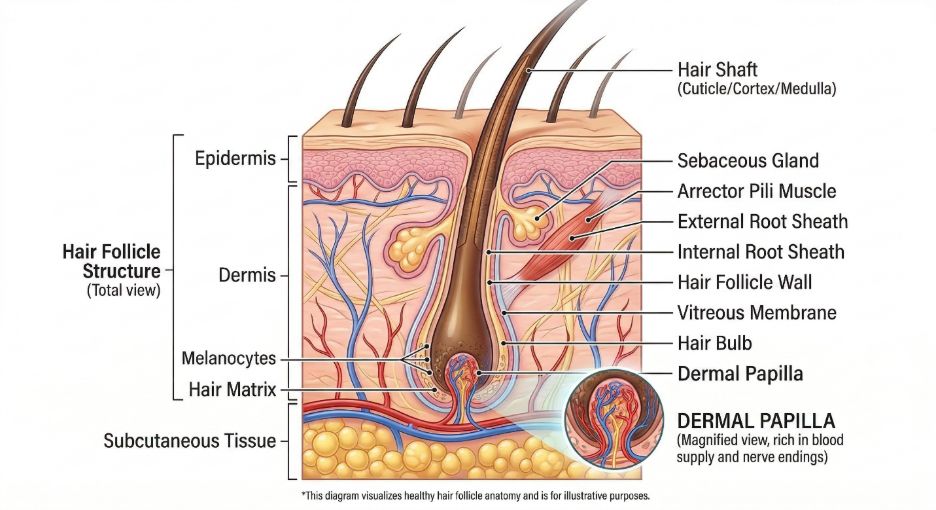
A hair follicle is a small structure located within the skin that produces the hair shaft. At the base of the follicle lies the hair bulb, where specialised cells divide and form the hair.
Within the bulb sits the dermal papilla, which supplies nutrients and biological signals that regulate hair growth. These signals influence how thick the hair shaft becomes and how long the follicle remains in the growth phase of the hair cycle.
Healthy follicles produce thick terminal hairs that provide visible coverage of the scalp.
How hair thickness is produced
The diameter of a hair strand depends largely on the size and activity of the follicle that produces it.
Large follicles generate thick hair shafts with a well-developed internal structure. These hairs are known as terminal hairs and are responsible for most of the visible coverage of the scalp.
Smaller follicles produce much finer hairs known as vellus hairs. These hairs are typically short, thin, and lightly pigmented.
The transition from terminal hair to vellus-like hair is a hallmark of follicle miniaturisation.
The process of miniaturisation
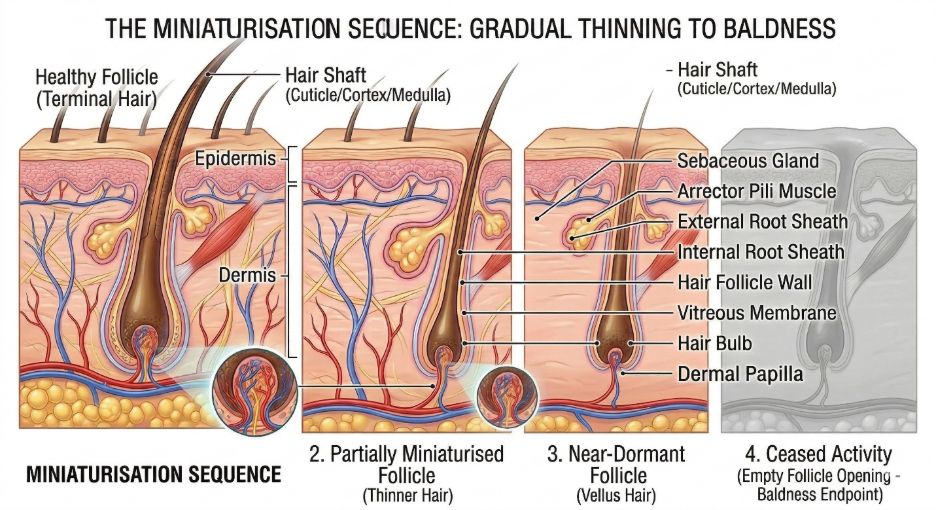
Miniaturisation occurs gradually over several hair growth cycles.
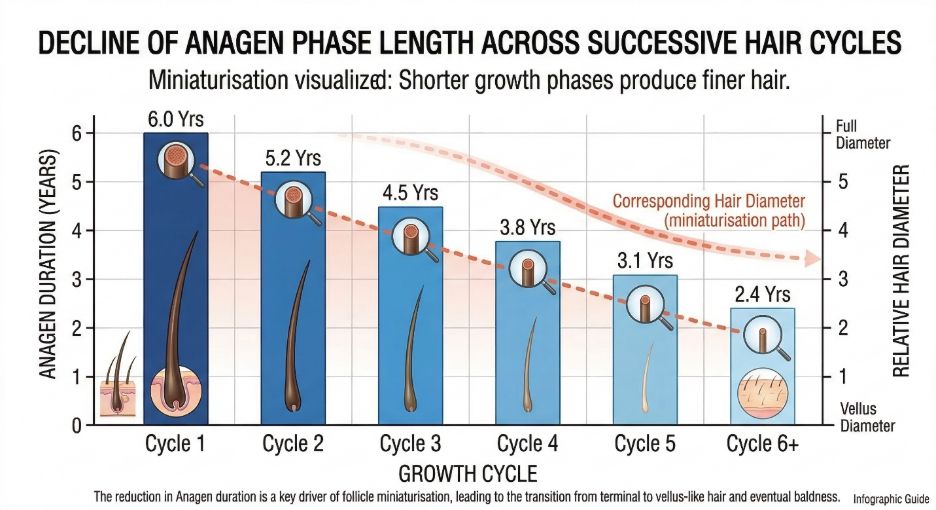
During each cycle, a follicle affected by androgenetic alopecia may produce a hair that is slightly thinner than the one produced in the previous cycle. The growth phase of the follicle may also become shorter.
As a result, the hair produced becomes both finer and shorter.
Over time, this progressive reduction in follicle size leads to the production of hairs that provide much less coverage of the scalp.
Why miniaturisation occurs
Follicle miniaturisation is strongly influenced by genetic factors and hormonal signals.
In individuals who are genetically predisposed, certain follicles are sensitive to specific hormonal influences. These signals gradually alter the behaviour of the follicle, causing it to shrink over successive growth cycles.
Not all follicles respond in the same way. Follicles located at the temples and crown are often more sensitive to these signals, which is why thinning in androgenetic alopecia usually begins in these areas.
Follicles on the sides and back of the scalp are often less sensitive and may remain relatively stable.
Changes in the hair growth cycle
Miniaturisation also affects the hair growth cycle.
In healthy follicles, the growth phase of the cycle can last several years. This allows the hair shaft to grow long and thick.
In miniaturised follicles, the growth phase becomes shorter. Because the hair spends less time growing, it may not reach the same thickness or length as before.
At the same time, the resting phase of the cycle may become relatively longer.
These combined changes gradually reduce the density and volume of hair in the affected areas.
How miniaturisation affects hair appearance
When a large number of follicles undergo miniaturisation, the visible appearance of the scalp changes.
Because each hair strand becomes thinner, the scalp may become more visible between hairs. Even though the number of follicles may not change significantly, the hair provides less coverage.
In the early stages, these changes may appear subtle. Over time, however, the reduction in hair thickness becomes easier to recognise.
The process typically develops slowly over many years.
Relationship to pattern hair loss
Miniaturisation is a defining feature of androgenetic alopecia.
In this condition, the gradual shrinking of hair follicles leads to the patterns of hair thinning commonly described using classification systems such as the Norwood scale in men or the Ludwig scale in women.
Because the follicles remain alive beneath the skin, the hair loss associated with miniaturisation is not the result of follicles disappearing but rather of follicles producing progressively finer hair.
However, in advanced stages of miniaturisation, a follicle may eventually cease to be active altogether. When this happens, the last hair it produced is shed in the normal course of the hair cycle and is not replaced by a new one. Because this occurs across a growing number of follicles over time, the scalp progressively loses coverage in the affected areas. This is the mechanism behind actual baldness: it is not simply that hairs become finer and shorter, but that follicles stop producing any hair at all, leaving areas of the scalp visibly bare rather than merely covered by barely visible vellus hairs.
How miniaturisation differs from shedding
Follicle miniaturisation is different from conditions that cause increased hair shedding.
In disorders such as telogen effluvium, a large number of hairs enter the resting phase of the hair cycle and are shed temporarily. The follicles themselves remain capable of producing normal hair once the cycle returns to balance.
Miniaturisation, by contrast, involves structural changes within the follicle that gradually reduce the thickness of the hair produced during each growth cycle.
Because the change occurs slowly, it often develops over many years.
A biological perspective
Follicle miniaturisation reflects gradual changes in the behaviour of hair follicles influenced by genetic and hormonal factors. As the follicles become smaller, the hairs they produce become thinner and shorter.
Although the follicles remain present beneath the skin, the reduction in hair thickness leads to visible thinning of the scalp over time.
Recognising this process helps explain why common forms of hair thinning develop gradually and why the appearance of hair density can change even when the number of follicles remains largely the same.
Author: Dr. Priya Goswami
Medical review: Dr. Denis Broun
Next step
If you notice coverage changes without increased shedding, confirm what process is occurring.
Take the Hair Assessment to have a physician review your pattern, identify whether miniaturization is present, and determine appropriate staging and next steps.

Add Comment