Hair thinning in men often follows patterns that have been observed and described for many decades. These patterns reflect how certain hair follicles gradually change their behaviour over time. One of the most widely used ways of describing this progression is the Norwood classification, a system that outlines the typical stages of male pattern hair loss.
The Norwood scale does not measure hair loss in terms of severity alone. Instead, it describes how hair thinning tends to appear and evolve across different areas of the scalp.
Understanding these stages can help place visible changes in hair growth into a broader biological context.
The hair growth cycle
Hair does not grow continuously. Each hair follicle operates according to a repeating biological cycle that consists of three distinct phases.
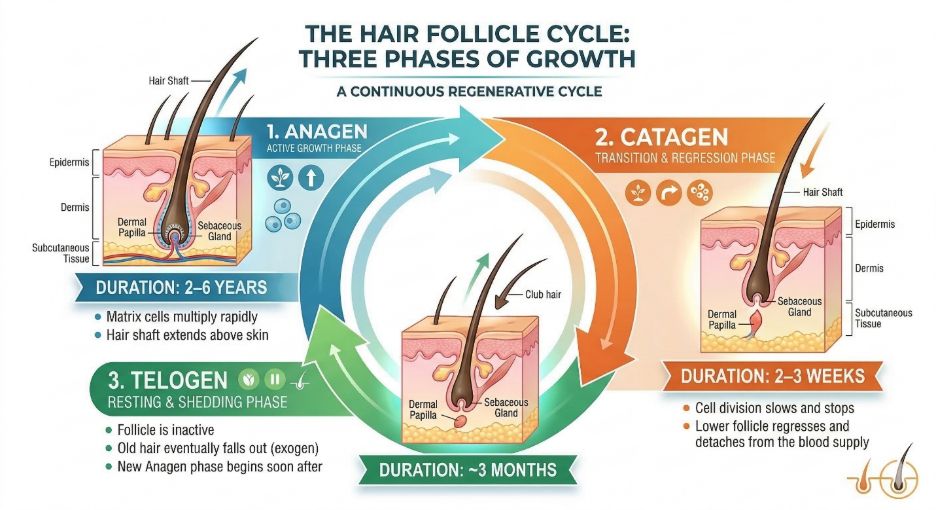
The first phase is the anagen phase, also known as the growth phase. During this period, the follicle actively produces a hair shaft. In healthy follicles on the scalp, the anagen phase can last between two and six years, which determines how long the hair is able to grow.
The second phase is the catagen phase, a short transitional period lasting approximately two to three weeks. During this phase, the follicle begins to shrink and detaches from its blood supply.
The third phase is the telogen phase, or resting phase. This period typically lasts around three months, during which the hair is retained in the follicle but no active growth occurs. At the end of this phase, the hair is shed and the follicle re-enters the anagen phase to begin a new cycle.
Because follicles cycle independently of one another, shedding is spread out naturally throughout the day and appears gradual. In male pattern hair loss, the progressive shortening of the anagen phase with each successive cycle is a key reason why hair becomes finer and shorter over time.
Why patterns appear in hair loss
Hair follicles across the scalp do not behave in exactly the same way.
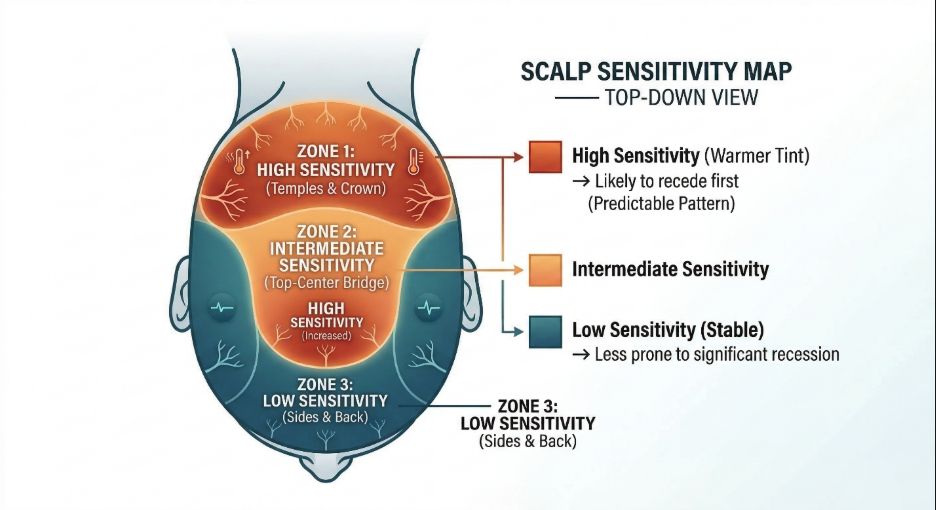
In individuals who are genetically predisposed to androgenetic alopecia, certain follicles are more sensitive to hormonal influences. These follicles gradually produce thinner hairs during successive growth cycles, a process known as follicleminiaturisation .
Because follicles in particular regions of the scalp are more sensitive to these signals, hair thinning often develops in predictable areas.
The temples and the crown are commonly affected first, while follicles on the sides and back of the scalp usually remain relatively stable.
The earliest stage
In the earliest stage of the Norwood classification, hair density across the scalp appears largely unchanged.
The hairline may retain its original shape, although subtle shifts toward a mature hairline may occur as part of normal development from adolescence into adulthood.
At this stage, most follicles continue to produce thick terminal hairs.
Early hairline changes
In the next stage, small changes may become visible at the temples.
The hairline may begin to move slightly backward in these areas, creating a more angular shape across the front of the scalp. These changes can be subtle and may develop gradually over several years.
Because hairline maturation can also produce similar changes, distinguishing early hairline recession from normal maturation may require observing how the hairline evolves over time.
Progression of temple recession
As hair thinning progresses, the recession at the temples may become more pronounced.
The hairline often forms a deeper contour at the sides of the forehead while the central portion of the hairline remains relatively stable. This pattern creates a shape that is sometimes described as resembling the letter “M”.
At the same time, changes in hair thickness may begin to occur within the affected areas as follicles gradually produce finer hair.
Thinning at the crown
Another region commonly involved in male pattern hair loss is the crown, located at the top of the scalp.
In some men, thinning at the crown develops around the same time as temple recession. In others, crown thinning may appear later.
The crown may initially show subtle reductions in hair density, with the scalp becoming more visible under bright lighting or when the hair is wet.
Over time, the area of thinning may gradually expand.
Separation between the hairline and crown
During intermediate stages of hair loss, thinning at the temples and crown may remain separated by a band of hair across the top of the scalp.
Although this region may still appear relatively dense, the follicles within it may already be undergoing subtle changes.
As miniaturisation progresses, the hair within this bridge can gradually become thinner.
Advanced stages
In later stages of the Norwood classification, the areas of thinning at the temples and crown may expand until they merge.
At this point, the remaining hair across the top of the scalp becomes much thinner or disappears altogether, leaving a continuous area of reduced density from the front hairline to the crown.
Hair on the sides and back of the scalp usually remains relatively preserved.
This distribution reflects the different sensitivities of follicles in these regions.
Variations between individuals
Although the Norwood classification describes typical patterns, hair loss does not develop in exactly the same way for every individual.
Some men experience primarily frontal hairline recession, while others notice more pronounced thinning at the crown. In some cases, thinning may develop more evenly across the top of the scalp.
Genetic factors influence how hair follicles respond to hormonal signals and therefore shape the pattern of hair thinning.
The biological process behind the stages
The stages described in the Norwood classification reflect the gradual process of follicle miniaturisation.
During each hair growth cycle, affected follicles produce hair that is slightly thinner than before. The growth phase of the follicle may also become shorter, leading to the production of shorter hair shafts.
Over many cycles, these changes reduce the thickness and density of hair in specific regions of the scalp.
The visible stages of hair loss therefore represent the cumulative effect of these gradual biological changes.
Understanding hair loss progression
The Norwood classification provides a useful way to describe how male pattern hair loss tends to evolve over time.
By observing where hair thinning appears and how it progresses across the scalp, clinicians and researchers can better understand the underlying processes affecting hair follicles.
Because hair follicles function within long growth cycles that may last several years, visible changes often develop slowly. Recognising these stages helps place those changes within the broader biology of hair growth.
Author: Dr. Priya Goswami
Medical review: Dr. Denis Broun
Next step
If you notice coverage changes without increased shedding, confirm what process is occurring.
Take the Hair Assessment to have a physician review your pattern, identify whether miniaturization is present, and determine appropriate staging and next steps.


Add Comment