Hair does not grow continuously. Each strand on the scalp follows a repeating biological cycle controlled by the hair follicle. At any given moment, some hairs are actively growing, some are preparing to stop growing, and others are resting before the next cycle begins.
This cycle is the reason why a certain amount of hair shedding is normal. It also explains why some conditions lead to visible thinning. To understand hair loss properly, it is important to first understand how normal hair growth works.
Hair growth depends on the activity of the hair follicle. The follicle is a small but complex structure embedded within the skin that produces the hair shaft and regulates its growth over time.
What a hair follicle is
A hair follicle is a microscopic organ located within the skin. Each follicle produces a single hair shaft and controls the timing of hair growth.
At the base of the follicle is the hair bulb, which contains cells that divide rapidly to form the hair shaft. Just beneath the bulb sits the dermal papilla, a structure that provides nutrients and biological signals that influence hair growth.
Cells in the bulb multiply and gradually push the forming hair upward through the follicle and out through the surface of the skin. As these cells move upward, they harden and form the visible hair shaft.
Each follicle operates independently. This is why hairs grow and shed at different times across the scalp rather than all at once.
The behaviour of the follicle determines how long hair grows, how thick the hair becomes, and when shedding occurs.
The phases of the hair growth cycle
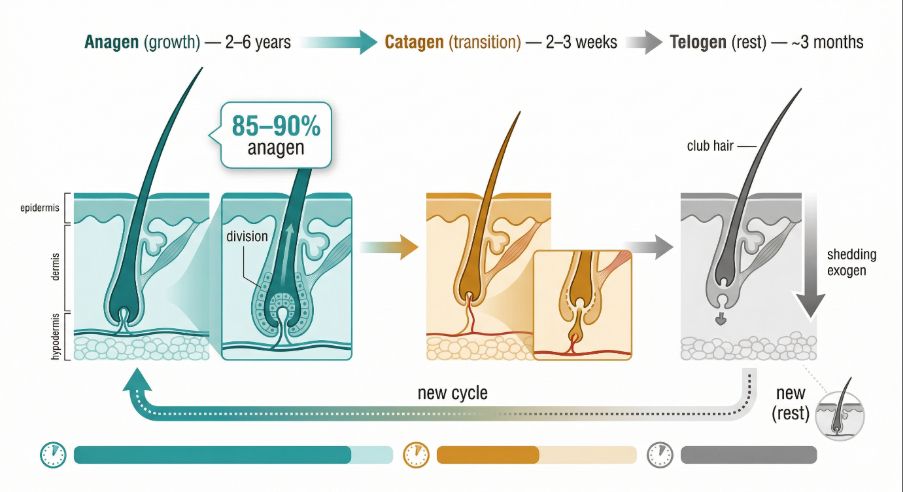
Hair growth occurs in a repeating cycle made up of three main phases. These phases are called anagen, catagen, and telogen.
Each follicle moves through these stages independently, which allows the scalp to maintain continuous hair coverage.
Anagen phase
The anagen phase is the active growth stage of the hair cycle. During this phase the follicle produces a new hair shaft.
Cells within the hair bulb divide rapidly and form the structure of the hair. As these cells accumulate, the hair shaft grows longer and emerges through the skin.
The length of the anagen phase largely determines how long hair can grow. On the scalp this phase may last between two and seven years, although the duration varies between individuals.
At any given moment, most scalp hairs are in the anagen phase. Estimates suggest that approximately 85 to 90 percent of scalp hairs are actively growing.
Catagen phase
After the growth phase ends, the follicle enters a short transitional stage known as the catagen phase.
During catagen, the follicle stops producing hair. The lower part of the follicle begins to shrink and gradually separates from the dermal papilla.
This phase represents a controlled shutdown of the growth process. It is relatively brief and typically lasts only a few weeks.
Because catagen is so short, only a very small proportion of hairs are in this stage at any given time.
Telogen phase
Following the transition phase, the follicle enters the telogen phase. This stage is often described as the resting phase of the hair cycle.
During telogen the follicle remains inactive. The hair that was produced during the previous growth phase remains loosely anchored in the follicle while the follicle prepares to begin a new cycle.
Eventually the hair sheds and the follicle re-enters the anagen phase, beginning the production of a new hair shaft.
Approximately 10 to 15 percent of scalp hairs are usually in the telogen phase at any moment.
Why hair shedding occurs
Because follicles cycle independently, hair shedding occurs gradually throughout the day.
When a hair reaches the end of the telogen phase, it is released from the follicle. A new hair then begins to grow from the same follicle.
For most individuals, losing between 50 and 100 hairs per day is considered normal and usually does not affect overall hair density.
Shedding becomes noticeable when the balance between growing hairs and resting hairs changes.
How the cycle affects hair density
Hair density on the scalp depends on how many follicles are actively producing hair at a given time.
When follicles remain in the anagen phase for a long period, they produce thick, fully developed hair shafts. The scalp appears dense because many follicles are actively generating hair.
If the growth phase becomes shorter, follicles produce thinner hairs and spend more time resting. Over time, this can lead to a gradual decrease in visible hair density.
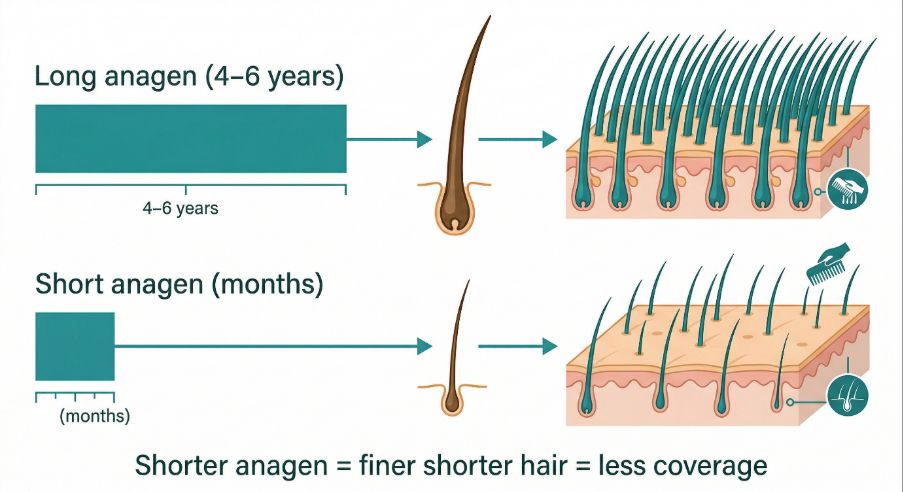
Changes in the duration of the growth phase are a key feature of several forms of hair loss.
Changes in the cycle during pattern hair loss
In androgenetic alopecia, often called male or female pattern hair loss, certain follicles gradually become smaller over successive growth cycles.
This process is known as follicle miniaturisation.
Miniaturised follicles produce thinner hair shafts, and the anagen phase becomes shorter. Each new cycle generates hair that is slightly finer than the previous one.
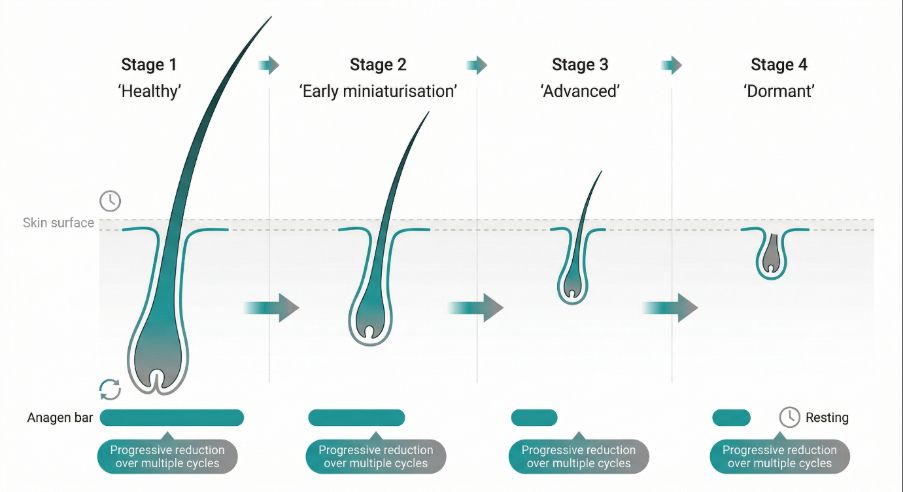
Over time, thick terminal hairs may be replaced by much finer hairs that provide less visible coverage of the scalp.
This process typically develops slowly over many years.
Other conditions that affect the hair cycle
Several conditions can temporarily disrupt the hair growth cycle.
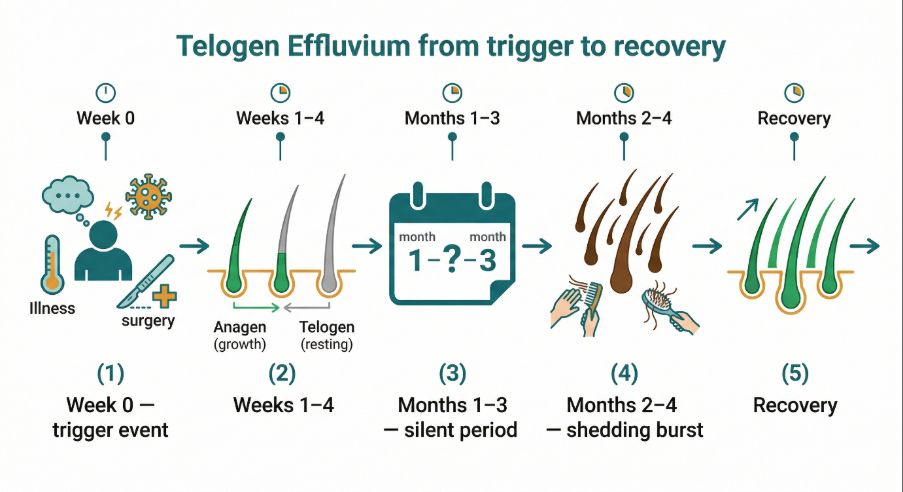
One example is telogen effluvium, in which a large number of follicles shift into the resting phase at the same time. This can result in increased hair shedding several months later.
Common triggers include severe illness, major surgery, significant psychological stress, or hormonal changes.
In many cases the hair cycle eventually returns to its normal rhythm once the underlying trigger resolves.
Other conditions may affect the follicle through different biological mechanisms, including immune system activity or inflammatory processes.
Medications and chemical exposure
Certain medications can disrupt the hair growth cycle and contribute to hair loss or thinning. Drug categories known to affect the follicle include anticoagulants such as heparin and warfarin, antihypertensive agents including beta-blockers, retinoids, hormonal treatments, and oncology drugs. Cytotoxic chemotherapy agents are particularly notable — they can directly impair the anagen phase, causing rapid and pronounced hair loss within weeks of treatment beginning.
Chemical exposures are a further recognised cause. Heavy metals including thallium, arsenic, and mercury can damage follicle function, with exposure occurring through occupational contact, contaminated environments, or ingestion. Industrial solvents and aggressive chemical hair treatments may similarly impair follicle health. Identifying and removing the causative substance is the primary step toward allowing the hair cycle to normalise.
Why hair loss patterns occur
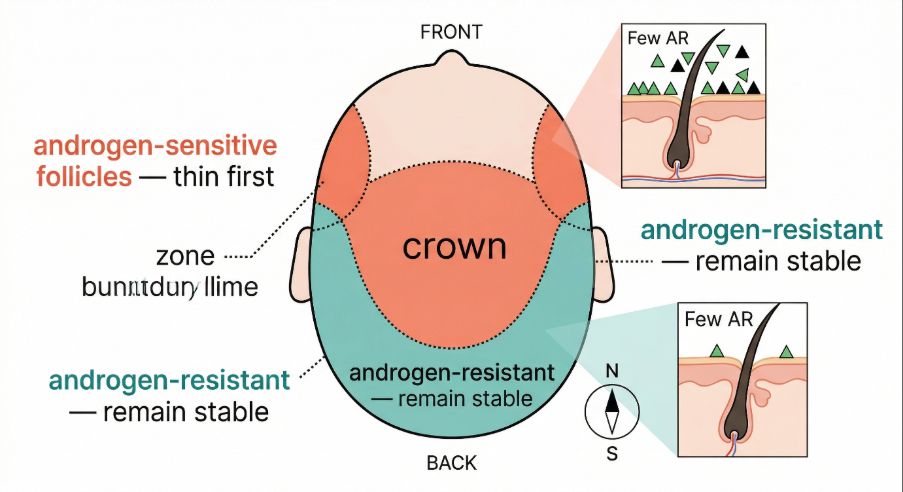
Not all follicles respond to biological signals in the same way. Some areas of the scalp are more sensitive to hormonal influences than others.
In androgenetic alopecia, follicles at the temples and crown often become thinner over time, while follicles on the sides and back of the scalp remain relatively stable.
This difference in follicle sensitivity leads to the characteristic patterns of hair loss described in classification systems such as the Norwood scale.
What research continues to explore
Although the basic stages of the hair cycle are well understood, many aspects of follicle biology remain under investigation.
Researchers are studying how genetic factors influence follicle behaviour, how hormonal signalling affects the growth cycle, and how inflammatory processes may alter hair production.
Advances in these areas may improve our understanding of hair disorders and lead to new approaches to managing hair loss.
A practical perspective
Hair growth is not a continuous process but a repeating cycle controlled by the activity of individual follicles.
Most hairs on the scalp are actively growing at any given time, while a smaller proportion are resting or preparing to shed. This natural cycle allows hair to renew itself continuously.
Hair thinning develops when the balance of this cycle changes. The growth phase may shorten, follicles may produce thinner hairs, or an unusually large number of hairs may enter the resting phase at the same time.
Understanding the hair growth cycle provides a useful foundation for recognising how different forms of hair loss develop and why they follow specific patterns over time.
Author: Dr. Priya Goswami
Medical review: Dr. Denis Broun
Next step
If you notice coverage changes without increased shedding, confirm what process is occurring.
Take the Hair Assessment to have a physician review your pattern, identify whether miniaturization is present, and determine appropriate staging and next steps.
Add Comment