Hair thinning does not always follow the familiar patterns often associated with male pattern hair loss. In some men, hair may appear less dense across the entire scalp rather than thinning mainly at the temples or crown. This form of hair change is commonly described as diffuse thinning.
Diffuse thinning refers to a gradual reduction in hair density that affects many areas of the scalp at the same time. Instead of forming clearly defined patterns, the hair may appear generally lighter or less full when compared with earlier stages of life.
Understanding diffuse thinning requires examining how hair follicles behave and how the hair growth cycle can be influenced by different biological factors.
How diffuse thinning differs from patterned hair loss
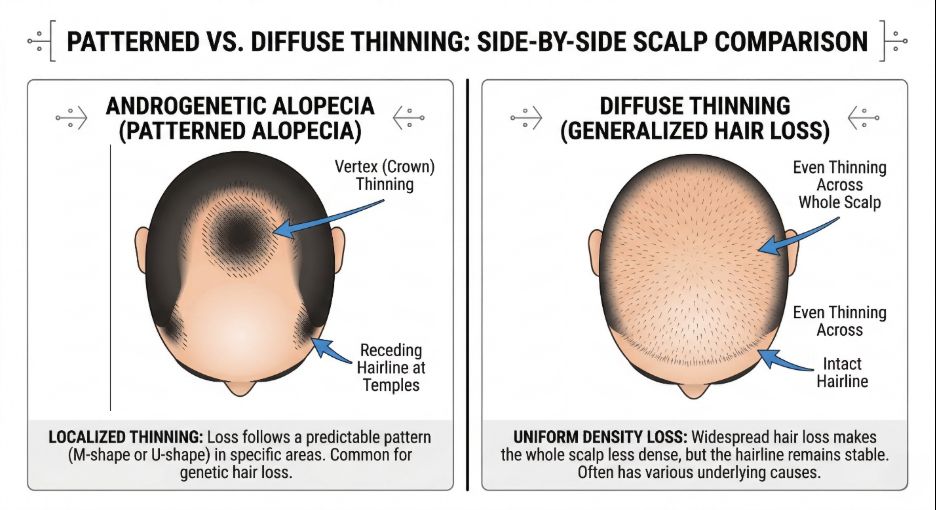
The most common form of hair loss in men is androgenetic alopecia. In this condition, hair thinning typically develops in specific areas of the scalp, particularly at the temples and the crown.
Diffuse thinning differs because the reduction in density occurs more evenly across the scalp.
Instead of forming a visible pattern, the hair may appear generally finer or less voluminous. The scalp may become more visible through the hair under bright light or when the hair is wet.
Because the thinning occurs across many regions, the hairline may remain relatively stable even while the overall density decreases.
The role of the hair growth cycle
Hair follicles grow according to a repeating biological rhythm known as the hair growth cycle. Each follicle moves through three distinct phases: a growth phase, a short transitional phase, and a resting phase.
The growth phase, known as anagen, can last between two and six years on the scalp. During this period the follicle actively produces the hair shaft and determines how long and thick the hair can grow.
This is followed by a brief transitional phase called catagen, lasting around two to three weeks, during which the follicle shrinks and separates from its blood supply.
Finally, the resting phase, or telogen, typically lasts around three months. The hair is held in the follicle without active growth and is eventually shed when the follicle re-enters anagen to begin a new cycle.
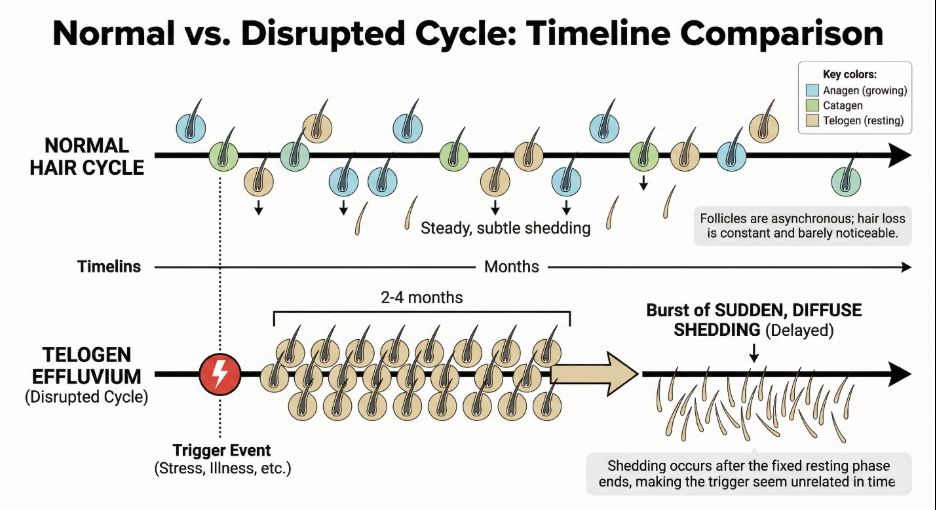
Normally, follicles cycle independently, which means hair shedding occurs gradually throughout the day.
Diffuse thinning can occur when this balance in the hair cycle is altered. If a larger number of follicles shift into the resting phase at roughly the same time, the overall density of hair may temporarily decrease.
In such cases, hair shedding may increase several months after the initial trigger.
Telogen effluvium and diffuse thinning
One of the most recognised causes of diffuse hair thinning is telogen effluvium.
In this condition, a significant number of hair follicles enter the resting phase of the hair cycle simultaneously. Because hairs in the resting phase are eventually released, shedding becomes noticeable after a delay of several months.
The shedding usually occurs across the entire scalp rather than in specific regions.
Although the increase in hair loss may appear dramatic, the follicles themselves remain capable of producing new hair during the next growth phase.
Physiological stress and the hair cycle
Several types of physiological stress can influence the behaviour of hair follicles.
Severe illness, high fever, major surgery, or rapid weight loss may temporarily disrupt the normal rhythm of the hair cycle. When the body experiences such stress, follicles may shift into the resting phase earlier than usual.
Because the resting phase lasts several months, the resulting shedding often appears well after the initial event.
Once the body recovers, hair follicles usually resume their normal cycling activity.
Nutritional influences on hair growth
Hair follicles require adequate nutrition to maintain normal growth.
Significant changes in diet or nutritional deficiencies can influence the hair cycle and may contribute to diffuse thinning. When the body experiences nutritional stress, follicles may temporarily shift into the resting phase.
As nutritional balance is restored, the hair cycle may gradually return to its usual rhythm.
Because the hair cycle unfolds slowly, recovery of density may take time.
Medical conditions affecting the scalp
Certain medical conditions can influence hair growth across the entire scalp.
Hormonal imbalances, systemic illnesses, or inflammatory conditions may alter the biological environment in which hair follicles function. These changes can affect the hair cycle and contribute to diffuse thinning.
In some situations, addressing the underlying condition may allow hair growth to return to its previous pattern.
Chemical and medicinal causes of hair thinning
Exposure to certain chemicals or medications can also disrupt the normal functioning of hair follicles and contribute to diffuse thinning.
Several categories of medication are known to affect the hair cycle. These include certain anticoagulants, antihypertensive drugs, retinoids, hormonal treatments, and medications used in oncology. The mechanism varies: some agents interfere with the anagen phase directly, while others push a large proportion of follicles prematurely into the telogen phase, producing shedding weeks to months after treatment begins.
Chemical exposures, whether through occupational contact or the use of harsh hair treatments, can also impair follicle health and lead to changes in hair density. In such cases, identifying and removing the causative agent is an important step in allowing the hair cycle to normalise.
| Cause category | Examples | Mechanism |
|---|---|---|
| Anticoagulants | Heparin, warfarin | Telogen push Shifts a proportion of follicles into the resting phase; shedding typically appears 2–4 months after starting treatment. |
| Antihypertensives | Beta-blockers (propranolol, metoprolol), ACE inhibitors | Telogen push Alters follicle perfusion and hormonal signalling, pushing follicles toward the resting phase. |
| Retinoids | Isotretinoin, acitretin, high-dose vitamin A | Both Can shorten the anagen phase and simultaneously accelerate entry into telogen; dose-dependent. |
| Hormonal treatments | Oral contraceptives (on initiation or cessation), androgens, corticosteroids, thyroid medications | Telogen push Hormonal fluctuations trigger synchronised telogen entry; loss usually appears 1–3 months after the hormonal change. |
| Oncology drugs | Cytotoxic chemotherapy (cyclophosphamide, doxorubicin), targeted therapies (EGFR inhibitors) | Anagen disruption Directly impairs rapidly dividing hair matrix cells; hair loss can begin within days to weeks of treatment. |
| Chemical / occupational exposure | Heavy metals (thallium, arsenic, mercury), harsh chemical hair treatments, industrial solvents | Both Toxic agents damage follicle structure directly (anagen disruption) or provoke systemic stress responses that trigger telogen entry. |
How diffuse thinning is evaluated
Because diffuse thinning does not follow a clear pattern, evaluating it often requires careful observation of the scalp and hair shafts.
Dermatologists may examine the thickness of individual hairs, the density of follicles in different areas, and the overall distribution of thinning. Tools such as dermoscopy can help reveal subtle differences in hair diameter and follicle behaviour.
Understanding whether thinning reflects increased shedding, changes in hair thickness, or alterations in the hair cycle helps clarify the biological processes involved.
Diffuse thinning and follicle miniaturisation
In some cases, diffuse thinning may also involve follicleminiaturisation , the gradual shrinking of hair follicles that occurs in androgenetic alopecia.
When miniaturisation affects many areas of the scalp rather than a specific pattern, the thinning may appear more evenly distributed.
Because these changes develop gradually over multiple hair cycles, the reduction in hair density may occur slowly over several years.
Understanding diffuse hair thinning
Diffuse hair thinning reflects changes in how hair follicles function rather than the sudden disappearance of hair.
Alterations in the hair growth cycle, physiological stress, nutritional factors, or hormonal influences can all affect the behaviour of follicles across the scalp.
Because hair follicles operate within a long biological cycle, visible changes in density often develop gradually. Understanding these underlying processes helps explain why diffuse thinning can occur and how it differs from the more familiar patterns of male pattern hair loss.
Author: Dr. Priya Goswami
Medical review: Dr. Denis Broun
Next step
If you notice coverage changes without increased shedding, confirm what process is occurring.
Take the Hair Assessment to have a physician review your pattern, identify whether miniaturization is present, and determine appropriate staging and next steps.
Add Comment