People often assume that hair loss begins when hair starts falling out in large amounts. In reality, visible thinning usually develops much earlier. Long before noticeable shedding occurs, the characteristics of individual hairs may begin to change.
Two concepts are important in understanding this process. The first is hair density, which refers to how many hair follicles are present in a given area of the scalp. The second is hair thickness, which refers to the diameter of each hair shaft.
Changes in these two factors can alter the appearance of the hair even when the number of follicles remains the same.
What hair density means
Hair density describes the number of hair follicles within a specific area of the scalp.
This number is largely determined before birth. During early development, the skin forms a fixed number of hair follicles that remain throughout life. Unlike some other tissues in the body, new follicles generally do not form after birth.
Because of this, individuals naturally vary in their hair density. Some people have a high concentration of follicles across the scalp, while others have fewer follicles in the same area.
Higher follicle density usually creates the appearance of fuller hair because more strands emerge from the scalp.
What hair thickness means
Hair thickness refers to the diameter of the individual hair shaft.
Some hairs are naturally thick and coarse, while others are fine and delicate. This characteristic is largely determined by the size and activity of the hair follicle.
Larger follicles tend to produce thicker hair shafts. Smaller follicles produce finer hairs.
Because thicker hairs occupy more space, they can provide greater visual coverage of the scalp even when the number of hairs is the same.
Why hair can appear thinner without losing follicles
In many forms of hair thinning, the number of follicles on the scalp does not change significantly.
Instead, the follicles begin to produce progressively thinner hairs. When the diameter of each hair shaft becomes smaller, the hair provides less coverage of the scalp.
This change can make the scalp appear more visible even though the number of follicles has not decreased.
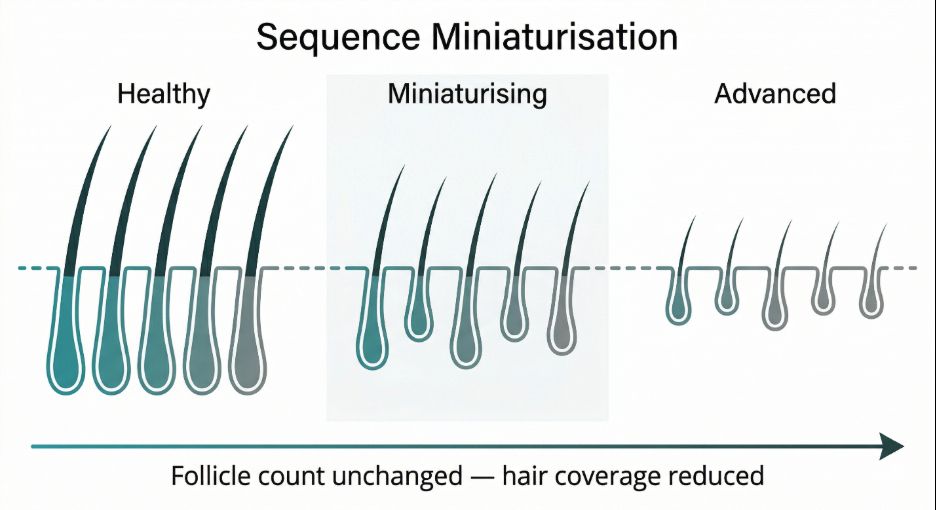
The process by which follicles produce thinner hairs over time is called miniaturisation.
The hair growth cycle
Because both density and thickness are shaped by follicle behaviour, understanding the hair growth cycle helps explain how either can change. Each follicle on the scalp moves through three repeating phases.
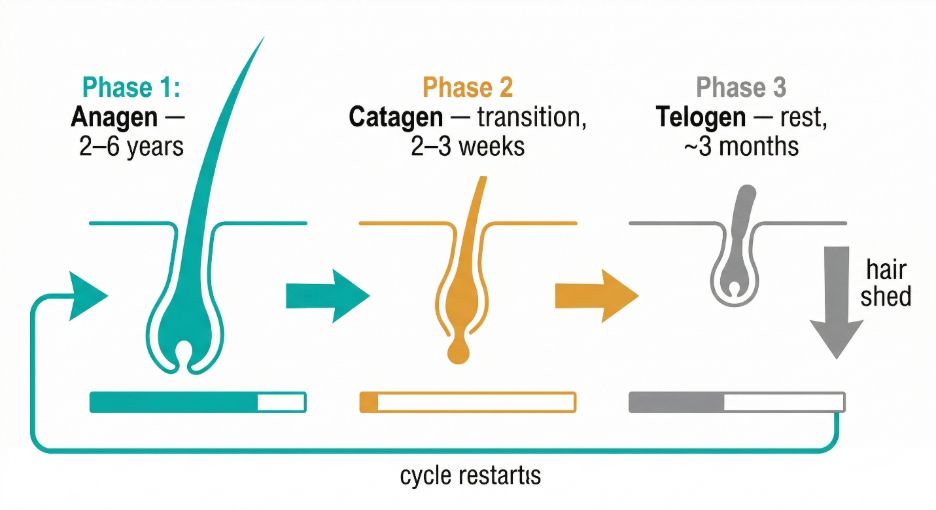
The anagen phase is the active growth period, lasting two to six years on the scalp. Its duration directly determines how long and thick the hair shaft becomes. The longer the anagen phase, the thicker the hair that can be produced.
The catagen phase is a short transitional period of approximately two to three weeks in which the follicle shrinks and detaches from its blood supply.
The telogen phase is the resting period, lasting around three months, after which the hair is shed and the cycle restarts. Changes that shorten the anagen phase or prematurely push follicles into telogen reduce both the thickness and the apparent density of the hair.
Miniaturisation of hair follicles
Miniaturisation is a gradual change in the size and activity of the hair follicle.
During each growth cycle, the follicle produces a hair that may be slightly thinner than the one produced during the previous cycle. Over time, this progressive reduction in hair diameter can transform thick terminal hairs into much finer hairs.
These finer hairs resemble the soft, lightly pigmented hairs known as vellus hairs.
Although the follicle remains present beneath the skin, the hair it produces provides much less visible coverage.
How this process relates to pattern hair loss
Miniaturisation is a central feature of androgenetic alopecia, the most common form of hair thinning in both men and women.
In this condition, certain follicles gradually become smaller due to their sensitivity to hormonal signals.
As the follicles shrink, the hair shafts they produce become thinner and shorter. The growth phase of the hair cycle may also become shorter.
Over many cycles, these changes lead to a reduction in hair thickness and an increase in scalp visibility.
Because the number of follicles often remains relatively stable, the change is primarily a shift in hair quality rather than a sudden loss of hair.
Density changes during shedding conditions
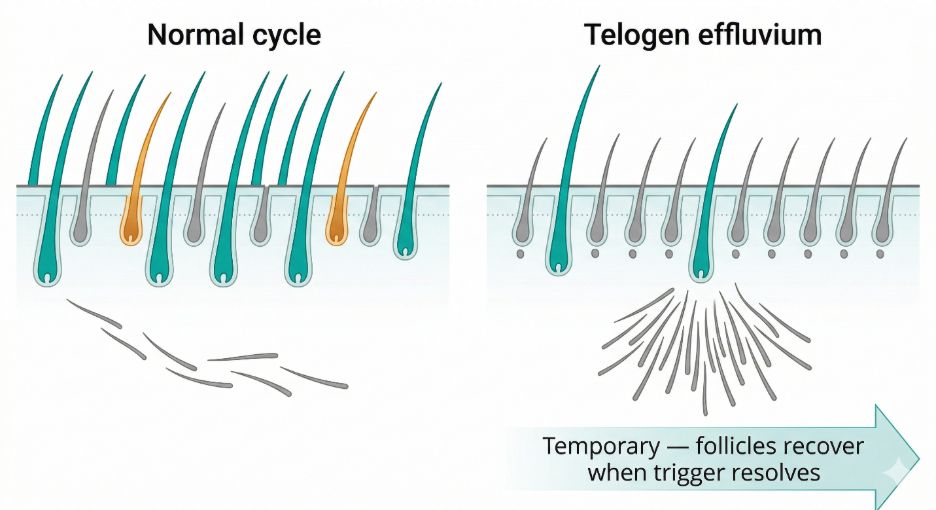
Some conditions can temporarily reduce hair density by increasing the number of hairs that enter the resting phase of the growth cycle.
For example, in telogen effluvium, a larger than usual number of follicles shift into the resting phase at the same time. When these hairs shed, the scalp may temporarily appear less dense.
In such situations, the follicles themselves usually remain capable of producing new hair. As the growth cycle returns to normal, new hairs may gradually restore density.
Medications and chemical exposure
Both hair density and hair thickness can also be affected by medications and chemical exposures. Certain drugs alter the hair cycle in ways that reduce either apparent density, hair diameter, or both. Anticoagulants, antihypertensives including beta-blockers, retinoids, hormonal treatments, and cytotoxic chemotherapy agents are among the categories known to affect the follicle cycle. Chemotherapy in particular can directly impair the anagen phase, producing rapid, pronounced changes in density.
Chemical exposures — including heavy metals such as thallium and arsenic, occupational solvents, and harsh topical hair treatments — can similarly damage follicle function and reduce the thickness or density of the hair produced. In these cases, identifying and removing the causative agent is the primary step toward recovery.
Why hair thinning may go unnoticed at first
Early changes in hair thickness can be subtle.
When only a small number of follicles begin producing thinner hair, the difference may be difficult to detect. Over time, however, more follicles may undergo similar changes.
As the proportion of thinner hairs increases, the scalp may begin to appear more visible under certain lighting conditions or when the hair is wet.
Because the process often occurs gradually, individuals may not notice the change until it becomes more pronounced.
Observing hair changes over time
Recognising the difference between hair density and hair thickness can help explain why hair thinning develops gradually.
Two individuals may have the same number of follicles on their scalp but appear to have very different hair volume if one person has thicker hair strands.
Similarly, when follicles begin producing thinner hairs, the appearance of density may decrease even though the follicles remain present.
Understanding this distinction provides useful insight into how many common forms of hair thinning develop.
Understanding the distinction
Hair density and hair thickness are related but distinct aspects of hair biology.
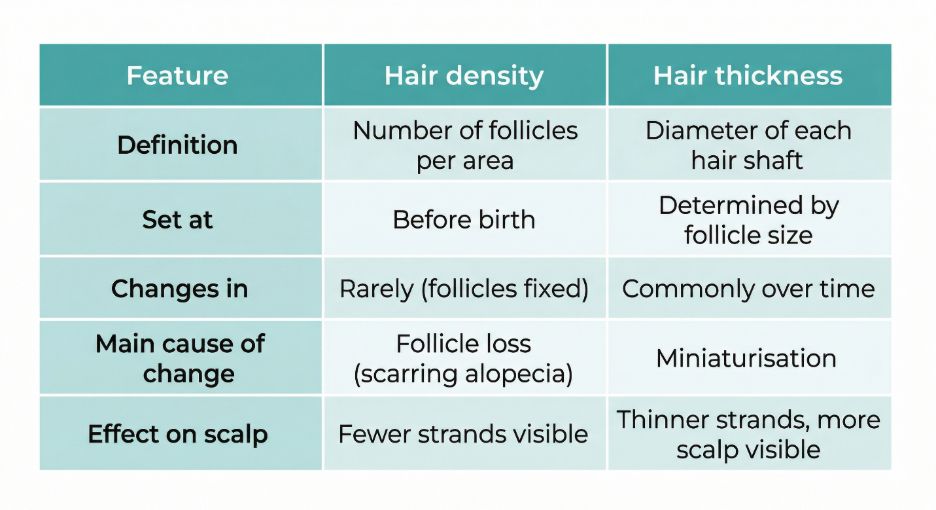
Density refers to how many follicles are present on the scalp, while thickness describes the diameter of the hair shaft produced by each follicle. Changes in either factor can influence the appearance of the hair.
In many cases of gradual hair thinning, the primary change occurs in the thickness of the hair produced by the follicle rather than the number of follicles themselves.
Recognising this difference helps clarify why hair thinning often develops slowly and why the scalp may appear less covered even when follicles remain present.
Author: Dr. Priya Goswami
Medical review: Dr. Denis Broun
Next step
If you notice coverage changes without increased shedding, confirm what process is occurring.
Take the Hair Assessment to have a physician review your pattern, identify whether miniaturization is present, and determine appropriate staging and next steps.

Add Comment