Hair loss in men can occur for several different reasons. In many cases, the process develops gradually and reflects changes in the behaviour of hair follicles over time. In other situations, hair shedding may occur more suddenly in response to physiological stress or medical conditions.
Understanding the possible causes of hair loss helps place these changes in a biological context. Hair growth is influenced by genetics, hormones, the immune system, and the general health of the body. When any of these factors affect the hair follicle or the hair growth cycle, visible changes in hair density or thickness may occur.
Several conditions account for most cases of hair loss in men.
The hair growth cycle
To understand how different conditions cause hair loss, it helps to understand how hair follicles normally work. Each follicle on the scalp operates in a repeating three-phase cycle.
The anagen phase is the active growth period, lasting two to six years on the scalp. During this phase the follicle produces the hair shaft, and its duration determines how long and thick the hair can grow. At any given time, roughly 85 to 90 percent of scalp follicles are in anagen.
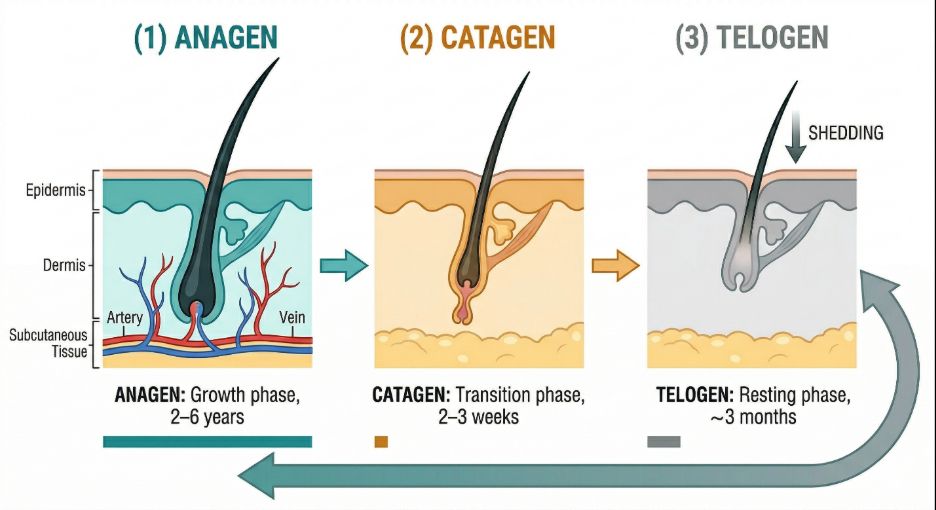
The catagen phase is a short transitional period of about two to three weeks in which the follicle shrinks and separates from its blood supply.
The telogen phase is the resting period, lasting roughly three months. The hair is held in the follicle without active growth until it is shed, after which the cycle restarts. Because follicles cycle independently, shedding is spread out naturally throughout the day. Many of the conditions described below cause hair loss by disrupting one or more of these phases.
Androgenetic alopecia
The most common cause of hair loss in men is androgenetic alopecia, often referred to as male pattern hair loss.
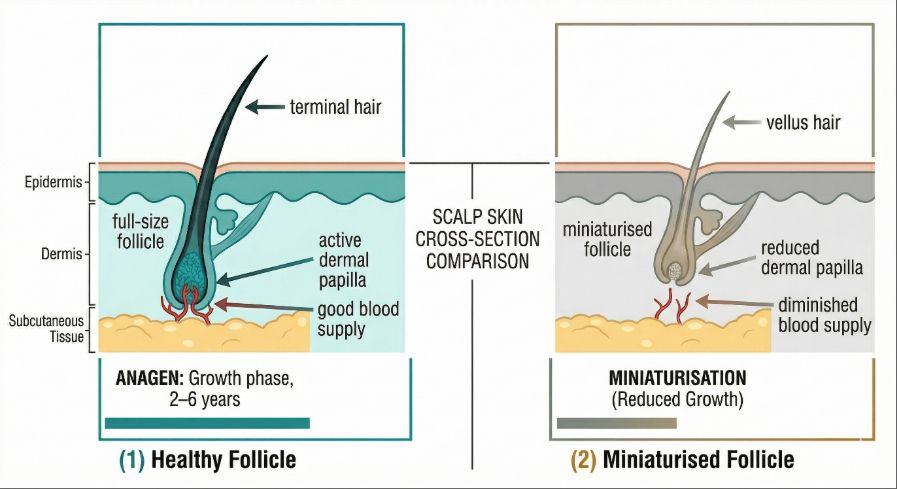
In this condition, certain hair follicles gradually become smaller over time. This process is known as follicleminiaturisation .
Miniaturised follicles produce thinner hair shafts during each growth cycle. As the hair becomes finer, it provides less coverage of the scalp. Over many cycles, thick terminal hairs may be replaced by much finer hairs.
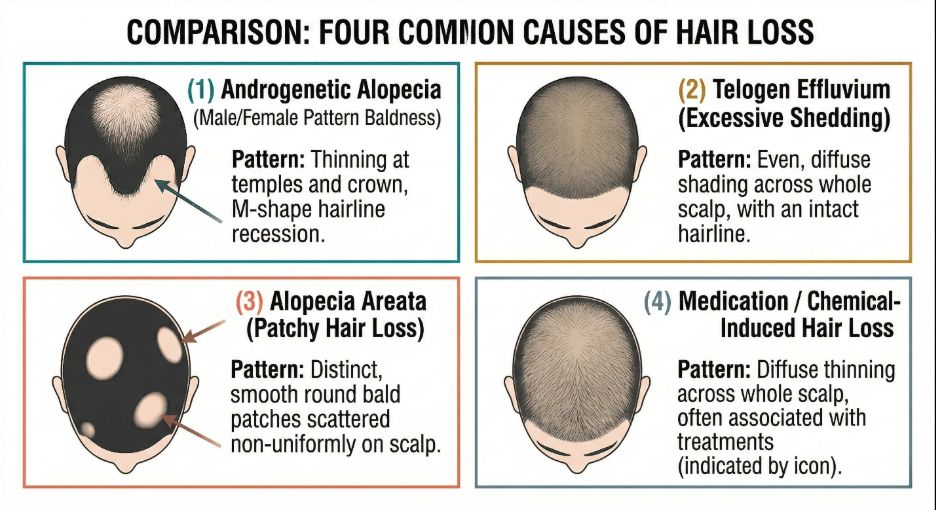
This process usually affects specific regions of the scalp, particularly the temples and the crown. Because these areas are more sensitive to hormonal signals in genetically susceptible individuals, hair thinning often follows characteristic patterns.
The progression of these patterns is commonly described using the Norwood classification.
Telogen effluvium
Another cause of hair loss in men is telogen effluvium, a condition in which a larger number of hair follicles enter the resting phase of the hair growth cycle at the same time.
When this occurs, increased shedding may become noticeable several months later as the resting hairs are released.
Telogen effluvium is often triggered by significant physiological stress on the body. Possible triggers include severe illness, major surgery, high fever, rapid weight loss, or certain medications.
Unlike androgenetic alopecia, this condition usually produces diffuse shedding across the scalp rather than thinning in specific patterns.
Because the follicles remain alive, hair growth often resumes once the underlying trigger resolves.
Alopecia areata
Alopecia areata is another condition that can cause hair loss in men. This condition is considered an autoimmune disorder in which the immune system temporarily interferes with the activity of hair follicles.
Hair loss in alopecia areata typically appears as round or oval patches on the scalp. The skin within these patches usually appears smooth and normal.
Although the condition can develop suddenly, the follicles themselves often remain capable of producing new hair. Regrowth may occur once the immune activity affecting the follicle subsides.
The course of the condition can vary between individuals, with some experiencing a single episode and others having recurrent episodes over time.
Medical conditions affecting hair growth
Certain medical conditions can influence hair growth by affecting the hair cycle or the biological environment of the follicle.
Hormonal imbalances, nutritional deficiencies, or systemic illnesses can alter how follicles produce hair. These influences may lead to increased shedding or gradual thinning.
Because hair follicles are sensitive to many signals from the body, changes in general health can sometimes affect the growth cycle.
When hair loss appears suddenly or progresses rapidly, evaluating possible underlying medical factors may be useful.
Medication-related hair loss
Some medications can influence hair growth by affecting the timing of the hair cycle.
Certain drugs may cause a larger number of follicles to enter the resting phase, leading to increased shedding several months later. In other cases, medications may disrupt the anagen phase directly. Drug categories associated with hair loss include anticoagulants such as heparin and warfarin, antihypertensive agents including beta-blockers, retinoids, hormonal treatments, and oncology drugs. Cytotoxic chemotherapy is a particularly well-recognised cause of rapid anagen-phase hair loss.
Not every individual taking a medication will experience hair changes, but the possibility is recognised with a number of treatments. When hair shedding develops after starting a new medication, clinicians may consider whether the timing corresponds with changes in the hair cycle.
Chemical and occupational causes
Exposure to certain chemicals can also disrupt hair follicle function. Heavy metals including thallium, arsenic, and mercury are established causes of hair loss, with exposure occurring through occupational settings, contaminated environments, or ingestion. Industrial solvents and aggressive chemical hair treatments may similarly damage the follicle or impair its cycle.
Identifying and removing the causative substance is the primary step toward recovery. Because of the delayed nature of telogen shedding, hair loss may continue for some months even after exposure has ended.
Age-related changes
Hair characteristics can also change gradually with age.
As the body ages, some hair follicles may produce slightly thinner hair shafts or spend longer periods in the resting phase of the growth cycle. These changes can lead to subtle reductions in hair density over time.
Age-related changes vary widely between individuals. Some people maintain relatively stable hair density throughout life, while others experience more noticeable thinning.
The importance of pattern and timing
Different causes of hair loss often produce different patterns of change.
Gradual thinning at the temples and crown is typical of androgenetic alopecia. Sudden diffuse shedding across the scalp may suggest a disruption of the hair cycle, such as telogen effluvium. Patchy hair loss may indicate autoimmune activity affecting the follicle.
The timing of hair changes, the distribution of thinning, and the behaviour of the hair growth cycle all provide clues that help distinguish between these conditions.
Understanding hair loss in context
Hair loss in men often reflects the interaction of several biological factors. Genetic predisposition, hormonal signals, immune activity, and physiological stress can all influence how hair follicles behave.
Because hair follicles operate in repeating cycles that may last several years, visible changes in hair density often develop gradually.
Understanding the different causes of hair loss provides a framework for interpreting these changes and recognising the biological processes that influence hair growth over time.
Author: Dr. Priya Goswami
Medical review: Dr. Denis Broun
Next step
If you notice coverage changes without increased shedding, confirm what process is occurring.
Take the Hair Assessment to have a physician review your pattern, identify whether miniaturization is present, and determine appropriate staging and next steps.

Add Comment